Divergent views on wealth distribution

Welcome to our community

Be a part of something great, join today!

Those numbers aren't very surprising really. There are a lot of people that don't uderstand how the economy works. As for the non whites wanting redistiribution, I am shocked. I thought they had their own way of wealth distribution? Sorry, couldn't resist
 
What a surprise... 2/3 of the people that barely pay any federal income tax (those with an income less than 30k) think other people should pay more tax.
 
The Dems and Pubs are almost mirror images of each other.

Men and women weren't that far off from each other, especially if you take the margin of error into consideration.

It would be interesting to see the responses if they changed the wording for these questions:

"As far as you are concerned, do we have too many poor people in this country, too few, or about the right amount?"
 
The Dems and Pubs are almost mirror images of each other.

Men and women weren't that far off from each other, especially if you take the margin of error into consideration.

It would be interesting to see the responses if they changed the wording for these questions:

"As far as you are concerned, do we have too many poor people in this country, too few, or about the right amount?"

I don't believe in wealth redistrubution, but I would answer we have too many poor people. Of course, my answer would be to free the private sector to allow for job creation, so I'm not sure the answer would help to illuminate what you wanted to show.
 
The Dems and Pubs are almost mirror images of each other.

Men and women weren't that far off from each other, especially if you take the margin of error into consideration.

It would be interesting to see the responses if they changed the wording for these questions:

"As far as you are concerned, do we have too many poor people in this country, too few, or about the right amount?"

I literally laughed out loud after reading your post, thanks.

Might as well ask if we should super size that subsidy with that free big mac..History shows the distribution of wealth has been and will be a constant. Just like playing Monopoly, you start out even, and through good or bad choices or luck, you gain or lose.

I dont have money, dont make big cash, I could qualify in the lower middle class, but to think we solve all the ills of the world by starting over and sharing the earned wealth of one set with the "poor" is silly.
 
Why not share our wealth with Mexico or some 3rd world nation that's really poor?
 
I don't believe in wealth redistrubution, but I would answer we have too many poor people. Of course, my answer would be to free the private sector to allow for job creation, so I'm not sure the answer would help to illuminate what you wanted to show.

I'd answer "too many" as well.

I wasn't trying to make a point about wealth distribution in the country, just how the results would be different if the questions were framed another way.

I'm a big stats buff, that's all.

BTW, I don't believe in wealth redistribution either but I do believe in membership dues.
 
Last edited:
http://www.npr.org/templates/story/story.php?storyId=130395070
INSKEEP: Let's define that term that you give there, wealth inequality. You're basically talking about what slice of all the national wealth belongs to the richest one percent or the lowest 10 percent, that sort of thing.
Mr. NORTON: Exactly, and if you look at most statistics, the bottom 40 percent of people in the United States basically have zero wealth.
INSKEEP: They're not all unemployed but you're basically saying they either don't own a house or the house that they own is worth less than what they owe on it. If you looked at their net worth, it's nothing.
Mr. NORTON: That's exactly right. And many of them, of course, have negative net wealth. But the latest estimates for the top 20 percent of Americans is that they have something like 85 percent of the wealth in the United States.
INSKEEP: So you were beginning with those facts but then you went on to survey people because you were asking not what is your situation now but what kind of country do you want? And what did you find?
Mr. NORTON: The first thing we wanted to do was ask people do they know what the distribution of wealth is right now, and then as you just mentioned, we also wanted to ask people what sort of society would you like to live in if you got to choose from scratch. And what we find is really two things. One is that people really underestimate what the actual level of wealth inequality is in the United States right now. And then in addition to that, when we asked them how unequal would you like it to be, they want things to be even more equal than they think they are, which is really more equal than they actually are.
INSKEEP: What do people want? If people could just dictate the kind of country they had, what would it be?
Mr. NORTON: If you think again in percentage terms, so the top 20 percent, as I said, have 85 percent of the wealth, most Americans want them to have roughly 35 percent of the wealth. You're talking about 50 percent of all the wealth in the United States, which as you can imagine is a very, very large number. People would like that to be more evenly distributed across people with less income.
INSKEEP: That's a colossal change.
Mr. NORTON: That's exactly right, and I think one of the reasons that we see people having a disconnect between understanding how much wealth inequality there really is, is this very strong American belief in the ability to be socially mobile and to be mobile with your wealth. So people have very strong beliefs that across generations and even in their own life they can go from rags to riches.
And it's certainly possible. I mean one of the fantastic things about America is that that is in fact possible. But it's much, much rarer than people believe, and especially wealth transmission, so money that goes from generation to generation to generation is very flat. So it tends to perpetuate a great deal over time.
INSKEEP: Is there any country that looks like the more equal country than Americans told you they wanted?
Mr. NORTON: The closer countries to what our respondents wanted are countries that are amusingly dissimilar to us, such as countries like Sweden. But for example, even Sweden has a much more unequal distribution of wealth than our respondents told us they would like the United States to have. And I should say, the other thing that we found is not just that people think things should be fairer in some sense than they are, but that there's wide agreement about that. So if we look at very rich people and very poor people, or if we look at Republicans and Democrats, all of these groups think that wealth should be more equally distributed when we asked them these questions than it actually is.

 

I'm of the opinion that wealth is a matter of choice. It's easier to obtain for some rather than others, but it's attainable for all. However, it does take sacrifice. You have to delay gratification when it's hardest to do so and then continue to sacrifice and work hard when others are coasting.

What wealth should never be is something created by individuals and taken to be distributed by society.
 

Mr. NORTON: If you think again in percentage terms, so the top 20 percent, as I said, have 85 percent of the wealth, most Americans want them to have roughly 35 percent of the wealth....and I think one of the reasons that we see people having a disconnect between understanding how much wealth inequality there really is, is this very strong American belief in the ability to be socially mobile and to be mobile with your wealth.

I think what this shows is that people have a disconnect from reality. The Pareto principle is certainly not solely an American phenomenon. Now, if the top 20% in America have 85% of the wealth instead of the expected 80, then perhaps we're a little top heavy, but not grossly so.

Just because people want something a certain way doesn't mean it's reasonable.
 
Last edited:
Considering you don't believe in and maintaining national borders, I can't tell if you're being sarcastic or not.

I thought that was just Minstrel. DC doesn't believe in borders either?
 
The disconnect comes from the difference between the "ability" to be upwardly mobile (rags-to-riches, if you will) and the "desire to work for it". Our country bends over backwards to foster and maintain the first (through things like compulsory public education, college loans/grants/scholarships, access to serve in the gov't, WIC, reduced-cost lunches, etc), while the people think that there's an obligation for the gov't to subsidize the second. I (as one who has had to use a lot of those resources) don't feel that hard work should be voluntary to move socially or economically. If you want to sit on your butt and play video games instead of taking AP classes, more power to you. If you want to get a liberal arts instead of an engineering degree or advanced occupational degree (JD, PhD, etc), America's about your right to do that. What it ISN'T about it your ability to have the same quality of life as someone who did put forth extra effort and sacrifice to delay gratification.

We've turned into a nation who took the one cookie immediately instead of the 4 cookies in 10 minutes, and now think it's unfair that someone gets 4 cookies when we only got one. And personally, I have very little sympathy for those who made poor choices and yet want the rewards that come with hard work.
 
And personally, I have very little sympathy for those who made poor choices and yet want the rewards that come with hard work.

Ahhh yes, the good ole "poor people are lazy & don't work hard enough" argument.
 
The disconnect comes from the difference between the "ability" to be upwardly mobile (rags-to-riches, if you will) and the "desire to work for it". Our country bends over backwards to foster and maintain the first (through things like compulsory public education, college loans/grants/scholarships, access to serve in the gov't, WIC, reduced-cost lunches, etc), while the people think that there's an obligation for the gov't to subsidize the second. I (as one who has had to use a lot of those resources) don't feel that hard work should be voluntary to move socially or economically. If you want to sit on your butt and play video games instead of taking AP classes, more power to you. If you want to get a liberal arts instead of an engineering degree or advanced occupational degree (JD, PhD, etc), America's about your right to do that. What it ISN'T about it your ability to have the same quality of life as someone who did put forth extra effort and sacrifice to delay gratification.

We've turned into a nation who took the one cookie immediately instead of the 4 cookies in 10 minutes, and now think it's unfair that someone gets 4 cookies when we only got one. And personally, I have very little sympathy for those who made poor choices and yet want the rewards that come with hard work.

100% Agree! Repped! (I think. Never done it before...)
 
Ahhh yes, the good ole "poor people are lazy & don't work hard enough" argument.

I defy you to show me someone in some situation who has attempted to improve their life and been stonewalled. I've personally helped dozens of people find programs to use to help them speak and read english, get low-cost nutritional food, tutoring for their kids, clothing, etc. I've worked with microlenders and helped minority kids get into the Naval Academy. And I'm one guy. But I've also been to Korea, to Africa, to Guatemala, etc and have seen what other "poor" people around the world do to survive, and it's not watching TV while waiting for an SSI check.

(edit: Note, I'm not talking about the physically unable. Someone's sick grandmother obviously can't learn to be a mechanic or something.)
 
Last edited:
I'm of the opinion that wealth is a matter of choice. It's easier to obtain for some rather than others, but it's attainable for all. However, it does take sacrifice. You have to delay gratification when it's hardest to do so and then continue to sacrifice and work hard when others are coasting.

What fraction of billionaires were raised in poverty?

barfo
 
I've personally helped dozens of people find programs to use to help them speak and read english, get low-cost nutritional food, tutoring for their kids, clothing, etc.

So you helped people find "handouts", I thought you were against handouts?
 
why is "billionaire" the cutoff for "wealth"?

I know people are probably getting tired of personal anecdotes, but I went from living in the projects across from Liberace on WIC as a kid to being the first in my family to graduate college (followed quickly by my brother and 3 cousins) and make 6 figures. I'd be pretty darn happy (and consider myself pretty well-off) the day my net worth exceeds 1M--which is a pittance for some people I work and interact with. My little girl already has a college fund set up, and I'm hoping that she (and her soon-to-be-born brother) are one of those people 25 years from now who think that 1M is a decent signpost on the road to where their goals are. And so on.

My parents weren't born with a silver spoon, but worked their butts off for me and my brothers, and get a kick out of seeing us succeeding in life and working hard for our kids.
 
So you helped people find "handouts", I thought you were against handouts?

Once again, you're not paying attention. How many of those people come back to donate things later, or volunteer to do work for the clinics, or help out at the shelter, or use that aid as a stepping-stone to something better.

And most of those things were done from a religious organization. (edit: the scholarships and WIC weren't. But the ESL, clothing, food bank, prayer support, medical, optical, dental, resume crafting and interview prep were)

(Further edit: We didn't help out those who were still abusing alcohol or drugs and wouldn't accept treatment. But religious affiliation didn't matter.)
 
Last edited:
why is "billionaire" the cutoff for "wealth"?

It isn't. The cutoff, as you know well, is income of $250,000/year :)

I know people are probably getting tired of personal anecdotes, but I went from living in the projects across from Liberace on WIC

Wait, what? Liberace? You lived across from this guy?

images


And he was on WIC?

as a kid to being the first in my family to graduate college (followed quickly by my brother and 3 cousins) and make 6 figures. I'd be pretty darn happy (and consider myself pretty well-off) the day my net worth exceeds 1M--which is a pittance for some people I work and interact with. My little girl already has a college fund set up, and I'm hoping that she (and her soon-to-be-born brother) are one of those people 25 years from now who think that 1M is a decent signpost on the road to where their goals are. And so on.

My parents weren't born with a silver spoon, but worked their butts off for me and my brothers, and get a kick out of seeing us succeeding in life and working hard for our kids.

Yeah, I think my point was something like yours, actually. It's possible to improve your station in life over where you were born, but if you want to be fabulously wealthy, you'd better not start at the bottom.

barfo
 
yeah, his mansion was kitty corner from our apartment block. Very weird, and I can't explain it 30 years later.
 
Yeah, I think my point was something like yours, actually. It's possible to improve your station in life over where you were born, but if you want to be fabulously wealthy, you'd better not start at the bottom.

barfo

But even in Sweden or Canada or any other social utopia one would like to compare to, you generally can't become a billionaire from the lowest tier of their socio-economic stratus. Here in the US, there are plenty of things in place to help people who want to work hard to improve their station...as opposed to, say, being a subsistence farmer in Ghana. That guy's basically stuck there, and his kids are, or else they're moving into the slums of the big city.

My contention in this thread, though, is that nowhere in our universe are you allowed to thrive and be socio-economically mobile without working hard for it. Additionally, it seems as if a large portion of America has chosen the instant gratification for less over working hard for something better. Which America gives them the right to do. But I think it stops short of giving them the right to have the "something better" taken from others and redistributed to them out of "fairness".
 
But even in Sweden or Canada or any other social utopia one would like to compare to, you generally can't become a billionaire from the lowest tier of their socio-economic stratus.

True dat, but no one in Sweden or Canada pretends that you can. I doubt people there go around saying "wealth is a choice". [Actually, I don't know, maybe everyone in Sweden and Canada does say that.]

barfo
 
well, the top 1% (per the CBO) of Americans make ~380k a year. Even if you use that extreme definition of "wealthy" as "top 1%", I don't think it's unreasonable for anyone to say that you can go from baby left on a doorstep with nothing to making ~380k/yr in one lifetime.

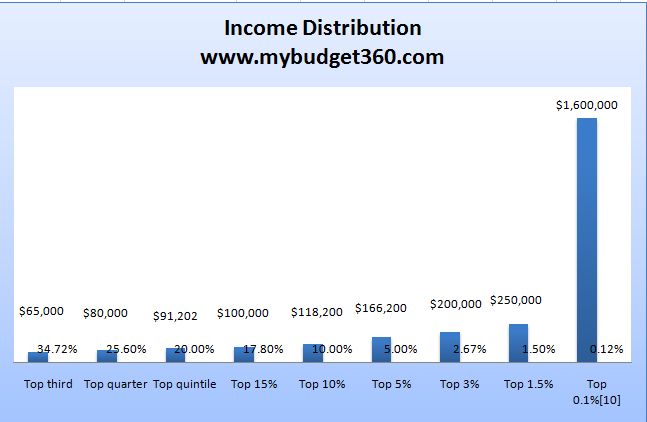
In Mook's post 9 the interviewee was talking about redistributing from the wealthiest 20%. mybudget360.com's graph shows that the 20% point is people making ~90k a year.

incomedistribution.png


I know for a fact that someone can go from poverty to making 90k in 20 years. And I don't think that those who have worked to do so have an obligation to those who didn't to supplement their quality of life if they don't want to work for it themselves.

Edit: As I've pointed out, and I think Maxiep said, that doesn't stop someone for doing so for charitable reasons, or b/c we're helping out a friend, or karmic purposes or whatever. I'm saying that there shouldn't be a forced redistribution of wealth from those who've set up their lives for it to those who haven't.
 
Last edited:
well, the top 1% (per the CBO) of Americans make ~380k a year. Even if you use that extreme definition of "wealthy" as "top 1%", I don't think it's unreasonable for anyone to say that you can go from baby left on a doorstep with nothing to making ~380k/yr in one lifetime.

Nor is it impossible for a poor person to win the lottery. It's just that it doesn't happen very often.

barfo
 
you think making top 1% money is akin to winning the lottery?
 

Users who are viewing this thread

Back
Top