
- Joined
- Sep 15, 2008
- Messages
- 34,724
- Likes
- 26,039
- Points
- 113
you think making top 1% money is akin to winning the lottery?
In the sense that it is about as unlikely an outcome for any given poor person, yes.
barfo


Follow along with the video below to see how to install our site as a web app on your home screen.
Note: This feature may not be available in some browsers.
you think making top 1% money is akin to winning the lottery?

you can't possibly think that there's a one in 192 million chance that a poor person can become a heart surgeon. Or a small business owner. Or a major-league athlete.
more to the point, what is your reasoning for someone like me, who went from not much to "top 20% wealth" just 10 years out of college, having my money taken away to pay someone who might've been born into better circumstances but didn't do as much with it as I did? Or sacrificed as much.

why is "billionaire" the cutoff for "wealth"?
I know people are probably getting tired of personal anecdotes, but I went from living in the projects across from Liberace on WIC as a kid to being the first in my family to graduate college (followed quickly by my brother and 3 cousins) and make 6 figures. I'd be pretty darn happy (and consider myself pretty well-off) the day my net worth exceeds 1M--which is a pittance for some people I work and interact with. My little girl already has a college fund set up, and I'm hoping that she (and her soon-to-be-born brother) are one of those people 25 years from now who think that 1M is a decent signpost on the road to where their goals are. And so on.
My parents weren't born with a silver spoon, but worked their butts off for me and my brothers, and get a kick out of seeing us succeeding in life and working hard for our kids.

Considering you don't believe in and maintaining national borders, I can't tell if you're being sarcastic or not.
I thought that was just Minstrel. DC doesn't believe in borders either?

why is "billionaire" the cutoff for "wealth"?
I know people are probably getting tired of personal anecdotes, but I went from living in the projects across from Liberace on WIC as a kid to being the first in my family to graduate college (followed quickly by my brother and 3 cousins) and make 6 figures. I'd be pretty darn happy (and consider myself pretty well-off) the day my net worth exceeds 1M--which is a pittance for some people I work and interact with. My little girl already has a college fund set up, and I'm hoping that she (and her soon-to-be-born brother) are one of those people 25 years from now who think that 1M is a decent signpost on the road to where their goals are. And so on.
My parents weren't born with a silver spoon, but worked their butts off for me and my brothers, and get a kick out of seeing us succeeding in life and working hard for our kids.

we are misusing the word wealth in this thread. When people talk about concentration of wealth, they are usually talking about concentration of assets, not of income. And that's a much harder problem to overcome than income, actually.

Just like playing Monopoly, you start out even, and through good or bad choices or luck, you gain or lose.
/c it seems like we want the same result (decent-quality health care for everyone)
As for taxes, I think our economy seemed to do just fine with the Clinton tax rates.
Big, hard choices need to be made, and it's not the time to be spending money on "making it 'fair' for everyone" or costly programs that don't project to work.
You are right. They do need to be made. But, like most Americans believe, this problem cannot, and will not be tackled with just cutting spending. There needs to be tax increases, and preferably less on the middle and lower class who are already struggling in this economy.
As for the DoD, lets bring home our troops and start by cutting war funding, and slicing our defense budget by 25% (I know you are a military man and don't like that kind of talk... and this is not meant to be bad)
Also, serious question because I don't know: what would pushing back the retirement/benefits age do for social security funding? And how far would it have to go to make a significant difference?
Also, is it correct that women get their benefits like 2 or 3 years before men? Why is that? If we pushed theirs back to like 65 also, would that do anything?

You are right. They do need to be made. But, like most Americans believe, this problem cannot, and will not be tackled with just cutting spending. There needs to be tax increases, and preferably less on the middle and lower class who are already struggling in this economy.
How can a "libertarian" ever justify higher taxes or wealth redistribution of any kind. Democrat.
To think that tax increases are going to make any significant dent in the problem is silly.
The federal revenue from individual income tax in 2009 was ~ $1Trillion. The federal budget deficit is project to be over $2Trillion. We could double people's income tax rates and still not pay for our government.
IM NOT A LIBERTARIAN! Never claimed to be, Jesus.
But I'm certainly not a Dem.
You are saying that tax increases will not help with this deficit shortfall? Personally myself, and many Americans, think it is silly to try and cut this clusterfuck of a deficit/debt with just spending cuts.
You are saying that tax increases will not help with this deficit shortfall?
Personally myself, and many Americans, think it is silly to try and cut this clusterfuck of a deficit/debt with just spending cuts.

I'm not as interested in overall tax rates as I am overall revenue. Taxes aren't a simple calculation; everything that you tax, you get less of.
An opposite example is when Bill Clinton lowered the capital gains tax rate and capital gains tax revenue increased.
The answer to the government raising more tax revenue may actually be to reduce some taxes.
Any realistic tax increases won't make any "significant dent" in the deficit.
Walks like a duck, quacks like a duck...
Stephen Moore said:The stock market boomed in the 1980s after the 1981 capital gains tax cut; it boomed to new heights in the late 1990s after the Clinton capital gains rate cut, and then again in 2003 after George W. Bush signed his capital gains tax cut into law.
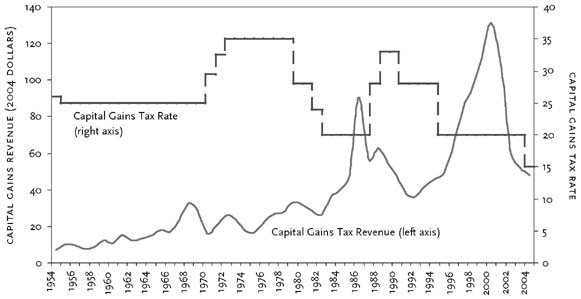
You're backing yourself up with an article written by an editor of the Wall Street Journal on a website funded by a Libertarian foundation. My! How unbiased of you.
Why does he consider bubble markets to be "booming markets"? Seriously. He barely mentions in passing the losses in revenue after stock market crashes. He seems to give too much credit to reduction in capital gains taxes spurring the economy to new heights, ignoring that almost everytime we've lowered taxes was right before our economy bubbled into a crash or crisis.
I am not so sure about this graph. From what I've researched Clinton didn't lower the CGT until 1997, so why does this chart show it dropping in 1995? The Effective Capital Gains Tax Rate in 1995 appears to have been 24.6% with 18% higher revenue than 1994. The next year, 1996, the ECGTR was even higher at 25.5% which was the highest effective rate of the 90s. Yet 1996 still had even higher revenue gains at 33% more than 1995. This was all leading into a catastrophic bubble later in the decade.
Well the Bush tax cuts was 2 trillion over 10 years in revenue (from 01 to 10).
Are you saying that by lowering taxes, we increase hiring, and therefore increase revenue?
It was the first article that showed the general conclusion that is generally accepted in the economic community: That there's a point where raising the capital gains tax results in diminishing returns in revenue. It's sweet and all that you can arrive at specific circumstances in a Skinner Box where rates were lowered and revenues didn't go up, but people a lot smarter than you and me have studied this phenomenon accounting for all the exogenous variables and they all arrive at roughly the same conclusion. In the world of economic research, that kind of general consensus is rare.
Personally, I think capital gains shouldn't be taxed at all. First, it's a one way street. If the Government is there with their hand out when I make money on an investement demanding their cut, can I go to them when I lose money on an investment? Second, it's money that's already been taxed. To have money to invest, you have to have made it. That income has been taxed as ordinary income. It's taxing money twice, which in my opinion is wrong. Third, it's a tax that can be avoided if you wish it, so you're going to base much of your investment decision on tax implications. Just like the real estate tax shelters that were disallowed in the 1986 tax reform law, it creates an environment that encourages suboptimal investing. We're all better off when people are able to enter and exit an investment at the optimal time for them as an investment, not to minimize their tax bill.
You can roll capital losses forward into future tax years and count them against gains in those years.
But it sucks if you lose, period.


