
OFFICIAL NASA Thread

Welcome to our community

Be a part of something great, join today!

Drill Here? NASA's Curiosity Mars Rover Inspects Site

http://www.nasa.gov/jpl/msl/curiosity-20140425/

"We want to learn more about the wet process that turned sand deposits into sandstone here...What was the composition of the fluids that bound the grains together? That aqueous chemistry is part of the habitability story we're investigating."

NASA's Mars Science Laboratory Project is using Curiosity to assess ancient habitable environments and major changes in Martian environmental conditions.

pia18084-cr_0.jpg
 
jlprk and Hobbsarable, good job updating this thread! :cheers:
 
Target on Mars Looks Good for NASA Rover Drilling

http://www.nasa.gov/jpl/msl/martian-sandstone-dust-removal-20140429/#.U2KnJoFdWQ4

"In the brushed spot, we can see that the rock is fine-grained, its true color is much grayer than the surface dust, and some portions of the rock are harder than others, creating the interesting bumpy textures," said Curiosity science team member Melissa Rice of the California Institute of Technology, Pasadena. "All of these traits reinforce our interest in drilling here in order understand the chemistry of the fluids that bound these grains together to form the rock."

pia18089_mahli-sol615_0.jpg
 
NASA's Curiosity Rover Drills Sandstone Slab on Mars

http://www.nasa.gov/jpl/msl/drill-hole-20140506/index.html#.U2p5VYFdWQ5

"The drill tailings from this rock are darker-toned and less red than we saw at the two previous drill sites," said Jim Bell of Arizona State University, Tempe, deputy principal investigator for Curiosity's Mast Camera (Mastcam). "This suggests that the detailed chemical and mineral analysis that will be coming from Curiosity's other instruments could reveal different materials than we've seen before. We can't wait to find out!"

pia18090-full_1.jpg
 
Reason they chose that spot to drill: Carbon is destroyed by cosmic radiation, if in the top meter of the ground, because wind erosion churns the soil and exposes it. The rover doesn't have a drill that long. This location is shielded from such erosion, so carbon (necessary to life as we know it) would survive longer and be detected now.

Reason for 2 holes: The 1st is a test by a short drill to verify rock hardness and composition. The 2nd is the long drill which sucks out dirt and shoots it up a pipe for analysis inside the rover.

 
I had read it here earlier in the day.

http://spaceflightnow.com/news/n1405/13rogozin/#.U3MfSZUU_IU

11 minutes before you posted, Soyuz landed with a Russian, American, and Japanese. None had exited the spacecraft yet. I was watching. I didn't post it because, no one cares, and, it's a 2-hour live show so few will read the post in time and none will then go to NASA-TV.
 
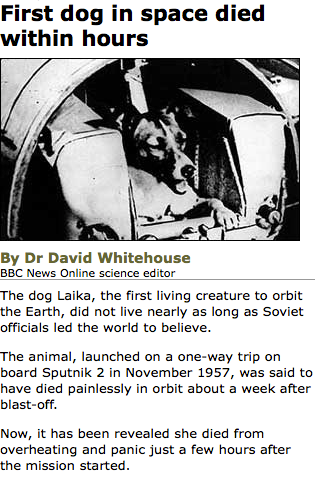
That was disclosed 20-30 years ago. Very old news. The dog was intended to die. Read the news more often, Denny.

The first animals launched bigger than a mouse were 2 American monkeys named Albert (died). Then more American monkeys (2/3 died). Then 2 Soviet dogs (lived). Then finally, the dog named Laika (died by design, no heat shield) in your post where you were sneaking politics into the thread.

Albert II, a rhesus monkey, became the first monkey in space on June 14, 1949, in a U.S.-launched V2, after the failure of the original Albert's mission on ascent. Albert I reached only 30–39 miles (48–63 km) altitude; Albert II reached about 83 miles (134 km). Albert II died on impact after a parachute failure. Numerous monkeys of several species were flown by the U.S. in the 1950s and 1960s. Monkeys were implanted with sensors to measure vital signs, and many were under anesthesia during launch. The death rate among monkeys at this stage was very high: about two-thirds of monkeys launched in 1940s and 1950s died on missions or soon after landing...

On July 22, 1951, the Soviet Union launched the R-1 IIIA-1 flight, carrying the dogs Tsygan (Russian: Цыган, "Gypsy") and Dezik (Russian: Дезик) into space, but not into orbit.[6] These two dogs were the first living higher organisms successfully recovered from a spaceflight.[6] Both space dogs survived the flight, although one would die on a subsequent flight. The U.S. launched mice aboard spacecraft later that year; however, they failed to reach the altitude for true spaceflight.

On November 3, 1957, the second-ever orbiting spacecraft carried the first animal into orbit, the dog Laika, launched aboard the Soviet Sputnik 2 spacecraft (nicknamed 'Muttnik' in the West). Laika died during the flight, as was intended because the technology to return from orbit had not yet been developed. At least 10 other dogs were launched into orbit and numerous others on sub-orbital flights before the historic date of April 12, 1961, when Yuri Gagarin became the first human in space.

http://en.wikipedia.org/wiki/Animals_in_space
 
Space-X is a commercial company that praises itself ad nauseam. It has flown 4 Dragon cargo spacecraft to the space station. The first was just practice, with worthless cargo. Of the 3 with real cargo, 2 have flooded during the water landings. They contained freezers full of blood, urine, and saliva samples, easily ruined if the freezers shorted out. Astronauts poke themselves with needles every day, and a private company losing samples pisses off NASA.

The news is that it happened the 2nd time out of 3 splashdowns, when Dragon landed Sunday. Supposedly, Space-X had redesigned the capsule's waterproofing after the first fiasco. This proves that privatization sucks, right, Denny?

http://aviationweek.com/space/water-found-inside-dragon-after-splashdown
 

Users who are viewing this thread

Back
Top