

Navigation
Install the app
How to install the app on iOS
Follow along with the video below to see how to install our site as a web app on your home screen.
Note: This feature may not be available in some browsers.
More options
Style variation
You are using an out of date browser. It may not display this or other websites correctly.
You should upgrade or use an alternative browser.
You should upgrade or use an alternative browser.
Should we be worried? (Re: Radiation fallout)
- Thread starter Fez Hammersticks
- Start date

MARIS61
Real American
- Joined
- Sep 12, 2008
- Messages
- 28,007
- Likes
- 5,012
- Points
- 113
"millions"?
Wow, my willful ignorance is stunning.
fixed.
Although in the end a probable understatement.
Few people bother to learn the eventual effects of pollution of the Earth, nuclear fallout being the most lasting and damaging of all to living organisms. Because it makes them feel small and impotent to realize their fate is out of their hands.
I am aware that at my age there is little risk from this particular accident, but unlike most nuclear pundits I have a conscience and think it's basic greed and a total lack of consideration/compassion for future generations on their part.
I am more likely to be exposed when we have a good earthquake and the fuel rods stored at the Trojan site start leaking. They were buried because they were too dangerous to move and no other state would allow us to move them so we're stuck with them forever, or maybe 40-60 years when they start leaking.
As for those of you with children, I suggest you do a little research into alternatives to dairy products to protect them what little you can.
MARIS61
Real American
- Joined
- Sep 12, 2008
- Messages
- 28,007
- Likes
- 5,012
- Points
- 113
Firemen rush into burning buildings. A suicide mission, that takes on far greater risk in the case of a mass scale catastrophe like 9/11.
I don't see a difference.
I don't either, coming from a family of many firemen.
But apparently that's a good thing to you, while I view it as a terrible and preventable tragedy.
MARIS61
Real American
- Joined
- Sep 12, 2008
- Messages
- 28,007
- Likes
- 5,012
- Points
- 113
I ask again, how many of these first responders have died from radiation poisoning? MARIS61 posts about doses killing people within 3 days. What's it been, a week now?
85 firefighters died in 2010 while on duty. Soldiers enlist and go to war knowing they could die
There's a reason people think of these guys as heroes, as well as the Fukushima 50. Those 50 guys aren't duped into going on site - they know better than MARIS61 does what the risks are.
You seem ignorant of Japanese culture. They have a reverence for martyrs or samurai. They are also a very obedient society and there have been hints in the media that they were ordered to go back in.
I can't give you a death count because the Japanese have not released any information on casualties. Depending on exposure, radiation poisoning takes minutes, hours, days, weeks or months to die.
The hundreds of cancers and other diseases fallout can cause come mostly through the food chain years or decades later.
wiki:
24 years after the catastropheTwenty four years after the catastrophe, restriction orders remain in place in the production, transportation and consumption of food contaminated by Chernobyl fallout. In the UK, they remain in place on 369 farms covering 750 km² and 200,000 sheep. In parts of Sweden and Finland, restrictions are in place on stock animals, including reindeer, in natural and near-natural environments. "In certain regions of Germany, Austria, Italy, Sweden, Finland, Lithuania and Poland, wild game (including boar and deer), wild mushrooms, berries and carnivorous fish from lakes reach levels of several thousand Bq per kg of caesium-137", while "in Germany, caesium-137 levels in wild boar muscle reached 40,000 Bq/kg. The average level is 6,800 Bq/kg, more than ten times the EU limit of 600 Bq/kg", according to the TORCH 2006 report. The European Commission has stated that "The restrictions on certain foodstuffs from certain Member States must therefore continue to be maintained for many years to come".[6]
As of 2009, sheep farmed in some areas of the UK are still subject to inspection which may lead to them being prohibited from entering the human food chain because of contamination arising from the accident:
"Some of this radioactivity, predominantly radiocaesium-137, was deposited on certain upland areas of the UK, where sheep-farming is the primary land-use. Due to the particular chemical and physical properties of the peaty soil types present in these upland areas, the radiocaesium is still able to pass easily from soil to grass and hence accumulate in sheep. A maximum limit of 1,000 becquerels per kilogramme (Bq/kg) of radiocaesium is applied to sheep meat affected by the accident to protect consumers. This limit was introduced in the UK in 1986, based on advice from the European Commission's Article 31 group of experts. Under power provided under the Food and Environment Protection Act 1985 (FEPA), Emergency Orders have been used since 1986 to impose restrictions on the movement and sale of sheep exceeding the limit in certain parts of Cumbria, North Wales, Scotland and Northern Ireland... When the Emergency Orders were introduced in 1986, the Restricted Areas were large, covering almost 9,000 farms, and over 4 million sheep. Since 1986, the areas covered by restrictions have dramatically decreased and now cover 369 farms, or part farms, and around 200,000 sheep. This represents a reduction of over 95% since 1986, with only limited areas of Cumbria, South Western Scotland and North Wales, covered by restrictions.[15]
369 farms and 190,000 sheep are still affected, a reduction of 95% since 1986, when 9,700 farms and 4,225,000 sheep were under restriction across the United Kingdom. .[16]
In Norway, the Sami people were affected by contaminated food (the reindeer had been contaminated by eating lichen, which are very sensitive to radioactivity).
None of this has anything to do with the insanity of nuclear power, especially in the hands of the idiots who "control" it.
MARIS61
Real American
- Joined
- Sep 12, 2008
- Messages
- 28,007
- Likes
- 5,012
- Points
- 113
Speaking of forced heroes, how many of you know the story about Chernobyl's 800,000 heroes?
The Liquidators: The Unknown Heroes of Chernobyl
Not many people realize that the miners, soldiers, and fireman who were the first responders to Chernobyl may have saved Europe.
The disaster occurred in the early morning hours of April 26, 1986, when a testing error caused the explosion at the Chernobyl nuclear power plant in northern Ukraine. During a radioactive fire that burned for 10 days, 190 tons of toxic materials were expelled into the atmosphere.
Six hundred firefighters were deployed immediately after the accident. In an attempt to stop the release of radioactive materials, the firefighters pumped cooling water into the core of the reactor. This did not work, and between 27 April and 5 May, more than 30 military helicopters flew over the burning reactor, dumping 2400 tons of lead, and 1800 tons of sand to try to smother the fire and absorb radiation.
This only made matters worse as the heat intensified under the dumped materials. The temperature in the reactor rose again.
Three days after the explosion, researchers at Academy of Sciences of Belarus made calculations estimating that that a critical mass of uranium, graphic, and water convulsed under the reactor, which could result in a 3-5 megaton blast as soon as 8 May.
Thousands of coal miners – drafted because of their expertise in underground tunneling – were tasked with digging a tunnel under the reactor and to install a coil for cooling the concrete base of the reactor and to reinforce any cracks appearing in the concrete.
These men worked in extremely high temperatures and were exposed to high doses of radiation. Their self-sacrifice likely prevented a second nuclear explosion that would have exposed Europe to massive doses of radioactive contamination.
Liquidators have reported that they could only work 5 to 60 seconds at a time due to the extreme temperatures and radiation levels. Others report that KGB confiscated their Geiger counters.
In the final phase of firefighting, the core of the reactor was cooled with nitrogen. Not until 6 May was the radioactive fire extinquished – 10 days after it began to rage.
The end of the fire at the reactor was only the beginning. Additional “liquidators” were conscripted to undertake what was perhaps the most dreadful task of all – the evacuation of contaminated villages and towns. The liquidators had to evacuate beautiful villages that had been inhabited for generations before returning to shoot the family pets. In all, over 400,000 people were forced to leave their homes and for own safety. Over 2,000 villages were bulldozed to the ground, and hundreds more lie silent.
Of the 800,000 Chernobyl liquidators, it is estimated that 25,000 have died since the disaster of diseases such as lung cancer, leukemia, and cardiovascular diseases, and 70,000 are permanently disabled. Twenty percent of the deaths are believed to be suicides.
On 2 April 2005, a leading Russian scientist reported that the hastily constructed cover over the Chernobyl sarcophagus is degrading and could cause a catastrophe of the same scale as the accident almost 20 years ago. According to Alexei Yablokov, President of the Center for Russian Environmental Policy, “If it collapses, there will be no explosion, but a pillar of dust containing irradiated particles will shoot 1.5 kilometers into the air and will be spread by the wind."
http://www.chernobyl-international.org/liquidators.html
The Liquidators: The Unknown Heroes of Chernobyl
Not many people realize that the miners, soldiers, and fireman who were the first responders to Chernobyl may have saved Europe.
The disaster occurred in the early morning hours of April 26, 1986, when a testing error caused the explosion at the Chernobyl nuclear power plant in northern Ukraine. During a radioactive fire that burned for 10 days, 190 tons of toxic materials were expelled into the atmosphere.
Six hundred firefighters were deployed immediately after the accident. In an attempt to stop the release of radioactive materials, the firefighters pumped cooling water into the core of the reactor. This did not work, and between 27 April and 5 May, more than 30 military helicopters flew over the burning reactor, dumping 2400 tons of lead, and 1800 tons of sand to try to smother the fire and absorb radiation.
This only made matters worse as the heat intensified under the dumped materials. The temperature in the reactor rose again.
Three days after the explosion, researchers at Academy of Sciences of Belarus made calculations estimating that that a critical mass of uranium, graphic, and water convulsed under the reactor, which could result in a 3-5 megaton blast as soon as 8 May.
Thousands of coal miners – drafted because of their expertise in underground tunneling – were tasked with digging a tunnel under the reactor and to install a coil for cooling the concrete base of the reactor and to reinforce any cracks appearing in the concrete.
These men worked in extremely high temperatures and were exposed to high doses of radiation. Their self-sacrifice likely prevented a second nuclear explosion that would have exposed Europe to massive doses of radioactive contamination.
Liquidators have reported that they could only work 5 to 60 seconds at a time due to the extreme temperatures and radiation levels. Others report that KGB confiscated their Geiger counters.
In the final phase of firefighting, the core of the reactor was cooled with nitrogen. Not until 6 May was the radioactive fire extinquished – 10 days after it began to rage.
The end of the fire at the reactor was only the beginning. Additional “liquidators” were conscripted to undertake what was perhaps the most dreadful task of all – the evacuation of contaminated villages and towns. The liquidators had to evacuate beautiful villages that had been inhabited for generations before returning to shoot the family pets. In all, over 400,000 people were forced to leave their homes and for own safety. Over 2,000 villages were bulldozed to the ground, and hundreds more lie silent.
Of the 800,000 Chernobyl liquidators, it is estimated that 25,000 have died since the disaster of diseases such as lung cancer, leukemia, and cardiovascular diseases, and 70,000 are permanently disabled. Twenty percent of the deaths are believed to be suicides.
On 2 April 2005, a leading Russian scientist reported that the hastily constructed cover over the Chernobyl sarcophagus is degrading and could cause a catastrophe of the same scale as the accident almost 20 years ago. According to Alexei Yablokov, President of the Center for Russian Environmental Policy, “If it collapses, there will be no explosion, but a pillar of dust containing irradiated particles will shoot 1.5 kilometers into the air and will be spread by the wind."
http://www.chernobyl-international.org/liquidators.html
MARIS61
Real American
- Joined
- Sep 12, 2008
- Messages
- 28,007
- Likes
- 5,012
- Points
- 113
A bit of good news and a hint to those with their heads stuck in the mud:
http://www.mnn.com/green-tech/resea...-power-helping-to-keep-the-lights-on-in-japan
http://www.mnn.com/green-tech/resea...-power-helping-to-keep-the-lights-on-in-japan
MARIS61
Real American
- Joined
- Sep 12, 2008
- Messages
- 28,007
- Likes
- 5,012
- Points
- 113
Japan's food sources already contaminated to dangerous levels.
http://www.msnbc.msn.com/id/42165497/ns/health/
http://www.msnbc.msn.com/id/42165497/ns/health/
MARIS61
Real American
- Joined
- Sep 12, 2008
- Messages
- 28,007
- Likes
- 5,012
- Points
- 113
Japan deliberately ignored safety warnings and pleas from the international Nuclear community for 5 years leading up to this accurately predicted and very avoidable tragedy.
Anything to save a buck (yen).
http://news.yahoo.com/s/afp/20110317/sc_afp/japannuclearuswikileaksdiplomacy_20110317041849
Anything to save a buck (yen).
http://news.yahoo.com/s/afp/20110317/sc_afp/japannuclearuswikileaksdiplomacy_20110317041849

- Joined
- Sep 9, 2008
- Messages
- 26,096
- Likes
- 9,073
- Points
- 113
Japan's food sources already contaminated to dangerous levels.
http://www.msnbc.msn.com/id/42165497/ns/health/
Uh, that said that the spinach and milk were as follows...no sign of "dangerous" at all.
Amazing how half-lives work.Edano said someone drinking the tainted milk for one year would consume as much radiation as in a CT scan; for the spinach, it would be one-fifth of a CT scan. A CT scan is a compressed series of X-rays used for medical tests.
The Health Ministry said iodine levels slightly above the safety limit were discovered Thursday in drinking water samples from Fukushima prefecture. On Friday, levels were about half that benchmark; by Saturday, they had fallen further.
Drinking one liter of water with the iodine at Thursday's levels is the equivalent of receiving one-eighty-eighth of the radiation from a chest X-ray, said Kazuma Yokota, a spokesman for the prefecture's disaster response headquarters.
For those "kids who don't read good", that's 1/88th.
I'm inspired by your crusade against this. If more people had the passion for anything that you have for deliberately throwing crap against the wall in order to display and promote ignorance, the world could be a better place.
- Joined
- Sep 9, 2008
- Messages
- 26,096
- Likes
- 9,073
- Points
- 113
8 days later, and the response to the OP's question is still:
No. The professionals are handling this, and will let you know when to worry. Thank you, and have a nice day.
No. The professionals are handling this, and will let you know when to worry. Thank you, and have a nice day.
MARIS61
Real American
- Joined
- Sep 12, 2008
- Messages
- 28,007
- Likes
- 5,012
- Points
- 113
Amazing how half-lives work.
If by amazing you mean very slowly, then yes.
Caesium-137 (137
55Cs, Cs-137) is a radioactive isotope of caesium which is formed mainly as a fission product by nuclear fission.
It has a half-life of about 30.17 years
Caesium-134 has a half-life of 2.0652 years.
Iodine-131 (131I), also called radioiodine (though many other radioactive isotopes of this element are known), is an important radioisotope of iodine. It has a radioactive decay half life of about 8 days.
Strontium-90 (90Sr) is a radioactive isotope of strontium, with a half life of 28.8 years.
MARIS61
Real American
- Joined
- Sep 12, 2008
- Messages
- 28,007
- Likes
- 5,012
- Points
- 113
Uh, that said that the spinach and milk were as follows...no sign of "dangerous" at all.
You continue to grasp at straws, this time by quoting the only non-educated voice in the article and deliberating pretending not to read the many nuclear and health experts who say otherwise.
In the first sign that contamination from Japan's stricken nuclear complex had seeped into the food chain, officials said Saturday that radiation levels in spinach and milk from farms near the tsunami-crippled facility exceeded government safety limits.
Iodine levels in the spinach exceeded safety limits by three to seven times, a food safety official said. Tests on the milk done Wednesday detected small amounts of iodine-131 and cesium-137, the latter being a longer-lasting element that can cause more types of cancer. But only iodine was detected Thursday and Friday, a Health Ministry official said.
Drinking one liter of water with the iodine at Thursday's levels is the equivalent of receiving one-eighty-eighth of the radiation from a chest X-ray, said Kazuma Yokota, a spokesman for the prefecture's disaster response headquarters.
This is the equivalent of getting a chest Xray every 2 weeks continually. Something no doctor would prescribe and almost certain to cause cancer.
MARIS61
Real American
- Joined
- Sep 12, 2008
- Messages
- 28,007
- Likes
- 5,012
- Points
- 113
Well Brian, at least there's one "expert" that thinks (or is too lazy to think?) like you do:
[video]http://www.huffingtonpost.com/2011/03/18/ann-coulter-radiation-is-_n_837512.html[/video]
[video]http://www.huffingtonpost.com/2011/03/18/ann-coulter-radiation-is-_n_837512.html[/video]

Klinky
Seal Of Approval
- Joined
- Jan 27, 2011
- Messages
- 589
- Likes
- 16
- Points
- 18
Well Brian, at least there's one "expert" that thinks (or is too lazy to think?) like you do:
[video]http://www.huffingtonpost.com/2011/03/18/ann-coulter-radiation-is-_n_837512.html[/video]
That's pretty sad when O'Reily has to be the voice of reason...
Radiation goes in, cancer comes out. Never a miscommunication.

TripTango
Quick First Step
- Joined
- Jan 7, 2009
- Messages
- 3,235
- Likes
- 95
- Points
- 48
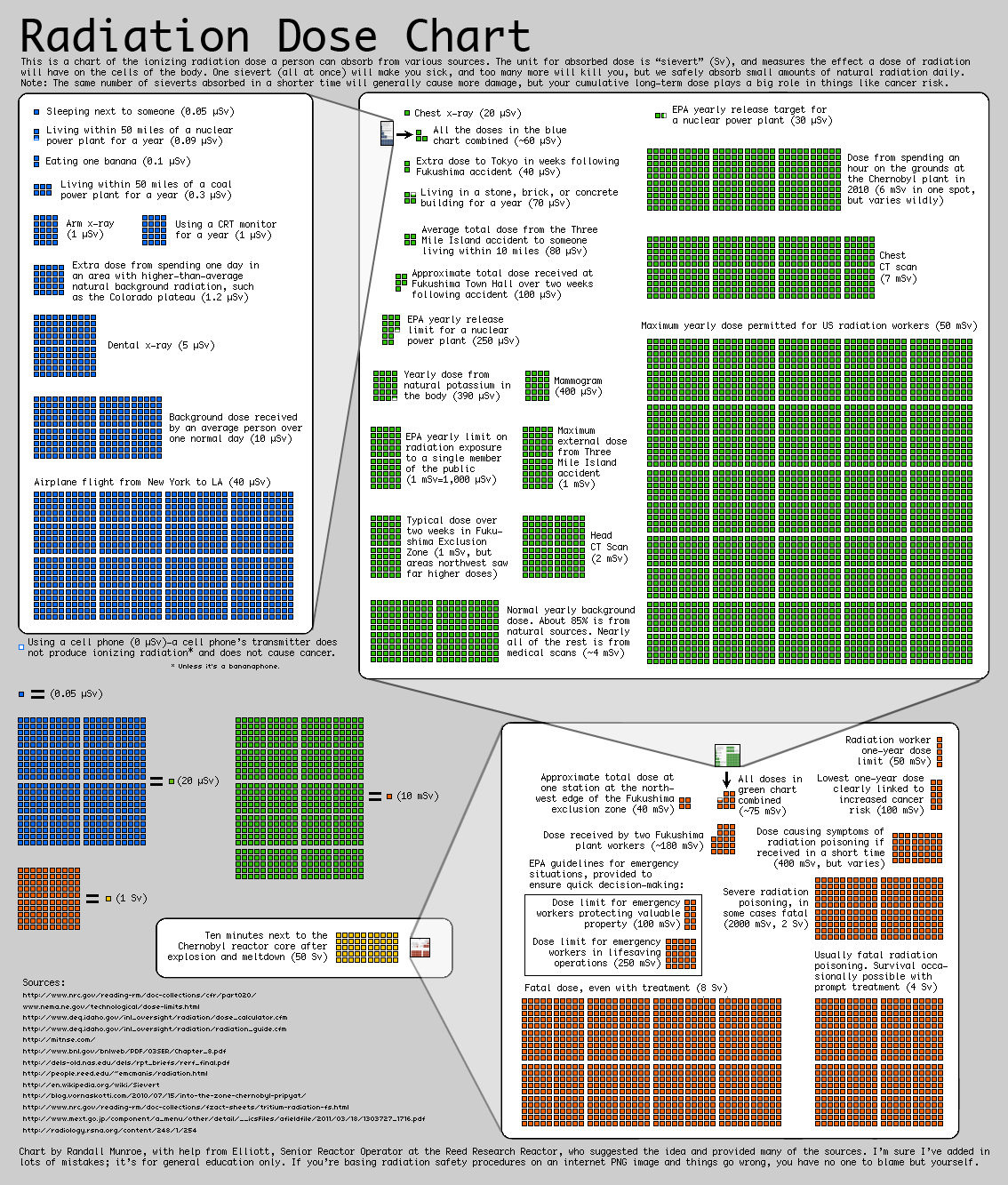
Interesting chart putting radiation doses in perspective (and in layman's terms):
http://xkcd.com/radiation/
http://xkcd.com/radiation/
MARIS61
Real American
- Joined
- Sep 12, 2008
- Messages
- 28,007
- Likes
- 5,012
- Points
- 113
US evacuates all military personnel from bases in Japan.
The US Military called out to US citizens in Japan. Abandon ship. Women and children first. This is not a drill. Moving out 10,000 people a day via all means possible. Beginning now.
Thursday, March 17, 2011
Japan: US Military begins voluntary evacuation
The US Navy said Thursday afternoon it would start evacuating families from Naval Air Facility Atsugi and Yokosuka Naval Base, near Tokyo. A few hours later, officials at Misawa Air Base, in northern Japan, did the same. Camp Zama, a U.S. Army facility near Tokyo, said it was allowing families and non-essential workers to voluntarily leave.
In a radio address Thursday afternoon, Col. Otto Feather, 374th Airlift Wing commander, said he expects Yokota Air Base to join the list soon.
from http://waronterrornews.typepad.com/home/2011/03/japan-us-military-begins-voluntary-evacuation.html
and
“The order of departure: Women and children first, non-essential person second, essential personnel third, and then me,” said Capt. Eric Gardner, Atsugi commander, during a broadcast on the base command channel.
from http://www.stripes.com/news/pacific...tary-evacuation-of-families-in-japan-1.137999
As of December 2009, there are 35,688 U.S. military personnel stationed in Japan and another 5,500 American civilians employed there by the United States.
The US Military called out to US citizens in Japan. Abandon ship. Women and children first. This is not a drill. Moving out 10,000 people a day via all means possible. Beginning now.
Thursday, March 17, 2011
Japan: US Military begins voluntary evacuation
The US Navy said Thursday afternoon it would start evacuating families from Naval Air Facility Atsugi and Yokosuka Naval Base, near Tokyo. A few hours later, officials at Misawa Air Base, in northern Japan, did the same. Camp Zama, a U.S. Army facility near Tokyo, said it was allowing families and non-essential workers to voluntarily leave.
In a radio address Thursday afternoon, Col. Otto Feather, 374th Airlift Wing commander, said he expects Yokota Air Base to join the list soon.
from http://waronterrornews.typepad.com/home/2011/03/japan-us-military-begins-voluntary-evacuation.html
and
“The order of departure: Women and children first, non-essential person second, essential personnel third, and then me,” said Capt. Eric Gardner, Atsugi commander, during a broadcast on the base command channel.
from http://www.stripes.com/news/pacific...tary-evacuation-of-families-in-japan-1.137999
As of December 2009, there are 35,688 U.S. military personnel stationed in Japan and another 5,500 American civilians employed there by the United States.


- Joined
- Sep 15, 2008
- Messages
- 34,724
- Likes
- 26,039
- Points
- 113
Camp Zama, a U.S. Army facility near Tokyo, said it was allowing families and non-essential workers to voluntarily leave.
Does that mean families were not allowed to voluntarily leave prior to this?
barfo

jlprk
The ESPN mod is insane.
- Joined
- Sep 25, 2009
- Messages
- 30,672
- Likes
- 8,853
- Points
- 113
The conservative government of Germany today made a U-turn, and agreed with the Left to close all 17 nuclear reactors in Germany because of the events in Japan.
http://hosted.ap.org/dynamic/storie...R_POWER?SITE=AP&SECTION=HOME&TEMPLATE=DEFAULT
BERLIN – Germany is determined to show the world how abandoning nuclear energy can be done. The world's fourth-largest economy stands alone among leading industrialized nations in its decision to stop using nuclear energy because of its inherent risks...The transition was supposed to happen slowly over the next 25 years, but is now being accelerated in the wake of Japan's Fukushima Dai-ichi nuclear plant disaster, which Chancellor Angela Merkel has called a "catastrophe of apocalyptic dimensions."...A center-left government a decade ago penned a plan to abandon the technology for good by 2021, but Merkel's government last year amended it to extend the plants' lifetime by an average of 12 years. That plan was put on hold after the March 11 earthquake and tsunami...Most of the country's leaders now seem determined to swiftly abolish nuclear power, possibly by 2020, and several conservative politicians, including the chancellor, have made a complete U-turn on the issue.
http://hosted.ap.org/dynamic/storie...R_POWER?SITE=AP&SECTION=HOME&TEMPLATE=DEFAULT

- Joined
- May 24, 2007
- Messages
- 73,125
- Likes
- 10,974
- Points
- 113
Most of the industrial world ends up following Germany's lead, so this is great news.
Where there's a willingness to change, there's hope.
Change to sitting around in the dark and cold.
- Joined
- Sep 9, 2008
- Messages
- 26,096
- Likes
- 9,073
- Points
- 113
You know, I can't quite wrap my head around the fact that the 5th-biggest earthquake in history resulted in almost 20,000 deaths and countless billions in damages...but the focus here is on an a "catastrophe of apocalyptic dimensions" that has so far made 20 people go to the hospital (and almost all have been released and are "all better").
Ms. Merkel has a degree in physics and is supposedly a Christian--you'd think she'd know enough about both to not be so wrong in her statements. Or maybe she's kowtowing to lobbyists. Which alternative energy source is Germany planning on using that doesn't have risks of causing 20 people to go to the hospital following a 9.0 earthquake?
BTW, the reason the Ronald Reagan carrier was moved out had nothing to do with 'radiation scares', but accountability. The same fission products released by the Fukushima plume are those that would be released in a navy reactor accident, and ones that we monitor for constantly. The reason our carriers and submarines can go into foreign ports is b/c the other countries recognize how safe our reactors are and how inspected they are. For this reason, the admirals decided to pull back Reagan so that there wouldn't be any traces of contamination belowdecks or in the ship's ventilation (no matter how slight) that could mask a potential nuclear accident onboard the ship. Not b/c they're afraid of the dose they'd be getting while closer to the coast. They have planes and helos flying every day through and over the area around Fukushima.
I'll reiterate--anyone dying a slow death right now? Or is this whole thing like calling "Fire" in a theater b/c your neighbor spilled a slurpee and you smell popcorn, which in your ineptitude and ignorance causes you to think there's the same risk as a real fire and you want to be the countercultural hero?
Ms. Merkel has a degree in physics and is supposedly a Christian--you'd think she'd know enough about both to not be so wrong in her statements. Or maybe she's kowtowing to lobbyists. Which alternative energy source is Germany planning on using that doesn't have risks of causing 20 people to go to the hospital following a 9.0 earthquake?
BTW, the reason the Ronald Reagan carrier was moved out had nothing to do with 'radiation scares', but accountability. The same fission products released by the Fukushima plume are those that would be released in a navy reactor accident, and ones that we monitor for constantly. The reason our carriers and submarines can go into foreign ports is b/c the other countries recognize how safe our reactors are and how inspected they are. For this reason, the admirals decided to pull back Reagan so that there wouldn't be any traces of contamination belowdecks or in the ship's ventilation (no matter how slight) that could mask a potential nuclear accident onboard the ship. Not b/c they're afraid of the dose they'd be getting while closer to the coast. They have planes and helos flying every day through and over the area around Fukushima.
I'll reiterate--anyone dying a slow death right now? Or is this whole thing like calling "Fire" in a theater b/c your neighbor spilled a slurpee and you smell popcorn, which in your ineptitude and ignorance causes you to think there's the same risk as a real fire and you want to be the countercultural hero?
- Joined
- May 24, 2007
- Messages
- 73,125
- Likes
- 10,974
- Points
- 113
The slow death is of the "you get old and die" variety, and the agony is dealing with chicken little variety.


MARIS61
Real American
- Joined
- Sep 12, 2008
- Messages
- 28,007
- Likes
- 5,012
- Points
- 113
jlprk
The ESPN mod is insane.
- Joined
- Sep 25, 2009
- Messages
- 30,672
- Likes
- 8,853
- Points
- 113
News from 2 hours ago:
The No. 3 reactor core is probably cracked and leaking radiation, which will more severely contaminate the environment. Most likely, radioactive water escaped from the reactor core. Other possibilities: it escaped from other equipment like pipes or the spent fuel pools stored atop the reactor.
News from several hours ago:
Two workers were hospitalized yesterday with radiation burns after stepping in the water, which was found to have radiation levels 10,000 times higher than water used in reactor cooling. Tokyo Electric Power Co. found eight different radioactive materials in the water of the turbine building basement, where the men were attempting to connect a power cable. The materials include cobalt and molybdenum-99.
This article got it right a week earlier:
http://articles.latimes.com/2011/mar/18/world/la-fg-japan-quake-wrapup-20110318
The No. 3 reactor core is probably cracked and leaking radiation, which will more severely contaminate the environment. Most likely, radioactive water escaped from the reactor core. Other possibilities: it escaped from other equipment like pipes or the spent fuel pools stored atop the reactor.
News from several hours ago:
Two workers were hospitalized yesterday with radiation burns after stepping in the water, which was found to have radiation levels 10,000 times higher than water used in reactor cooling. Tokyo Electric Power Co. found eight different radioactive materials in the water of the turbine building basement, where the men were attempting to connect a power cable. The materials include cobalt and molybdenum-99.
This article got it right a week earlier:
http://articles.latimes.com/2011/mar/18/world/la-fg-japan-quake-wrapup-20110318

Rodolfo
Double Stamp>Triple Stamp
- Joined
- Oct 20, 2008
- Messages
- 4,153
- Likes
- 47
- Points
- 48
Similar threads

- Replies
- 5
- Views
- 301

- Replies
- 5
- Views
- 200


- Replies
- 162
- Views
- 4K

Users who are viewing this thread
Total: 1 (members: 0, guests: 1)