I would have to give the greatest rivalry award to some soccer rivalry outside of the US. Even though I hate soccer, people die for those games (actually die).But I will give my two cents on the best rivalry in college football, and one of the best in American sports (because of basis reasons, I say the best) is Ohio State vs. Michigan, what is so great about that story? Many people don't know this, but there is a hate between the two states that go way back.Do you guys know about the Toledo war that started in 1835? Here is an article on it:<div class='quotetop'>QUOTE </div><div class='quotemain'>The war between Michigan and Ohio It was a "war" that both Ohio and Michigan could rightfully claim they won, a one-casualty conflict in which the only blood drawn came from a knife thrust into the leg of a Michigan sheriff. It was the Toledo War, a hotly contentious boundary dispute when it began in April, 1835, but now a source of amusement to many whose only knowledge of the war is from flawed accounts of the event.Most ask why anyone would fight Ohio over Toledo -- especially since Michigan got the Upper Peninsula as consolation for losing the argument. The late Tom Jones, former director of the Historical Society of Michigan, called that a "common, hindsight reaction built on a misconception. It ignores a couple of points." First, Toledo as a significant entity didn't exist in 1835. And second, when the boundary arguement was settled, Michigan didn't get the Upper Peninsula in exchange, it got only the western end of the peninsula -- the eastern end had long been considered part of Michigan, Jones said. In 1835 Ohio had been a state since 1803. The Michigan territory's population numberted only about 6,000. Ohioans, who thought of the territory as unclaimed wilderness that they could more or less annex at will, claimed their boundary ran along a line north of the Maumee River. That assured Ohioans in the region of access to Lake Erie, an obviously important consideration. The claim conflicted with Congresssional guidelines for carving up the western lands as established in the Northwest Ordinance of 1787. But who really cared? But as the population of the Michigan territory grew, its officials also perceived the advantages of controlling the mouth of the Maumee. Plus, they had legal ground for this claim. It seemed quite clear that according to the Northwest Ordinance the boundary should be drawn from the tip of Lake Michigan eastward to Lake Erie, which would put the mouth of the Maumee in Michigan.When Michigan petitioned to become a state in 1835, Ohio began putting pressure on Congress in support of its claim to a boundary line extending to North Cape in Maumee Bay. Michigan objected. Ohio insisted. During the dispute, confusion reigned. People addressing letters to villages in the disputed territory sometimes gave the address as Ohio, sometimes as Michigan. At least one letter was addressed to someone in the "State of Confusion." "As with all such matters, the issue wasn't simple. It involved presidential politics, party alliances, poor maps, pride, and more," says Jones. "I contend that the solution was political," he said. "Had the matter gone to the Supreme Court, it probably would have been resolved in Michigan's favor. But President (Andrew) Jackson didn't want that. The year 1836 was an election year. He was courting Ohio's electoral votes, and he worked out a political compromise." But before that could be reached, the war began. In February, Ohio's legislature voted to extend the state's jurisdiction over the Toledo Strip. Michigan Territory Gov. Stevens T. Mason responded that he would not hesitate "to resist to the utmost every encroachment or invasion upon the rights and soil of this territory." Ohio Gov. Robert Lucas, calling Mason's supposed bluff, showed up at Perrysburg, Ohio, along with 300 Ohio militiamen. Meanwhile, Gov. Mason marched to Monroe from Detroit, the territorial capital, with a "posse" of sheriff's deputies, who actually were Michigan militiamen. "Men galloping about--guns getting ready--wagons being filled with people and hurrying off, and everybody in commotion. The two armies struggled for a soggy week to find each other in the wilderness and swamps surrounding the region, but never did come in contact." When elements from Michigan and Ohio did meet, however, Michigan started the shooting. President Jackson had asked Gov. Mason to let Ohio commissioners run a survey of the disputed boundary line to just north of the Point Place. Gov. Mason refused.When Gov. Lucas sent his surveyors out on April 26, a Michigan posse under Lenawee County Undersheriff William McNair met them. The undersheriff demanded that the Ohioans leave Michigan territory. They refused and shots were fired. No one was hit. But members of the surveying crew were arrested and charged with violating the Pains and Penalties Act, which prohibited Ohioans from exercising any authority in Michigan. Under Gov. Mason's orders, Gen. Jacob. W. Brown of Tecumseh combed the disputed territory, arresting Ohio officials, including the entire family of Maj. Benjamin Franklin Stickney. The Major was tied to his horse for the trip to the Monroe County Jail. Maj. Stickney's son, named Two (he had a brother named One), made a dramatic attempt to rescue his father by drawing a knife and lunging at Monroe County Sheriff Joseph Wood, wounding him in the thigh and drawing the only blood in the Toledo War. Congress eventually approved a bill admitting Michigan to statehood on the condition that it accept the northern boundary line, which effectively ended the matter. Or so everyone thought. As recently as 1972, the U.S. Supreme Court heard arguments from attorneys who still maintain that Toledo belongs in Michigan. But most Toledo War buffs consider that a footnote to the affair.</div>The only way for Michigan to become a state was to except defeat. Now Michigan sounds like they still want the Toledo strip back. Now true, this doesn't have to do with the football teams, but the two teams did play each other in 1897. People say there was still anger between the states and that the anger might have been taken into the Michigan game.It really is a great rivalry, with a lot of history (I just spoke of some of the history, I could go on and on about the history between the actual colleges).


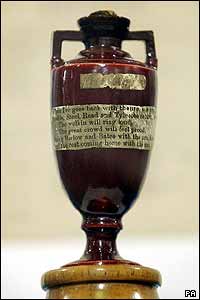 Now that is a great rivalry. This year ashes just started and we are kicking the sh*t out of the POMS.
  anyone know about the ashes or has anyone got a rivalry with a better story?


 But last year we beat them in the first test and they came back and beat us.


