Watergate Lawyer Makes Bombshell Claim Donald Trump Tried to Block Epstein Files, Revealing He Was a ‘FBI Informant’
Donald Trump has been trying to stall the release of the Epstein files because of the bombshell revelation the documents are hiding, according to Watergate lawyer Nick Ackerman.
Ackerman, who has often commented on Trump’s legal matters, on Sunday
flagged “a key email from Jeffrey Epstein’s estate,” in addition to “statements by Trump ally House Speaker Mike Johnson,” which together purportedly show “it is highly likely that Trump was a confidential FBI informant in the first sex trafficking investigation into Epstein and his partner in crime Ghislaine Maxwell.”
The emails and statements hint that Trump might have shared important information with authorities, possibly affecting the direction of the investigation into the notorious pair.
Experts note that this revelation could reshape public understanding of Trump’s involvement with Epstein, raising questions about the depth of his cooperation with federal law enforcement during the probe.
Media outlets have largely ignored the importance of this email.
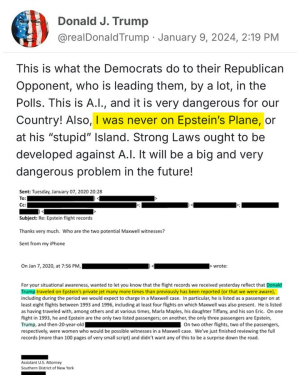
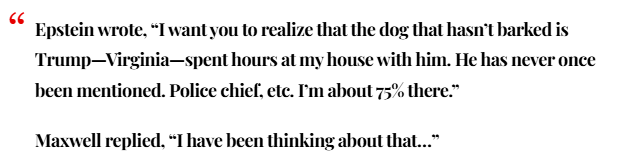
In an email sent to Maxwell on April 2, 2011, Epstein shared his thoughts about Donald Trump.
It’s worth connecting the dots with what we now know.
Epstein wrote this email after Florida authorities and the FBI had completed their investigations into his conduct with underage girls and after he had served his unusually lenient sentence.
Although the second federal investigation had not yet started, victims were already filing civil lawsuits against Epstein, who was a registered sex offender.
The phrase, “dog that hasn’t barked” comes from the Sherlock Holmes story entitled “The Adventure of Silver Blaze.”
In the story, Holmes identified the murderer by noting that the watchdog at the crime scene had not barked, which meant the dog recognized the killer.
Epstein pointed out to Maxwell the unusual silence surrounding Donald Trump in the investigation. He noted that the “police chief, etc.”—a shorthand reference to the Palm Beach detectives who handled the case—had never mentioned Trump, even though he had spent significant time at Epstein’s house with one of the victim-witnesses, Virginia Giuffre.
He emphasized the peculiarity of this oversight, highlighting that such an obvious connection had gone completely unaddressed in official reports. The reference to the “silent watchdog” echoed Holmes’ idea that sometimes the absence of action or mention can reveal as much as what is actively reported.
Epstein observed that none of the investigators ever brought up Trump, even though Trump had spent hours with Giuffre. Drawing on the Sherlock Holmes metaphor of the silent watchdog, he concluded that Trump was the “dog that hasn’t barked,” which led him to believe that Trump must have been cooperating against him.
Epstein’s note that he was “75% there” reflected how confident he felt in his suspicion that Trump had been cooperating with authorities during the earlier investigations. He seemed to believe that enough evidence or insight had convinced him of Trump’s involvement behind the scenes.
Maxwell’s reply, “I have been thinking about that…,” indicated that she shared his suspicions. Her response suggested that she, too, believed Trump might have been assisting investigators, reinforcing Epstein’s sense that the silence around Trump was significant.
House Speaker Mike Johnson made headlines on September 5, 2025, when he described Epstein’s actions as an “unspeakable evil.” He added that Donald Trump had served as an FBI informant in an effort to dismantle Epstein’s criminal operations, highlighting the gravity of the situation and Trump’s alleged cooperation with authorities.
Johnson also revealed that he and Trump had discussed the matter multiple times, including “as recently as twenty-four hours ago.” His statements underscore the ongoing attention and significance of Epstein’s crimes, while providing insight into Trump’s reported involvement in the investigation.
Within days, Johnson, who regularly communicates with Trump, retracted his statement without offering a clear or convincing explanation. He claimed that he might not have chosen the “right word.”
Unsurprisingly, the White House denied that Trump had served as an FBI informant in the Epstein case, stating that Johnson’s original description was inaccurate.
It’s clear that Trump does not want his role as an FBI informant to be publicly known. The secrecy surrounding such matters is often deliberate, especially when high-profile figures are involved.
Drawing from my experience as a prosecutor, the main way someone becomes a confidential informant is through the FBI leveraging their involvement in criminal activity. This process allows the agency to gain cooperation while offering the individual a path to avoid prosecution.
When it comes to Trump, the FBI’s leverage may not have been related to his connection with Epstein’s sex trafficking. The true reason could have been something entirely different.
This raises a key question: if the leverage wasn’t Epstein, then what exactly did the FBI know about Trump? The uncertainty leaves room for speculation about the nature of his cooperation.
The big question — will future productions of DOJ’s Epstein files reveal Trump’s involvement as an FBI informant against Epstein? It certainly should.
Donald Trump has been trying to stall the release of the Epstein files because of the bombshell revelation the documents are hiding, according to Watergate lawyer Nick Ackerman. Ackerman, who has often commented on Trump’s legal matters, on Sunday flagged “a key email from Jeffrey Epstein’s...

thedailyadda.com