What do you make of this, mook?

Welcome to our community

Be a part of something great, join today!

Can't think of an answer, huh?

barfo

An answer to what? You made up hypotheticals that aren't even realistic and don't even deserve an answer. For instance, a business's tax on profit doesn't pay for sidewalks. That is a different tax unrelated to revenue or profit. There are already taxes in place to tax a business just to exist.

Why do you want to eliminate all low-margin businesses that can't afford tax on revenue and hire employees? Why are you only in favor of the giant corporations making huge margins? You're fellow pinkos would be ashamed of you.
 
An answer to what? You made up hypotheticals that aren't even realistic and don't even deserve an answer. For instance, a business's tax on profit doesn't pay for sidewalks.

Oh, please. Excuse me for saying sidewalks. I should have said National Defense. Or Medicare. Or farm subsidies. Ok? Now try to address the question. Why should profitable companies carry the load for non-profitable companies?

barfo
 
Why don't we clean up America and get these handout-begging incompetent businesses off the streets? Why do millions of Social Security recipients have to die early to subsidize Hawaii vacations for small businessmen so incompetent that they need tax breaks to break even?

As one who has run the office while the owner takes a vacation for months because of my competence, I know.
 
Oh, please. Excuse me for saying sidewalks. I should have said National Defense. Or Medicare. Or farm subsidies. Ok? Now try to address the question. Why should profitable companies carry the load for non-profitable companies?

barfo


Why do you want to eliminate all low-margin businesses that can't afford tax on revenue and hire employees? Why are you only in favor of the giant corporations making huge margins?

If a company can cut costs to stay afloat during the bad times, while still paying the existing tax for a business just to exist, I'm fine with that.
 
http://spectator.org/archives/2011/07/29/steve-wynn-is-right#

A recent survey by the U.S. Chamber of Commerce found that 64 percent of small businesses will not hire anyone in the next year. The reasons given all concern government: taxation, regulation, and the threat of new legislation.

I am shocked that no small business said they won't be hiring anyone because they don't run their business well enough to expand. =) Seriously though... There is no context to that number... though it does show small business are very willing to blame their failures elsewhere. Like when corporations axed ton of employees after 9/11 (the company that I worked for at the time 50K+) when they could blame it on something else (it's not US! It was 9-11!!!) Yeah right... they hired most of those positions back with people with less years of seniority.
 
Why do you want to eliminate all low-margin businesses that can't afford tax on revenue and hire employees? Why are you only in favor of the giant corporations making huge margins?

I don't / I'm not. I was raising the question of why you don't, because according to your philosophy, such as it is, you should be in favor of it.

If a company can cut costs to stay afloat during the bad times, while still paying the existing tax for a business just to exist, I'm fine with that.

That's more in keeping with the Republican tradition, I guess: lay off workers, don't pay taxes, you are fine with that.

barfo
 
I don't / I'm not. I was raising the question of why you don't, because according to your philosophy, such as it is, you should be in favor of it.

You're confused.

blazerboy30 said:
paying the existing tax for a business just to exist, I'm fine with that.

don't pay taxes, you are fine with that.

barfo

Are you drunk?
 
Are you drunk?

Yes, of course I am, but that isn't a problem for debating you. As you know perfectly well, the 'existing tax for a business just to exist' is actually pretty tiny (in Oregon, it was $10/year until just recently).

So, you continue to avoid the question: is it fair/reasonable/good policy that profitable businesses subsidize unprofitable businesses?

barfo
 
Yes, of course I am, but that isn't a problem for debating you. As you know perfectly well, the 'existing tax for a business just to exist' is actually pretty tiny (in Oregon, it was $10/year until just recently).

So, you continue to avoid the question: is it fair/reasonable/good policy that profitable businesses subsidize unprofitable businesses?

barfo

How much is sales tax there? That's a tax on revenue.
 
That supposed superiority comes at a cost...
http://seekingalpha.com/article/146992-comparing-u-s-healthcare-spending-with-other-oecd-countries

Having "the best" means jack shit if people can't afford it.


0pX8e.jpg


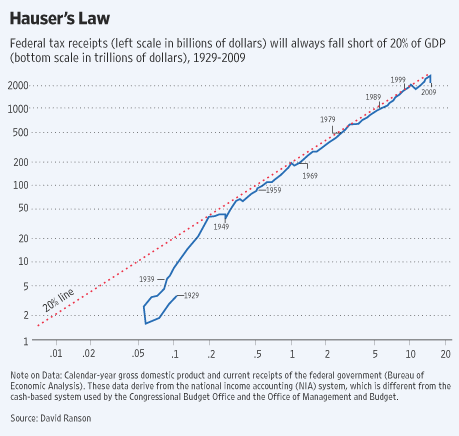
Doesn't really stand up very well when the highest data point is pre-Bush tax cuts(well above 19.5) & the second lowest data point is during Bush tax cuts(below 15%). When your "law" swings wildly by up to 25% or more I don't think you get to call it a law anymore.

Nah brah I don't think so.


Reality:


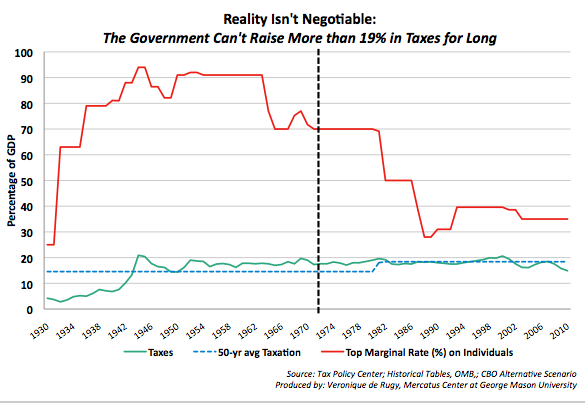
It shows the historical path of federal taxation as a percentage of GDP (using the earliest records available from the OMB) alongside top-marginal-tax-rate data from the Tax Policy Center. From 1930 to 2010, tax-revenue collection in the United States has never topped 20.9 percent, averaging 16.5 percent of GDP over 80 years. This despite the drastic historical fluctuation in tax rates on the wealthiest Americans.

This reality is called Hauser’s Law, after Standford University professor Kurt Hauser, who had a very good piece in the Wall Street Journal this weekend:


Higher taxes discourage the “animal spirits” of entrepreneurship. When tax rates are raised, taxpayers are encouraged to shift, hide and underreport income. Taxpayers divert their effort from pro-growth productive investments to seeking tax shelters, tax havens and tax exempt investments. This behavior tends to dampen economic growth and job creation. Lower taxes increase the incentives to work, produce, save and invest, thereby encouraging capital formation and jobs. Taxpayers have less incentive to shelter and shift income.

Chart%20image_0.png


Tough luck nigguh. :]

http://www.nationalreview.com/corner/254034/hausers-law-reality-isnt-negotiable-veronique-de-rugy

Bush was not a fiscal conservative I don't care what he believes in or what state our economy was in due to his policies. Peace.

That’s because these Democrats still think they will be able to raise more revenue by letting marginal rates go up. But that ignores the fact that the federal government has never been able to get much more than 19 percent of GDP in tax revenues, no matter how high the top marginal tax rate goes.
 
Last edited:
I feel rather special for being singled out in the title. I feel a little annoyed, though, so many seem to have such a dim view of the capabilities of the American entrepreneur vs those in, say, Germany.

Germany has a much higher tax burden and far greater regulatory issues. They've even got a more grim GDP/National Debt ratio, and even owes much more of its debt to foreign countries than we do. Yet there are people just like me over there who have no problem making a buck.

However, they are sitting on a pretty enviable 6% unemployment rate.

They do a much better job of investing in things like education, health care and infrastructure, especially in the good times, and it's helping them get through these rough times.

Maybe I'm just less whiny than the US Chamber of Commerce, but I just don't feel like regulation or tax rates make that much difference in my day-to-day business. If my customers have jobs and can afford my products, I make money. If they don't, I don't. It doesn't take complicated arguments about revisions in health care policy or the ability of the top .5% to accumulate capital to fund investment in growth sectors to understand why I will or won't make a buck.

I've got plenty of access to capital. I worry about health care, of course--a hell of a lot more than the typical German small businessman. But I'm in the same boat as everyone else. If my health care costs or finance costs or costs for conforming to some regulation or another rise, well, it's probably true for my competitors too. We all jack our prices a little and none are really that much better or worse off than the others.

But if you take jobs away from my customers, especially in this current economy, well, I'm fucked. If the customers have no money, I have no business. Corporations are sitting on trillions of dollars in cash right now, too afraid to spend it because there's no point in investing if there ain't consumer demand. I am sitting on a very small nest egg too for the self-same reason. The only entity in the US that does have the wherewithal to cut massive checks in this economy is the federal government. Meanwhile, we've got infrastructure problems all over the place.

I'd like to see our government:
1. Implement some new tax brackets for those making, say, more than $1 mil and $10 mil.
2. Vastly simplify the tax code for everyone, eliminating almost all deductions. Just a nice simple progressive system with space for obvious keepers like 401ks and college savings plans. Other than taxing the top .5% of the US more, it's otherwise revenue neutral. The focus is really simplicity, not raising revenues.
3. A long-term plan for Medicare/Medicaid/SS that puts it on the path to stability. I'm ok with raising ages, "death panels" (lol--I prefer the term "advanced care planning consultations", but whatever) and means testing.
4. Short-term investment in a major infrastructure stimulus plan focused on ports, highways, power grid, rail, etc. Also invest more in science/NASA, but the real dollars are actually quite minor.
5. Pulling out of Iraq/Afghanistan.

Honestly, I think if Americans had an up or down vote on the above, I'd be shocked if it didn't pass with massive overwhelming support. It's a moderate, middle-of-the-road roadmap that sadly only makes sense in the real world and not the political world. So of course it has no chance of happening.

 
Last edited:
Ooo I don't want to post something short that would seem disrespectful mook.

I've been in that position before where I make a long-winded argument only to see some punk complain, and post one line as a retort. You've almost put me in that position though, lol.

I'll just stick to my side discussion, but just a few years ago the States seemed to be doing just fine. No matter what you feel is right only complex economic formulas matter, not feelings or emotions. Greece could be a perfect counterpoint to your example, and Germany is just one European country whereas many were devastated by the 2008 financial crisis.

I don't think the point of Social Security is to get back more than what you've earned. The Department of Labor and Education are worthless and inefficient. This country is pretty big too, something you haven't considered. Spain and Peru are also larger, so is California. Germany does not seem analogous given that context. The federal government has different priorities and goals than local governments.
 
Last edited:
I feel rather special for being singled out in the title. I feel a little annoyed, though, so many seem to have such a dim view of the capabilities of the American entrepreneur vs those in, say, Germany.

Germany has a much higher tax burden and far greater regulatory issues. They've even got a more grim GDP/National Debt ratio, and even owes much more of its debt to foreign countries than we do. Yet there are people just like me over there who have no problem making a buck.

However, they are sitting on a pretty enviable 6% unemployment rate.

They do a much better job of investing in things like education, health care and infrastructure, especially in the good times, and it's helping them get through these rough times.

Maybe I'm just less whiny than the US Chamber of Commerce, but I just don't feel like regulation or tax rates make that much difference in my day-to-day business. If my customers have jobs and can afford my products, I make money. If they don't, I don't. It doesn't take complicated arguments about revisions in health care policy or the ability of the top .5% to accumulate capital to fund investment in growth sectors to understand why I will or won't make a buck.

I've got plenty of access to capital. I worry about health care, of course--a hell of a lot more than the typical German small businessman. But I'm in the same boat as everyone else. If my health care costs or finance costs or costs for conforming to some regulation or another rise, well, it's probably true for my competitors too. We all jack our prices a little and none are really that much better or worse off than the others.

But if you take jobs away from my customers, especially in this current economy, well, I'm fucked. If the customers have no money, I have no business. Corporations are sitting on trillions of dollars in cash right now, too afraid to spend it because there's no point in investing if there ain't consumer demand. I am sitting on a very small nest egg too for the self-same reason. The only entity in the US that does have the wherewithal to cut massive checks in this economy is the federal government. Meanwhile, we've got infrastructure problems all over the place.

I'd like to see our government:
1. Implement some new tax brackets for those making, say, more than $1 mil and $10 mil.
2. Vastly simplify the tax code for everyone, eliminating almost all deductions. Just a nice simple progressive system with space for obvious keepers like 401ks and college savings plans. Other than taxing the top .5% of the US more, it's otherwise revenue neutral. The focus is really simplicity, not raising revenues.
3. A long-term plan for Medicare/Medicaid/SS that puts it on the path to stability. I'm ok with raising ages, "death panels" (lol--I prefer the term "advanced care planning consultations", but whatever) and means testing.
4. Short-term investment in a major infrastructure stimulus plan focused on ports, highways, power grid, rail, etc. Also invest more in science/NASA, but the real dollars are actually quite minor.
5. Pulling out of Iraq/Afghanistan.

Honestly, I think if Americans had an up or down vote on the above, I'd be shocked if it didn't pass with massive overwhelming support. It's a moderate, middle-of-the-road roadmap that sadly only makes sense in the real world and not the political world. So of course it has no chance of happening.


Great post, rep'd!
 
Mook,

My take is you're not in the 64% mentioned in the article. One size doesn't fit all?
 
What makes "sense" doesn't matter. What matters is what produces results. The eye test and feel test are inadequate replacements for real political progress.

People have to make real cuts if they want to get out of the debt crisis and save our credit rating.
 
Yes, of course I am, but that isn't a problem for debating you. As you know perfectly well, the 'existing tax for a business just to exist' is actually pretty tiny (in Oregon, it was $10/year until just recently).

So, you continue to avoid the question: is it fair/reasonable/good policy that profitable businesses subsidize unprofitable businesses?

barfo

You're just being blatantly dishonest here, with the $10/year garbage. A business will either be paying property tax or rent (which then has tax paid on it) just to remain in business, even without making any profit. A business that is paying those taxes, but just breaking even is not putting a drain on the economy while also keeping jobs.
 
Here's a pretty good piece by (of all people) David Frum: http://edition.cnn.com/2011/OPINION/08/01/frum.debt.republicans/index.html

I'll crop it down drastically, but I encourage everyone to read it:

I am not alone.
Only about one-third of Republicans agree that cutting government spending should be the country's top priority. Only about one-quarter of Republicans insist the budget be balanced without any tax increases.
Yet that one-third and that one-quarter have come to dominate my party. That one-third and that one-quarter forced a debt standoff that could have ended in default and a second Great Recession. That one-third and that one-quarter have effectively written the "no new taxes pledge" into national law.
There was another way. There still is.
Give me a hammer and a church-house door, and I'd post these theses for modern Republicans:
1) Unemployment is a more urgent problem than debt.

2) The deficit is a symptom of America's economic problems, not a cause.

3) The time to cut is after the economy recovers.

4) The place to cut is health care, not assistance to the unemployed and poor.

5) We can collect more revenue without raising tax rates.

6) Passion does not substitute for judgment.
Republicans and conservatives have worked themselves into a frenzy of rage and contempt for President Barack Obama. House Speaker John Boehner's post-deal PowerPoint for Republican House members was actually labeled "Two Step Approach to Hold President Obama Accountable" (PDF) -- as if the supreme goal of policy in this time of economic hardship were to fix the blame for all problems on the president. This exercise in finger-pointing satisfies the emotions of the Republican base. It does not accurately explain the causes of the crisis or offer plausible remedies.
7) You can't save the system by destroying the system.
In their passion, Republicans convinced themselves that the constitutional republic and the free-enterprise system were threatened as never before. Their response? To threaten to blow up the free-enterprise system and wreck the republic unless they gained their point.
Republicans have become so gripped by pessimism and panic that they feel they have nothing to lose by rushing into a catastrophe now. But there is a lot to lose, and in these past weeks America nearly lost it. Let's hope that as America steps back from the brink, Republicans remember that it's their job to protect the system, not to smash the system in hopes of building something better from the ruins.
 
Mook,

My take is you're not in the 64% mentioned in the article. One size doesn't fit all?

One size does fit all, though. That "size" being whatever the Tea Party says it will be. All three branches of government have to conform to what a minority of one half of the legislative branch says (Tea Partiers in the House of Representatives), or they will no longer fund our government.

If you really look at what's happening, it's blatantly un-democratic. Tea Partiers have the ability to go out and win elections on the platform of limited government. They can run Senate and Presidential campaigns based on that platform. If they win, they should have the power to dictate things like whether we pay our bills or not.

But they haven't won those elections. They won one round of elections in the House of Representatives, and are leveraging that one win into dictating how the rest of our government behaves. Their strategy is "My way or nihilism." It's insanity. It's gimmicky. It's against the will of the majority of the American people (most Americans actually favor tax increases and much less drastic cuts to entitlements.)

Sorry, I'm not really replying to your particular point. I'm just really frustrated that a group of people who represent maybe 20% of America are holding a gun to the rest of us and saying, "I will save you if you follow my plan, but if you don't I'll blow your head off."

Go win some more elections if your ideas are so great. When you do, you'll have America on your side and I'll have no reason to complain.
 
One size does fit all, though. That "size" being whatever the Tea Party says it will be. All three branches of government have to conform to what a minority of one half of the legislative branch says (Tea Partiers in the House of Representatives), or they will no longer fund our government.

If you really look at what's happening, it's blatantly un-democratic. Tea Partiers have the ability to go out and win elections on the platform of limited government. They can run Senate and Presidential campaigns based on that platform. If they win, they should have the power to dictate things like whether we pay our bills or not.

But they haven't won those elections. They won one round of elections in the House of Representatives, and are leveraging that one win into dictating how the rest of our government behaves. Their strategy is "My way or nihilism." It's insanity. It's gimmicky. It's against the will of the majority of the American people (most Americans actually favor tax increases and much less drastic cuts to entitlements.)

Sorry, I'm not really replying to your particular point. I'm just really frustrated that a group of people who represent maybe 20% of America are holding a gun to the rest of us and saying, "I will save you if you follow my plan, but if you don't I'll blow your head off."

Go win some more elections if your ideas are so great. When you do, you'll have America on your side and I'll have no reason to complain.

Heh.

No size fits all, not "one size."

And vote counting (like the Whips do, like they do at board meetings, etc.) is one of the oldest things about democracy. This is nothing new or special.

In the 40s and 50s, the Democrats had to deal with the Southern bigot types while trying to integrate the military, etc.
 
I don't care if there's a (D), (R), (Tea) or (I) after your name...if you don't think that spending is massively out-of-control, then your head's in the sand.

These "massive cuts" that the compromise calls for seem utterly ridiculous. Really? We had to go to the brink of default for our lawmakers to compromise on the need to cut 5% of the projected overrun of the next decade? WTF is that?

The deficit is a symptom of America's problems. Namely, that we've become a social-welfare state without thinking through how to actually do it. We didn't set our country up like Norway (or even France or Germany) and are now wondering why we can't pay for things that Germans and French get for free. We finally took the mantle of becoming masters of our own geopolitical destiny and now seem shocked that ships and planes and tanks and soldiers actually cost money (forget that military spending has gone from ~15% of GDP to <5% in the last 50 years). Joe and Jane American (in the words of Mark Hertsgaard, who I generally disagree with) "are barely aware of their own history, much less anyone else's."

I was too young to understand what Carter and Reagan and Bush I were doing, other than what I saw on TV. I didn't have time to read up on the intricacies and politics of the Clinton Administation, and I spent much of the Bush one at sea. I don't have the energy or feel the need to "assign blame" to people of the past (including the first 18 months of the Obama administation) except to analyze the facts. But what I'm seeing from our lawmakers in the last year or so is making me a bit sick. I imagine the greybeards here will tell me that it's "business as usual", but how the hell can (assumingly) smart people, elected by millions, be unable to comprehend a profit/loss sheet (or, failing that, a checkbook register)? How can people think that a "SuperCongress" or backroom bribing to get people to cross the party lines for an unpopular vote are the right way to do things?

I'll repeat this, since some don't seem to be acknowledging it...you could remove the entire Department of Defense, Department of Homeland Security, and NASA and still have a budget overrun of $600B. If you want to "compromise" and say "sure, keep DoD/DHS (with some small cuts here and there) but make sure you bring home every soldier, ship and plane from Iraq and Afghanistan", you have only shaved ~$150B...or <10% of the federal overrun.

We aren't set up to be an entitlement state. Nowhere was Social Security supposed to support people for the last 12-15 years (on average) of their life. Medicare taxes weren't calculated to be able to support the costs and quantity of all the care people are using it for. We haven't set up a tax to cover the interest of the debt we're piling up, which is causing more overruns (~200B this year, or ~20% of all income tax receipts...and rising).

The compromise can't be this tepid. If you want to push against Hauser's law (which I've only recently learned about, so excuse me if I used that the wrong way) to raise taxes in the belief that it'll be beneficial, then fine. But I can't fathom how our lawmakers feel that there doesn't need to be a concomitant cut in our spending (which DoD has already implemented, and is looking at more) or a reason to ensure that budgets going forward cannot add to the debt problems.

looking forward to the tl;dr's like with the last medicare/caid post
File:GAO_Slide.png
 
Last edited:
You're just being blatantly dishonest here, with the $10/year garbage. A business will either be paying property tax or rent (which then has tax paid on it) just to remain in business, even without making any profit. A business that is paying those taxes, but just breaking even is not putting a drain on the economy while also keeping jobs.

Not all businesses pay rent or own property. For example, if you were a "consultant" you probably wouldn't pay any additional property tax, although you might avoid paying some income tax by claiming your daughter's bedroom as an office.

So, you continue to avoid the question: is it fair/reasonable/good policy that profitable businesses subsidize unprofitable businesses?

barfo
 
Not all businesses pay rent or own property. For example, if you were a "consultant" you probably wouldn't pay any additional property tax, although you might avoid paying some income tax by claiming your daughter's bedroom as an office.

So, you continue to avoid the question: is it fair/reasonable/good policy that profitable businesses subsidize unprofitable businesses?

barfo

And the "consultant" like you're suggesting wouldn't have many expenses, making most of their revenue profit... thus they would pay tax on it. The example of using the daughter's bedroom as a write-off is illegal. I didn't know you had changed the debate to: "should we enforce current tax law?".

You're trying to find one-off examples instead of the majority, and it is pretty boring. Your question isn't applicable, so I'll ask an equally inapplicable question: Should frogs be taxed per mile that they fly? Don't avoid the question.
 
And the "consultant" like you're suggesting wouldn't have many expenses, making most of their revenue profit... thus they would pay tax on it. The example of using the daughter's bedroom as a write-off is illegal. I didn't know you had changed the debate to: "should we enforce current tax law?".

I didn't. That comment was just for color.

You're trying to find one-off examples instead of the majority, and it is pretty boring. Your question isn't applicable, so I'll ask an equally inapplicable question: Should frogs be taxed per mile that they fly? Don't avoid the question.

I favor takeoff and landing fees rather than a per-mile charge.

Why do you claim my question is not applicable? The US has a tax policy at present to tax corporate profits, you implied that you favor that policy versus taxing revenue. I'm just asking why. It's not a difficult question.

barfo
 
And the "consultant" like you're suggesting wouldn't have many expenses, making most of their revenue profit... thus they would pay tax on it. The example of using the daughter's bedroom as a write-off is illegal. I didn't know you had changed the debate to: "should we enforce current tax law?".

You're trying to find one-off examples instead of the majority, and it is pretty boring. Your question isn't applicable, so I'll ask an equally inapplicable question: Should frogs be taxed per mile that they fly? Don't avoid the question.

Apparently barfo isn't up-to-date on the tax ramifications of running your own LLC. Plus, you can't write off your daughter's bedroom, but it is legal to write off a home office, although that really doesn't mean much in terms of actual tax obligations.

Hint - my taxes are much more than he paid at his cushy union job.
 
Apparently barfo isn't up-to-date on the tax ramifications of running your own LLC.

You are hilariously incorrect on that score.

Plus, you can't write off your daughter's bedroom, but it is legal to write off a home office, although that really doesn't mean much in terms of actual tax obligations.

That one you actually got right. One for three.

Hint - my taxes are much more than he paid at his cushy union job.

I kind of think you don't have any idea about that. But, feel free to post how much tax you paid, and I'll let you know whether you were right or not.

barfo
 
barfo
View Profile View Forum Posts Private Message View Blog Entries View Articles Add as Contact commie pinko

This message is hidden because barfo is on your ignore list.
View Post.Remove user from ignore list

I'm sure I missed out on yet another Lupus joke. :(
 
I'm sure I missed out on yet another Lupus joke. :(

Aww, you put me on ignore? :smiley-sadbye: Was it something I said? I sure hope so.

barfo
 
Last edited:

Users who are viewing this thread

Back
Top