Is this a hate crime? Part 2

Welcome to our community

Be a part of something great, join today!

Nice bait and switch. Also, it's even more laughable that you won't give credit to a president when they do good because they don't run the country, then use that same argument for when they do bad. A governor is in the same position as the president for the state.

You're cute!
generalize much? after telling me how I smell, you counter with how cute I am?
 
That's all I need to hear. You are dead wrong and haven't given one shred of proof that the economy was worse when Obama took office than Reagan.

College at UC Davis, UC Berkley etc used to be FREE Until Reagan's punk ass...

http://college.monster.com/news/articles/1064-whatever-happened-to-when-college-was-free

The era of free tuition ended, ironically, with the student movement of the 1960s, just as campuses were getting more populous, diverse, and democratic. Ronald Reagan made the University of California a major punching bag of his 1966 campaign for governor of California, with the encouragement of FBI director J. Edgar Hoover, who saw campus peace activists as dangerous subversives. Upon taking office, Reagan managed to have UC president Clark Kerr fired—he had been the architect of mass higher education not just in California, but across the country—and hiked fees at the UC colleges to the approximate levels of tuition charged elsewhere.

How's that working out for student debt now?
 
The Miseries of Stagflation
When Ronald Reagan took over the leadership of the United States in 1981, he inherited an economy that was in terrible shape—the worst American economy, in fact, since the Great Depression of the 1930s. Americans had enjoyed a prolonged period of widespread prosperity from the beginning of World War II through the end of the 1960s, but that long boom—built largely on the absolute supremacy of American industrial production, a temporary consequence of the destruction wrought on every other major industrial power (Germany, Britain, France, Italy, Russia, Japan) during World War II—had run out of steam by the early 1970s. The economy began to sag under the weight of a multitude of new structural challenges.
 
When Ronald Reagan took over the leadership of the United States in 1981, he inherited an economy that was in terrible shape—the worst American economy, in fact, since the Great Depression of the 1930s. Americans had enjoyed a prolonged period of widespread prosperity from the beginning of World War II through the end of the 1960s, but that long boom—built largely on the absolute supremacy of American industrial production, a temporary consequence of the destruction wrought on every other major industrial power (Germany, Britain, France, Italy, Russia, Japan) during World War II—had run out of steam by the early 1970s. The economy began to sag under the weight of a multitude of new structural challenges.

As Europe and Japan finished rebuilding from the Second World War, American manufacturers lost their effective global monopoly and soon found themselves struggling to compete with foreign goods, cutting sharply into corporate profits and stock-market values. At the same time, a huge new cohort of young people—the "baby boom" generation—entered the labor force en masse, requiring the economy to create several million new jobs each year just to keep pace with the rapidly growing workforce. (Rising immigration rates added even more jobseekers to the strained labor market.) Meanwhile, unsustainably high levels of government spending—the cost of the long Vietnam War and the expensive social programs of Lyndon Johnson's Great Society—began exerting greater and greater inflationary pressures on the economy, even as turmoil in the Middle East produced oil price shocks in 1973 and again in 1979 that brought record-high prices and shortages in supply of the world's most indispensable commodity.

The entire package added up to a decade of economic misery as Americans endured a new and seemingly intractable problem dubbed "stagflation"—stagnation in growth and employment, combined with inflation in consumer prices. According to the Keynesian economic doctrines that had dominated American thinking about the economy since the time of Franklin Roosevelt, stagflation was not even supposed to be possible; most liberal economists before the 1970s believed that inflation would only occur in times of rapid economic growth. Sky-high inflation in a time of slow growth and rising unemploymentwas unprecedented, and incredibly painful for ordinary Americans whose standard of living began dropping precipitously. The Nixon, Ford, and Carter Administrations all intervened clumsily in the economy to try to rectify the situation by applying heavy-handed measures such as Nixon's wage and price controls, but none came close to finding success. The deep economic malaise of the 1970s seemed to prove that the liberal economic order established in the 1930s had run out of fresh ideas. The government no longer had any answers for the economic challenges facing the country. It was time for something different.
 
Inflation was higher, interest rates much higher, unemployment much higher.
 
The Miseries of Stagflation
When Ronald Reagan took over the leadership of the United States in 1981, he inherited an economy that was in terrible shape—the worst American economy, in fact, since the Great Depression of the 1930s. Americans had enjoyed a prolonged period of widespread prosperity from the beginning of World War II through the end of the 1960s, but that long boom—built largely on the absolute supremacy of American industrial production, a temporary consequence of the destruction wrought on every other major industrial power (Germany, Britain, France, Italy, Russia, Japan) during World War II—had run out of steam by the early 1970s. The economy began to sag under the weight of a multitude of new structural challenges.

Please provide the right wing link that you got this from....
 
We weren't losing 750K jobs per month.

We weren't losing 750K jobs for very long, no matter what Obama did.

As far as what Reagan inherited, the 750K jobs/month were lost over the last 4 years.

upload_2015-9-4_9-46-34.png

Thanks Obama!
 
Please provide the right wing link that you got this from....
Duh... Pay attention sir. It was first posted before the pastes. And it wasn't "right wing". It was actually an economics study sight. You have been blinded by your liberalism. Almost borderline Communist way of thinking
 
Duh... Pay attention sir. It was first posted before the pastes. And it wasn't "right wing". It was actually an economics study sight. You have been blinded by your liberalism. Almost borderline Communist way of thinking
What's with all the blind bashing? Witchhunting for commies again? You must have loved J. Edgar Hoover
 
You two need to relax and realize youre both right and wrong.

A joke to lighten the mood

What's brown and rhymes with Snoop?


Dr. Dre

This has to be your best joke post EVER!!!

This made my coworkers laugh like a MF!

:biglaugh::biglaugh::biglaugh::biglaugh::biglaugh::biglaugh::biglaugh::biglaugh:
 
What's with all the blind bashing? Witchhunting for commies again? You must have loved J. Edgar Hoover
When someone is so far up the liberal ass, they are commies. When Conservatives are so far up conservative's ass, they are facists
 
Reagan ADMITS trading arms for hostages! WTF? We aren't supposed to negotiate with Terrorists and REAGAN DID....

History lesson.

http://www.newworldencyclopedia.org/entry/Iran-Contra_Affair


Michael Ledeen, a consultant of National Security Adviser Robert McFarlane, requested assistance from Israeli Prime Minister Shimon Peres for help in the sale of arms to Iran.[16] At the time, Iran was in the midst of the Iran-Iraq War and could find few Western nations willing to supply it with weapons.[17] The idea behind the plan was for Israel to ship weapons through an intermediary (identified as Manucher Ghorbanifar)[1] to a moderate, politically influential Iranian group opposed to the Ayatollah Khomeni;[18] after the transaction, the U.S. would reimburse Israel with the same weapons, while receiving monetary benefits. The Israeli government required that the sale of arms meet high level approval from the United States government, and when Robert McFarlane convinced them that the U.S. government approved the sale, Israel obliged by agreeing to sell the arms.[16]

In 1985, President Reagan entered Bethesda Naval Hospital for colon cancer surgery. While recovering in the hospital, McFarlane met with the president and told him that Representatives from Israel had contacted the National Security Agency to pass on confidential information from a sect of moderate, politically influential Iranians opposed to the Ayatollah.[18] These Iranians sought to establish a quiet relationship with the United States, before establishing formal relationships upon the death of the Ayatollah.[18] McFarlane told Reagan that the Iranians, to demonstrate their seriousness, offered to persuade the Hezbollah terrorists to release the seven U.S. hostages.[19] Reagan allowed McFarlane to meet with the Israeli intermediaries because, according to him, establishing relations with a strategically located country, thus preventing the Soviet Union from doing the same, was a beneficial move.[18][20]

Following the Israeli-U.S. meeting, Israel requested permission from the U.S. to sell a small number of TOW antitank missiles to the moderate Iranians,[19] saying that it would demonstrate that the group actually had high-level connections to the U.S. government.[19]Reagan initially rejected the plan, until Israel sent information to the U.S. showing that the moderate Iranians were opposed to terrorism and had fought against it.[21] With a reason to trust the moderates, Reagan authorized the payment to Israel, who would sell the weapons to the moderate Iranians.[19] Reagan was committed to securing the release of the hostages, which motivated his support for the arms initiatives.[1] The president requested that the moderate Iranians do everything in their capability to free the hostages held by Hezbollah.[22]
 
Better than giving them our missiles? :dunno:

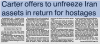
Carter offered arms for hostages. I saw him do it on live TV.

EDIT: read in the newspaper article that Carter offered to drop the embargo on trade (e.g. weapons).
 

Users who are viewing this thread

Back
Top