
optimism

Welcome to our community

Be a part of something great, join today!

Bonds are instruments of wealth. People who normally pay interest were collecting it.

So you are saying the average American joe who would normally be paid to fix widgets or manufacture widgets or grow widgets, was instead being paid to shoot Germans. The money used to pay them was taken from people who would normally spend that money on investing in the manufacturing of widgets or widget farms or widget schools.

And this was really good for the economy.

In fact, much, much, much better than if the government had simply spent that money on creating more widget schools or helping widget entrepreneurs create new businesses or infrastructure to help transport widgets or helped pay for better health care.

It just seems to me that money spent on things other than shooting Germans gets recycled into the economy over and over and over. You build the school, it educates people, those educated people build new companies, those companies hire people, etc. If you use the money to shoot Germans, well, you wind up with a lot of dead Germans.

I just don't get that. You are going to have to explain this in more detail. Try three sentences.
 
Last edited:
So you are saying the average American joe who would normally be paid to fix widgets or manufacture widgets or grow widgets, was instead being paid to shoot Germans. The money used to pay them was taken from people who would normally spend that money on investing in the manufacturing of widgets or widget farms or widget schools.

And this was really good for the economy.

In fact, much, much, much better than if the government had simply spent that money on creating more widget schools or helping widget entrepreneurs create new businesses or infrastructure to help transport widgets or helped pay for better health care.

It just seems to me that money spent on things other than shooting Germans gets recycled into the economy over and over and over. You build the school, it educates people, those educated people build new companies, those companies hire people, etc. If you use the money to shoot Germans, well, you wind up with a lot of dead Germans.

I just don't get that. You are going to have to explain this in more detail. Try three sentences.

1. Govt. needs money to fund the war.
2. Govt. issues bonds to get those funds.
3. Who buys the bonds? They're bought with the soldiers' salaries.
4. Remember, most of these guys were eating at the soup kitchens, not earning a paycheck and paying a mortgage.
5. Additionally, govt. needed Ford to make tanks and jeeps and planes, so issuing bonds took cash from potential car buyers.
6. When the War was over, the boys cash in their bonds to use as 5% down for VA loan to buy a house.

6 sentences. ;)
 
3. Who buys the bonds? They're bought with the soldiers' salaries.

Really? What gives with all the ads from that era asking joe public to buy bonds. The debt was owed to over 85 million Americans, a lot more than just people who fought in the war (16 million).

4. Remember, most of these guys were eating at the soup kitchens, not earning a paycheck and paying a mortgage.
It was a good public works project in terms of employing people. (But let's not overstate it--unemployment rates topped out around 25% during the Great Depression. Most of these guys were actually earning paychecks before they were drafted.)

5. Additionally, govt. needed Ford to make tanks and jeeps and planes, so issuing bonds took cash from potential car buyers.
Woohoo! Government takeover of major american car manufacturers! It worked then, and it seems to be working now!

6. When the War was over, the boys cash in their bonds to use as 5% down for VA loan to buy a house.
The soldiers got sweet government loans for housing and education, paid for by borrowing from the general public. Kind of like how we now borrow money to pay for all sorts of public education and housing programs that you hate.

There are actually two major differences between government spending now to get us out of recession and government spending then to get us out of depression:

1. In WWII a shit-ton of that spending went to killing Germans (and Americans). After the war, a lot also went to nice federal education and housing programs.
Now a shit-ton of that money goes to keeping old people alive and happy. A lot also goes to the military. Some of it (not nearly enough, in my book) goes to education, infrastructure and health care for everyone else.

2. In WWII nearly all that money came from the US. We borrowed it from soldiers, yes, but also bankers and grandparents and industrialists and everybody. We also taxed the wealthy through the nose.
Now the majority of our borrowing comes from overseas.

Government spending to get us out of tight financial spots clearly works. When nobody wants to write a check, Uncle Sam will, and it'll cash every time. It was true in WWII, and it's true now.

The big problem as I see it is that during our fatter years we didn't raise taxes and reduce spending, so that we'd be ok to borrow/spend more in the past few years of shitty economy. Instead, Bush and Congress dug us into a deep hole of borrowing from foreigners, and we're borrowing even more to try to pull the economy out.
 
Last edited:
except the 500k peeps who couldnt buy houses with their cashed in war bonds because they were, you know, dead.
 
Really? What gives with all the ads from that era asking joe public to buy bonds. The debt was owed to over 85 million Americans, a lot more than just people who fought in the war (16 million).

It was a good public works project in terms of employing people. (But let's not overstate it--unemployment rates topped out around 25% during the Great Depression. Most of these guys were actually earning paychecks before they were drafted.)

Woohoo! Government takeover of major american car manufacturers! It worked then, and it seems to be working now!

The soldiers got sweet government loans for housing and education, paid for by borrowing from the general public. Kind of like how we now borrow money to pay for all sorts of public education and housing programs that you hate.

There are actually two major differences between government spending now to get us out of recession and government spending then to get us out of depression:

1. In WWII a shit-ton of that spending went to killing Germans (and Americans). After the war, a lot also went to nice federal education and housing programs.
Now a shit-ton of that money goes to keeping old people alive and happy. A lot also goes to the military. Some of it (not nearly enough, in my book) goes to education, infrastructure and health care for everyone else.

2. In WWII nearly all that money came from the US. We borrowed it from soldiers, yes, but also bankers and grandparents and industrialists and everybody. We also taxed the wealthy through the nose.
Now the majority of our borrowing comes from overseas.

Government spending to get us out of tight financial spots clearly works. When nobody wants to write a check, Uncle Sam will, and it'll cash every time. It was true in WWII, and it's true now.

The big problem as I see it is that during our fatter years we didn't raise taxes and reduce spending, so that we'd be ok to borrow/spend more in the past few years of shitty economy. Instead, Bush and Congress dug us into a deep hole of borrowing from foreigners, and we're borrowing even more to try to pull the economy out.

The soldiers sent home their paychecks and it was good for the govt. to take that money out of circulation so consumers wouldn't create demand for automobiles and other things that the govt. needed to make war materiel. There was no govt. takeover of industry, it just created massive demand for products those industries could make but normally didn't.

16M soldiers means 16M jobs created. Someone (Rosie the Riveter or other previously unemployed) had to take the place of anyone who had a job and went into the armed forces.

"Some of it goes to the military" - not enough by FDR's standard, since he spent the equivalent of 2x what we take in from all forms of taxation on military alone. When he spent deficits that were 25% of the entire budget (for years), all those peace-time/peaceful type social programs didn't do SQUAT to make a thing better.

If you think the high tax rates funded the War, think again. We'd have had no deficits (but they were HUGE!) if your belief were true. Doesn't even pass the sniff test. And all forms of income tax revenue only made up 1/8th of receipts (a good argument to cut govt. by 1/8th now and eliminate everyone's income tax).

The govt. is really only good at one thing, and that's writing checks. I've posted on numerous occasions that the best govt. programs in history were the VHA and GI Bill (education vouchers, which you oppose).
 
I oppose education vouchers? I didn't know that. I thought I liked it when the government helps out on paying for education. Huh.

I didn't say high tax rates exclusively funded the war. Why do you think I did?

None of the peace time programs did squat? I've got a few damns that might disagree with you.

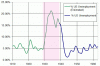
Actually, it took a few years for the programs to start to have an impact, here's unemployment in that era:
US_Unemployment_1910-1960.gif


Notice that big plummet and then spike in 1937? Here's why:
1937

* The Supreme Court declares the National Labor Relations Board to be unconstitutional.

* Roosevelt seeks to enlarge and therefore liberalize the Supreme Court. This attempt not only fails, but outrages the public.

* Economists attribute economic growth so far to heavy government spending that is somewhat deficit. Roosevelt, however, fears an unbalanced budget and cuts spending for 1937. That summer, the nation plunges into another recession. Despite this, the yearly GNP rises 5.0 percent, and unemployment falls to 14.3 percent.

1938

* Congress passes the Agricultural Adjustment Act of 1938 and the Fair Labor Standards Act. (More)

* No major New Deal legislation is passed after this date, due to Roosevelt's weakened political power.

* The year-long recession makes itself felt: the GNP falls 4.5 percent, and unemployment rises to 19.0 percent.

* Britain becomes the third nation to recover as it begins deficit spending in preparation for war.
http://www.huppi.com/kangaroo/Timeline.htm

The depression was trending down, it had a hiccup when we prematurely gave up on federal spending programs to fight it, then it continued down when a new federal spending program (WWII and the post-war programs) came along.
 

Attachments

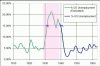
  • US_Unemployment_1910-1960.gif
    US_Unemployment_1910-1960.gif
    12.4 KB · Views: 2
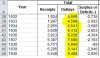
Looks like unemployment was exactly the same in 1932 and 1940. 1932 would be when FDR was elected.
Capture.jpg
 
Looks like unemployment was exactly the same in 1932 and 1940. 1932 would be when FDR was elected.
View attachment 2343

lol. Yeah, that's why it's called a "line chart" and not "two data points stuck on a piece of paper." Because trends before and after the points kind of matter.
 
And it sure looks like the dip in unemployment coincides with decreased spending.
 

Attachments

  • Capture.PNG
    Capture.PNG
    11.1 KB · Views: 4
lol. Yeah, that's why it's called a "line chart" and not "two data points stuck on a piece of paper." Because trends before and after the points kind of matter.

lol, yeah, when you start at the one data point, then spend $26B (equal to 33% of all spending) in deficits until the second point, you can be sure that the $26B had no effect. Otherwise as spending increased, unemployment would decrease, no?
 
And it sure looks like the dip in unemployment coincides with decreased spending.

You've got cause and effect mixed up there. Unemployment was falling as early as 1935. As the falling rate gathered momentum, FDR came under a lot of political pressure to cut programs by deficit hawks. In '37 and '38, the hawks got their way, causing the second spike. As the government again started writing checks to ramp up for WWII, unemployment started falling again.

Again, you cherry pick two data points. I'm talking trends.
 
You've got cause and effect mixed up there. Unemployment was falling as early as 1935. As the falling rate gathered momentum, FDR came under a lot of political pressure to cut programs by deficit hawks. In '37 and '38, the hawks got their way, causing the second spike. As the government again started writing checks to ramp up for WWII, unemployment started falling again.

Again, you cherry pick two data points. I'm talking trends.

The trend was continuously upward as FDR increased spending (from the first point marked).

Just like Obama said unemployment wouldn't exceed 8% if we spent his $800B stimulus money.

If at first you don't succeed, keep on sucking 'till you do succeed?
 
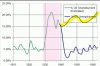
For grins, I added what I think the trend was to your graph.
 

Attachments

  • Capture.jpg
    Capture.jpg
    19.9 KB · Views: 10
1. Govt. needs money to fund the war.
2. Govt. issues bonds to get those funds.
3. Who buys the bonds? They're bought with the soldiers' salaries.

Denny, were you giggling hysterically when you wrote this? Because I certainly am reading it.


4. Remember, most of these guys were eating at the soup kitchens, not earning a paycheck and paying a mortgage.
5. Additionally, govt. needed Ford to make tanks and jeeps and planes, so issuing bonds took cash from potential car buyers.
6. When the War was over, the boys cash in their bonds to use as 5% down for VA loan to buy a house.

6 sentences. ;)

mook has already deconstructed this, so I won't bother, but the point bears repeating: everything you claim was effective in the 40s is just the sort of thing you are adamantly opposed to in the present.

barfo
 
Denny, were you giggling hysterically when you wrote this? Because I certainly am reading it.


mook has already deconstructed this, so I won't bother, but the point bears repeating: everything you claim was effective in the 40s is just the sort of thing you are adamantly opposed to in the present.

barfo

You have a fine wit, but I'm not seeing WW III and 45% of GDP spent on our military.

Want to try again?
 
You're blind as a bat.

From optimism to optometry.

No, I'm not blind. The only countries in recent memory that spend the amount on military that FDR did are North Korea, Iraq under Saddam, and the USSR before it fell. It would be quite obvious if the US were currently spending at that kind of level.
 
we would have somewhere around 150 aircraft carriers instead of 11? That's a lot o' jobs. :)
 
we would have somewhere around 150 aircraft carriers instead of 11? That's a lot o' jobs. :)

16M jobs in the military alone, or a bit over 10% of the entire population.
 
No, I'm not blind. The only countries in recent memory that spend the amount on military that FDR did are North Korea, Iraq under Saddam, and the USSR before it fell. It would be quite obvious if the US were currently spending at that kind of level.

Since most military spending is not disclosed even to the politicians who approve it, I fail to see how it would be obvious.
 
Unemployment was virtually unchanged from the start of the Depression and the start of WW II. The Nazis' Depression ended long before ours did.

So yeah.

You must be talking about a different depression, and different war.

This link dispels many other myths about the depression and what/who caused it.

http://www.huppi.com/kangaroo/Timeline.htm

1930 - The unemployment rate climbs from 3.2 to 8.7 percent.
1931 - unemployment rises to 15.9 percent.
1932 - unemployment rises to 23.6 percent.
1933 - Unemployment rises slightly, to 24.9 percent.
1934 - unemployment falls to 21.7 percent.
1935 - unemployment falls to 20.1 percent.
1936 - unemployment falls to 16.9 percent.
1937 - unemployment falls to 14.3 percent.
1938 - unemployment rises to 19.0 percent.
1939 - unemployment falls to 17.2 percent.


The main causes of the depression were simply an ultra-conservative Supreme Court which continually ruled for the rich over the common man, and enormous tax breaks for the rich. This lead to the rich becoming so powerful they actually tried to overthrow the government by financing a military coup.

1945 - The top tax rate is 91 percent. It will stay at least 88 percent until 1963, when it is lowered to 70 percent. During this time, America will experience the greatest economic boom it has ever known.

Bush Jr's administration repeated the same agenda of raping the poor to reward the rich, but Halliburton and it's personal agency The Department of Homeland Security, is a much more ingenious method of military coup. Most Americans don't even realize we've been overthrown yet.
 
The income tax was instituted 16 years before the Depression. It was unconstitutional, so they had to pass an amendment to make it legal. It was a 2% tax on only the wealthy, and it was promised that this was all it would ever be.

Another government lie.

Again, I don't see 16M in the military from a population of 132M going on here. The numbers would be closer to a 40M man military given out population is over 310M today. We spent 45% of the entire GDP back then on WW II and the huge military. We barely spend 20% of GDP on the entire federal government (at least in terms of receipts).


1931 - unemployment rises to 15.9 percent.
1939 - unemployment falls to 17.2 percent.

What is 17.2 - 15.9 ? That's how much all of the New Deal failed to improve things (made them worse). All you have to offer is excuses, in spite of the actual data which shows that the govt. spent money in unprecedented amounts and percentages of the economy.

The rich never paid big income taxes, even if the rate was 90%, because of the mortgage deduction instituted in 1913. Guys like Arthur Wirtz were filthy rich, and owned as much real estate (and mortgages) as it took to eliminate most of or all of their tax liability. Wirtz owned the Bulls, the Blackhawks, Chicago Stadium, the Merchandise Mart, and a number of other Chicago landmarks.

The reason the US saw such great economic success immediately following WW II was that the war wasn't fought on our soil. Our cities and factories weren't bombed into oblivion like the Japanese and German cities were. As those countries rebuilt their factories and manufacturing capabilities, they gradually took away our market share. We might still make Cadillacs, but they make the Lexus and BMW and Porsche and Mercedes, as well as cars that sell for the common man (Corolla, Volkswagen, etc.).
 
The income tax was instituted 16 years before the Depression. It was unconstitutional, so they had to pass an amendment to make it legal.

That's funny. Women voting was unconstitutional, so they had to pass an amendment to make that legal. Happened about the same time, too.

It was a 2% tax on only the wealthy, and it was promised that this was all it would ever be.

Another government lie.

Really? The government promised that it would only ever be 2%? Exactly how did the "government" express this promise?
If someone promises that something will last forever, are they a liar, or are you an idiot for believing them? Or do you bring your lunch?

Again, I don't see 16M in the military from a population of 132M going on here. The numbers would be closer to a 40M man military given out population is over 310M today. We spent 45% of the entire GDP back then on WW II and the huge military. We barely spend 20% of GDP on the entire federal government (at least in terms of receipts).

You are right, Denny, the stimulus package was too small. That is the point you are making, right?


1931 - unemployment rises to 15.9 percent.
1939 - unemployment falls to 17.2 percent.

What is 17.2 - 15.9 ? That's how much all of the New Deal failed to improve things (made them worse).

Nice try, but the New Deal didn't start to have effect on 1/1/32 and end on 12/31/39.

All you have to offer is excuses, in spite of the actual data which shows that the govt. spent money in unprecedented amounts and percentages of the economy.

It's called a stimulus package nowadays.

The reason the US saw such great economic success immediately following WW II was that the war wasn't fought on our soil. Our cities and factories weren't bombed into oblivion like the Japanese and German cities were. As those countries rebuilt their factories and manufacturing capabilities, they gradually took away our market share. We might still make Cadillacs, but they make the Lexus and BMW and Porsche and Mercedes, as well as cars that sell for the common man (Corolla, Volkswagen, etc.).

Ok, here you have a point. It is economically better to bomb than to be bombed. I agree.

barfo
 
Last edited:
What's funny is the idiots in government repeatedly fail to create jobs by borrowing and spending vast sums of money and no matter how much is spent and dismal the failure, they argue they should have spent more.

:lol:

Clinton got it right. He spent less money and we had good times.

Get it?
 
well, I certainly didn't have any blue-dress-stained interns...but I was spending less money then. :dunno:
 
Speaking of optimism...

http://www.nytimes.com/2011/04/22/us/22poll.html?_r=1

Nation’s Mood at Lowest Level in Two Years, Poll Shows

Americans are more pessimistic about the nation’s economic outlook and overall direction than they have been at any time since President Obama’s first two months in office, when the country was still officially ensnared in the Great Recession, according to the latest New York Times/CBS News poll.
 
Anyone who starts a sentence with "I wanna talk to you about enlarging your... " you gotta worry about.

barfo

Brah, Osteen is making money, that's the important part.

He has mad game. :pimp:
 
Clinton got it right. He spent less money and we had good times.

Get it?

To be fair - Clinton also raised the top marginal tax rate to a staggering 36% in 1993.

It's really not too complicated - more income, less expense is good for the cash flow.

We probably need to do both to get out of the current quagmire.
 
To be fair - Clinton also raised the top marginal tax rate to a staggering 36% in 1993.

It's really not too complicated - more income, less expense is good for the cash flow.

We probably need to do both to get out of the current quagmire.

Doubling everyone's income tax won't come close, though. Let's see them cut enough spending first and then raising revenue to close the gap might make sense.

I'm dubious that if they somehow doubled revenues that they would also double spending so we'd be looking at $3T deficits.
 
To be fair - Clinton also raised the top marginal tax rate to a staggering 36% in 1993.

It's really not too complicated - more income, less expense is good for the cash flow.

We probably need to do both to get out of the current quagmire.

Yup.
 

Users who are viewing this thread

Back
Top