Wikileaks Glimpse pt 2.

Welcome to our community

Be a part of something great, join today!

It doesn't work that way
to our knowledge....that's where the can of worms usually cracks open...you trust it doesn't work that way if you choose to believe the results. I don't.
 
That the emails that he sent are real. Exactly what River was suggesting they are not.
I didn't say they weren't real.....I was saying they could have been altered...so my doubt is whether you are getting untainted results.
 
I know there's corruption in govt.......my question is why does it surprise anyone? Emails, I don't trust to be set in stone....at the bottom of your last post it says....I trust Mozilla....which is a choice...now I don't know much about computer programming or codes granted....but I know a little about classified material and corruption ....to think there's nobody who can alter info because it's been checked....well we used to say that under Nixon too. Don't worry...we've already checked it and now it's ash


No it doesn't surprise me. What does surprise me is the depth and absolutely scale at which this is occurring within the Clinton Foundation and her network. I expect her and her husband to be in jail soon.
 
Yeah, I was wrong. But it is still spoofable.

Not that I personally believe the emails are faked - from what I've seen they seem real enough.

barfo

From the security blog, when someone said the same thing:

"Actually, DKIM does a one way hash of the entire contents, so any changes in the content would cause a invalid test.So, regardless of your political beliefs, this would not work. DKIM signs the email by encrypting the one way hash of the content. So this is wrong."
 
Weaknesses in the WikiLeaks system....of course, this is just Wikipedia info
Weaknesses[edit]
The RFC itself identifies a number of potential attack vectors.[29]

DKIM signatures do not encompass the message envelope, which holds the return-path and message recipients. Since DKIM does not attempt to protect against mis-addressing, this does not affect its utility. A concern for any cryptographic solution would be message replay abuse, which bypasses techniques that currently limit the level of abuse from larger domains [clarification needed]. Replay can be inferred by using per-message public keys, tracking the DNS queries for those keys and filtering out the high number of queries due to e-mail being sent to large mailing lists or malicious queries by bad actors. For a comparison of different methods also addressing this problem see e-mail authentication.

Arbitrary forwarding[edit]
As mentioned above, authentication is not the same as abuse prevention. An evil email user of a reputable domain can compose a bad message and have it DKIM-signed and sent from that domain to any mailbox from where they can retrieve it as a file, so as to obtain a signed copy of the message. Use of the l tag in signatures makes doctoring such messages even easier. The signed copy can then be forwarded to a million recipients, for example through a botnet, without control. The email provider who signed the message can block the offending user, but cannot stop the diffusion of already-signed messages. The validity of signatures in such messages can be limited by always including an expiration time tag in signatures, or by revoking a public key periodically or upon a notification of an incident. Effectiveness of the scenario can hardly be limited by filtering outgoing mail, as that implies the ability to detect if a message might potentially be useful to spammers.[30]

Content modification[edit]
DKIM currently features two canonicalization algorithms, simple and relaxed, neither of which is MIME-aware.[31] Mail servers can legitimately convert to a different character set, and often document this with X-MIME-Autoconverted header fields. In addition, servers in certain circumstances have to rewrite the MIME structure, thereby altering the preamble, the epilogue, and entity boundaries, any of which breaks DKIM signatures. Only plain text messages written in us-ascii, provided that MIME header fields are not signed,[32] enjoy the robustness that end-to-end integrity requires.

The OpenDKIM Project organized a data collection involving 21 mail servers and millions of messages. 92.3% of observed signatures were successfully verified, a success rate that drops slightly (90.5%) when only mailing list traffic is considered.[33]

Annotations by mailing lists[edit]
The problems might be exacerbated when filtering or relaying software makes changes to a message. Without specific precaution implemented by the sender, the footer addition operated by most mailing lists and many central antivirus solutions will break the DKIM signature. A possible mitigation is to sign only designated number of bytes of the message body. It is indicated by l tag in DKIM-Signature header. Anything added beyond the specified length of the message body is not taken into account while calculating DKIM signature. This won't work for MIME messages.[34]

Another workaround is to whitelist known forwarders, e.g. by SPF. For yet another workaround, it was proposed that forwarders verify the signature, modify the email, and then re-sign the message with a Sender: header.[35] However, it should be noted that this solution has its risk with forwarded 3rd party signed messages received at SMTP receivers supporting the RFC 5617 ADSP protocol. Thus, in practice, the receiving server still has to whitelist known message streams.

Short key vulnerability[edit]
In October 2012, Wired reported that mathematician Zach Harris detected and demonstrated an email source spoofing vulnerability with short DKIM keys for the google.com corporate domain, as well as several other high-profile domains. He stated that authentication with 384-bit keys can be factored in as little as 24 hours "on my laptop," and 512-bit keys, in about 72 hours with cloud computing resources. Harris found that many organizations sign email with such short keys; he factored them all and notified the organizations of the vulnerability. He states that 768-bit keys could be factored with access to very large amounts of computing power, so he suggests that DKIM signing should use key lengths greater than 1,024. Wired stated that Harris reported, and Google confirmed, that they began using new longer keys soon after his disclosure. According to RFC 6376 the receiving party must be able to validate signatures with keys ranging from 512 bits to 2048 bits, thus usage of keys shorter than 512 bits might be incompatible and shall be avoided. The RFC 6376 also states that signers must use keys of at least 1024 bits for long-lived keys, though long-livingness is not specified there.[36]
 
Weaknesses in the WikiLeaks system....of course, this is just Wikipedia info
Weaknesses[edit]
The RFC itself identifies a number of potential attack vectors.[29]

DKIM signatures do not encompass the message envelope, which holds the return-path and message recipients. Since DKIM does not attempt to protect against mis-addressing, this does not affect its utility. A concern for any cryptographic solution would be message replay abuse, which bypasses techniques that currently limit the level of abuse from larger domains [clarification needed]. Replay can be inferred by using per-message public keys, tracking the DNS queries for those keys and filtering out the high number of queries due to e-mail being sent to large mailing lists or malicious queries by bad actors. For a comparison of different methods also addressing this problem see e-mail authentication.

Arbitrary forwarding[edit]
As mentioned above, authentication is not the same as abuse prevention. An evil email user of a reputable domain can compose a bad message and have it DKIM-signed and sent from that domain to any mailbox from where they can retrieve it as a file, so as to obtain a signed copy of the message. Use of the l tag in signatures makes doctoring such messages even easier. The signed copy can then be forwarded to a million recipients, for example through a botnet, without control. The email provider who signed the message can block the offending user, but cannot stop the diffusion of already-signed messages. The validity of signatures in such messages can be limited by always including an expiration time tag in signatures, or by revoking a public key periodically or upon a notification of an incident. Effectiveness of the scenario can hardly be limited by filtering outgoing mail, as that implies the ability to detect if a message might potentially be useful to spammers.[30]

Content modification[edit]
DKIM currently features two canonicalization algorithms, simple and relaxed, neither of which is MIME-aware.[31] Mail servers can legitimately convert to a different character set, and often document this with X-MIME-Autoconverted header fields. In addition, servers in certain circumstances have to rewrite the MIME structure, thereby altering the preamble, the epilogue, and entity boundaries, any of which breaks DKIM signatures. Only plain text messages written in us-ascii, provided that MIME header fields are not signed,[32] enjoy the robustness that end-to-end integrity requires.

The OpenDKIM Project organized a data collection involving 21 mail servers and millions of messages. 92.3% of observed signatures were successfully verified, a success rate that drops slightly (90.5%) when only mailing list traffic is considered.[33]

Annotations by mailing lists[edit]
The problems might be exacerbated when filtering or relaying software makes changes to a message. Without specific precaution implemented by the sender, the footer addition operated by most mailing lists and many central antivirus solutions will break the DKIM signature. A possible mitigation is to sign only designated number of bytes of the message body. It is indicated by l tag in DKIM-Signature header. Anything added beyond the specified length of the message body is not taken into account while calculating DKIM signature. This won't work for MIME messages.[34]

Another workaround is to whitelist known forwarders, e.g. by SPF. For yet another workaround, it was proposed that forwarders verify the signature, modify the email, and then re-sign the message with a Sender: header.[35] However, it should be noted that this solution has its risk with forwarded 3rd party signed messages received at SMTP receivers supporting the RFC 5617 ADSP protocol. Thus, in practice, the receiving server still has to whitelist known message streams.

Short key vulnerability[edit]
In October 2012, Wired reported that mathematician Zach Harris detected and demonstrated an email source spoofing vulnerability with short DKIM keys for the google.com corporate domain, as well as several other high-profile domains. He stated that authentication with 384-bit keys can be factored in as little as 24 hours "on my laptop," and 512-bit keys, in about 72 hours with cloud computing resources. Harris found that many organizations sign email with such short keys; he factored them all and notified the organizations of the vulnerability. He states that 768-bit keys could be factored with access to very large amounts of computing power, so he suggests that DKIM signing should use key lengths greater than 1,024. Wired stated that Harris reported, and Google confirmed, that they began using new longer keys soon after his disclosure. According to RFC 6376 the receiving party must be able to validate signatures with keys ranging from 512 bits to 2048 bits, thus usage of keys shorter than 512 bits might be incompatible and shall be avoided. The RFC 6376 also states that signers must use keys of at least 1024 bits for long-lived keys, though long-livingness is not specified there.[36]


River the DKIM keys on the Clinton email server were 1024 bit.

Not sure what you're trying to show here.
Mis-addressing is not in question.
Content modification would break DKIM signatures, they are not broken.

Also, this isnt a wikileaks system, this is in majority if not all mail servers.
 
River the DKIM keys on the Clinton email server were 1024 bit.

Not sure what you're trying to show here.
Mis-addressing is not in question.
Content modification would break DKIM signatures, they are not broken.
I'm not defending Hillary by a long shot but I looked up DKIM to see what they said and apparently....it has flaws....apparently email formats can also be changed but in this cyber world...my logic says there are humans who can alter things so they are not quite as trustworthy as they've appeared to be....WikiLeaks I learned is also a system with connections to several major web browsers...yahoo, etc...now call me naïve but I'd think there's probably a code to break their system without detection. I'm sure the vast majority of content they display is legit.....I'm also sure that they probably veil some things to make them look transparent. I don't want the internet governing my country or influencing our elections....the sad thing is that candidates can run for office without these things disqualifying them to start with. We need to raise the bar for anyone who runs for president obviously. Trump's past is about as sleazy as you could get.
 
I'm not defending Hillary by a long shot but I looked up DKIM to see what they said and apparently....it has flaws....apparently email formats can also be changed but in this cyber world...my logic says there are humans who can alter things so they are not quite as trustworthy as they've appeared to be....WikiLeaks I learned is also a system with connections to several major web browsers...yahoo, etc...now call me naïve but I'd think there's probably a code to break their system without detection. I'm sure the vast majority of content they display is legit.....I'm also sure that they probably veil some things to make them look transparent. I don't want the internet governing my country or influencing our elections....the sad thing is that candidates can run for office without these things disqualifying them to start with. We need to raise the bar for anyone who runs for president obviously. Trump's past is about as sleazy as you could get.

OK understood, but I believe that most of the DKIM flaws are with lesser secure keys; below 1024bit. Much like with SSL Certificates.

I wouldn't say the internet is governing your country. I believe them when they said that they received the Clinton information from inside the US Government. These are people that are not corrupt trying to whistleblow on this corruption.

I am cool with getting 2 new candidates; that's fine, but we really need to open other people's eyes on the corruption, collusion, and criminal activity that is the Clinton Foundation and Campaign.,
 
I believe everything that is on the internet.

Especially if it supports a preconceived belief.

Well.... probably not a very wise decision on your part.

But when it comes to Wikileaks, find me something they have faked....
 
Well.... probably not a very wise decision on your part.

But when it comes to Wikileaks, find me something they have faked....
That would be unfair in my case....I only have a few computer skills but I can find articles that support anything on google
 
Tell me what this means. It appears from what's here that someone who donated $1M to the foundation is getting meetings set up at the Clinton Global Initiative, which doesn't seems like a problem of any sort. What evil am I missing?

barfo
 
Here's another wikileaked email from the witch. I have to assume she wants to put the 10 year old in her oven.

Sent: Friday, August 28, 2009 4:39 PM

To: Verveer, Melanne S

Subject: Noori All

Do you recall Noori Ali(?), the ten year old Yemeni girl who got herself divorced? I met her at the Glamour awards last year. There was a CNN story last few days about how unhappy she is, still living at home, not attending school and quite angry that her life is not better. Is there any way we can help her? Could we get her to the US for counselling and education?

barfo
 
Here's another wikileaked email from the witch. I have to assume she wants to put the 10 year old in her oven.

Sent: Friday, August 28, 2009 4:39 PM
To: Verveer, Melanne S
Subject: Noori All

Do you recall Noori Ali(?), the ten year old Yemeni girl who got herself divorced? I met her at the Glamour awards last year. There was a CNN story last few days about how unhappy she is, still living at home, not attending school and quite angry that her life is not better. Is there any way we can help her? Could we get her a position as an intern for Bill?

barfo

Corrected your mail to what it really said.
 
I thought the argument was that there isn't anything really bad in these emails. Now we're discussing if they are real? Hmmm
 
The criminal isn't denying the emails are authentic.

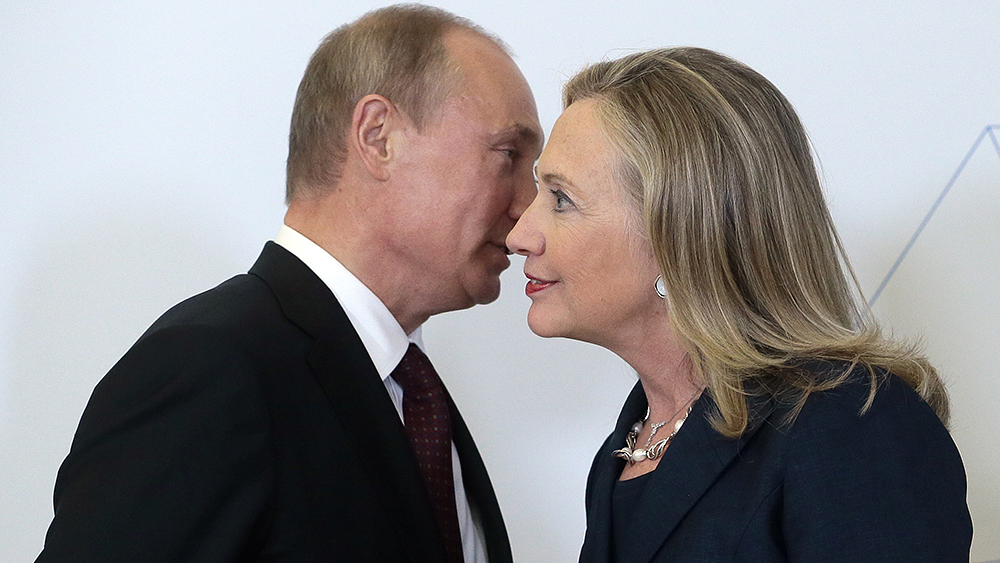
Instead, she's burning bridges with the Russians. "Diplomatic Failure."
 
The criminal isn't denying the emails are authentic.

Instead, she's burning bridges with the Russians. "Diplomatic Failure."
Putin just made Steven Seagal a citizen...they're buddies...I'd burn a Russian bridge just over that!
 
EDIT2-hillary-080116-AP.jpg


http://www.investors.com/politics/e...ndal-russia-and-her-reset-pal-vladimir-putin/

New revelations from Peter Schweizer, the author of the meticulously documented book "Clinton Cash," and Stephen K. Bannon, executive chairman of Breitbart, show that Hillary's campaign Chairman John Podesta "sat on the board of a small energy company alongside Russian officials that received $35 million from a Putin-connected Russian government fund."

Making things worse, Podesta never fully disclosed the relationship, as the law requires. But of greater concern than Podesta is what it says about Clinton's strange and mutually beneficial relationship with Russia that led to Clinton lending a hand in helping Vladimir Putin build Skolkovo, a high-tech community meant to be "the Russian equivalent of America's Silicon Valley."

This is not some sort of free-enterprise experiment. As the authors detail in a study published by the Government Accountability Institute, some 30,000 workers toiled in the state-of-the-art tech hub "under strict governmental control." While Clinton was in charge at the State Department, the U.S. recruited a bunch of U.S. high-tech powerhouses -- including Google, Cisco and Intel -- to take part in the project. Of the 28 companies from the U.S., Europe and Russia that took part, 17 were donors to the Clinton Foundation or paid for Bill Clinton to give speeches.
 
So to summarize, sometimes when we meet with Russians we smile, sometimes we frown.

You should consider publishing these findings, Denny.

barfo
 
So to summarize, sometimes when we meet with Russians we smile, sometimes we frown.

You should consider publishing these findings, Denny.

barfo

 
So to summarize, sometimes when we meet with Russians we smile, sometimes we frown.

You should consider publishing these findings, Denny.

barfo

More like reset button, failed diplomacy. I'm not seeing a huge benefit to having Russia as an enemy. Unless you're a warmonger.
 

Users who are viewing this thread

Back
Top