"The Debate"

Welcome to our community

Be a part of something great, join today!

545773_531594270188568_1479759273_n.jpg

Doesn't it seem like Sesame Street should MAKE money (and pay taxes to the government) rather than TAKE money in the form of government subsidies?

If the feds were helping fund Disneyland, I don't think that people would be upset if Mickey Mouse were expected to stand on his own two feet.

Ed O.
 
From the military perspective, it's not that way at all. From the Chairman of the Joint Chiefs to me to the sailors in my unit, the vast majority of military members understand that to get the budget reined in, it requires military spending to be cut as well.

The "unpatriotic" part (if you want to say it) is when people toss out a number willy-nilly ("Super-Committee can't decide, so get rid of XTrillion from somewhere!!11!") without looking at requirements, missions, or strategic plans.

To be fair, they talked a lot about being able to fight wars in two theaters at the same time. Then they went out and started wars in two theaters.

How about we scale back our requirements, missions, and strategic plans?
 
Sorry, but that just isn't a reasonable way to determine whether a certain spend is necessary.

You don't make a decision whether or not to spend on a particular project based on how much a completely different, unrelated project costs. Also, it doesn't matter what percentage of the total PBS budget comes from the government. We either are spending $450 MILLION or we're not.

It is a strawman to argue that only PBS or planned parenthood are being picked on. It was an example, not an entire plan.

I think Mitt put it as plain as it can be stated. He would take a look at each item and make a decision for or aginst based upon the criteria of "Is this worth barrowing monies from China to further fund?"

He even stated that he liked the mod, BigBird etc, etc.

When I saw Mitt say that, at first I believed that he had made a big mistake, to expose on national TV his willingness to take an ax to the alter of the left, but upon reflection, I feel that it took balls to make a stand. Further, if the harshest criticism that can be said about him last night was this, well, that alone is a victory.
 
Doesn't it seem like Sesame Street should MAKE money (and pay taxes to the government) rather than TAKE money in the form of government subsidies?

If the feds were helping fund Disneyland, I don't think that people would be upset if Mickey Mouse were expected to stand on his own two feet.

Ed O.

I don't know what kind of restrictions goes into getting gov't money, but if the gov't can help provide youth programing without all the advertisment for fast food or toys, I think that is good for society.

The disney channel is a bunch of commericials for disney products or kids products that are not healthy. On top of that , they seem to have little censor on the shows they run. They are more concerned about getting kids to watch than they are about what the kids are actually watching, IMO.

I would hate to see PBS die if fed funding stopped. But i suppose PBS can probably just sell out to advertisers and shows that draw ratings. If it happens, I would hope they would still put quality shows as a hgh priority though.
 
Last edited:
I'm curious... What specifics (other than the tax deduction limit) made you feel better about Romney winning?

I just thought he came across as more of a real human being than he has in the Republican debates/on the stump. He seemed less like an artificially concocted right wing product and more like a guy who was speaking from conviction. (I was listening on the radio, so I didn't see body language.) For much of the debate he just seemed more like a rational moderate New England Republican. He was even arguing for banking regulation at one point. But it wasn't so much policy as it was demeanor.

I think the specter of him losing badly has opened up an opportunity to portray himself more as a centrist without getting crucified by the right. Given his penchant for being all over the map on policy, the center is probably the most natural for him.

It gives me hope that if he were to win, he could effect real policy change that could gain bipartisan support. For example, if Romney had somehow won the 2008 election, I think he probably could've pushed through a very similar bill to the ACA, but one with bipartisan support. The ACA is essentially a Republican idea that they had to turn against because Obama was for it. Democrats might similarly turn against Romney were he to win, but the Democratic penchant for actually wanting to legislate stuff makes me think they wouldn't be nearly so unified in opposition as Republicans have been.
 
I don't know what kind of restrictions goes into getting gov't money, but if the gov't can help provide youth programing without all the advertisment for fast food or toys, I think that is good for society.

The disney channel is a bunch of commericials for disney products or kids products that are not healthy. On top of that , they seem to have little censor on the shows they run. They are more concerned about getting kids to watch than they are about what the kids are actually watching, IMO.

I would hate to see PBS die if fed funding stopped. But i suppose PBS can probably just sell out to advertisers and shows that draw ratings. If it happens, I would hope they would still put quality shows as a hgh priority though.

PBS is 85% sponsored by viewers like you. Pony up and they won't need to sell out to any corporate interests.
 
PBS is 85% sponsored by viewers like you. Pony up and they won't need to sell out to any corporate interests.

OK boss. I'm sure if feds cut their funding, all I need to do us pony up and they won't need to sell out to corporate interest.

Sounds like solid plan!
 
OK boss. I'm sure if feds cut their funding, all I need to do us pony up and they won't need to sell out to corporate interest.

Sounds like solid plan!

Heh.

I'm just pointing out that they get the vast majority of their funding NOT from the govt. and they aren't selling out to corporate interests. I don't think they need govt. money because they have a service and model that people support.

I also find it questionable to have the govt. even in some perceived position to influence the media like this (ownership, pay its bills).
 
I just thought he came across as more of a real human being than he has in the Republican debates/on the stump. He seemed less like an artificially concocted right wing product and more like a guy who was speaking from conviction. (I was listening on the radio, so I didn't see body language.) For much of the debate he just seemed more like a rational moderate New England Republican. He was even arguing for banking regulation at one point. But it wasn't so much policy as it was demeanor.

I think the specter of him losing badly has opened up an opportunity to portray himself more as a centrist without getting crucified by the right. Given his penchant for being all over the map on policy, the center is probably the most natural for him.

It gives me hope that if he were to win, he could effect real policy change that could gain bipartisan support. For example, if Romney had somehow won the 2008 election, I think he probably could've pushed through a very similar bill to the ACA, but one with bipartisan support. The ACA is essentially a Republican idea that they had to turn against because Obama was for it. Democrats might similarly turn against Romney were he to win, but the Democratic penchant for actually wanting to legislate stuff makes me think they wouldn't be nearly so unified in opposition as Republicans have been.

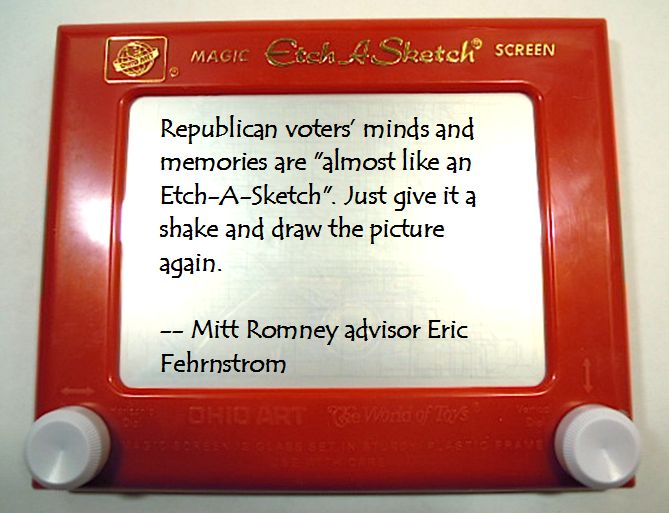
Etch-a-sketch-romney.jpg
 
^^^ Interesting. I just looked up the etch-a-sketch comment and I don't see any reference to "republican voters' minds and memories" in the quote. Nor does it say "just give it a shake and draw the picture again."

What was said was, "the general election is almost like an etch-a-sketch. We kind of shake it and start all over again.”

Do you see even a subtle difference?
 
I also find it questionable to have the govt. even in some perceived position to influence the media like this (ownership, pay its bills).

When I read that statement, it makes sense and I want to agree with that. Then I think of practicable application and I look at PBS. Label it anyway you want, I'm convinced PBS (whatever their influence) is a great channel option for American people. If the channel is lost or has to sell out to corporations, it would be a shame and bad thing for our society (on a small scale, this isn't national security stuff)
 
OK boss. I'm sure if feds cut their funding, all I need to do us pony up and they won't need to sell out to corporate interest.

Sounds like solid plan!

I'm just doing some quick math based on the facts posted in the thread.

PBS is supported 85% by viewers. PBS gets $456M from the gov't. From that math, PBS costs $3.04B a year to run. That seems awfully high, but does anyone have comparative numbers for, say, the WB or something?
 
The fact they can be jerked around by having their funding threatened is bad for PBS.
 
I'm just doing some quick math based on the facts posted in the thread.

PBS is supported 85% by viewers. PBS gets $456M from the gov't. From that math, PBS costs $3.04B a year to run. That seems awfully high, but does anyone have comparative numbers for, say, the WB or something?

The $3B figure is what I see it costing PBS to run. Most of it is directed to the local stations, FWIW.
 
Like it would somehow kill the integrity of PBS to run a commercial or two before and after each show so the taxpayers wouldn' have to foot the bill?
 
Do you see even a subtle difference?

C'mon, Denny! They put the actual QUOTE in the quotation marks. That you thought the entire passage was a quote is your basic lack of grammar skills.

;)

Ed O.
 
With the standard that they have set, their model of public funding, one would have to believe that they would be fine. One point to take into consideration is, when PBS really took off, it was in the early 70s, when the average TV set picked up, what? three or four channels? Is there really anything that they do better than anyone else? For the most part, I dont think I am being unfair to say that they are left to extreme left, and have always found it ironic that the very people in office that continued support, were getting bashed on air.
 
I'm just doing some quick math based on the facts posted in the thread.

PBS is supported 85% by viewers. PBS gets $456M from the gov't. From that math, PBS costs $3.04B a year to run. That seems awfully high, but does anyone have comparative numbers for, say, the WB or something?
I'd say the WB costs about 20 bucks to run, judging by the quality of their content.
 
Regarding PBS, I have a "if it ain't broke, don't fix it" attitude.

I'd really rather focus on those than areas where people are generally very dissatisfied with the quality of service delivered by our government.

I have two friends who are doctors at the local VA. When I'd made sneering remarks about cadavers laying around in the VA hallways, one of them pointed me toward this article, which was a fascinating example of what can happen in government reform if people ditch the "big government/small government" argument and focus on improving service.

Yet here's a curious fact that few conservatives or liberals know. Who do you think receives higher-quality health care. Medicare patients who are free to pick their own doctors and specialists? Or aging veterans stuck in those presumably filthy VA hospitals with their antiquated equipment, uncaring administrators, and incompetent staff? An answer came in 2003, when the prestigious New England Journal of Medicine published a study that compared veterans health facilities on 11 measures of quality with fee-for-service Medicare. On all 11 measures, the quality of care in veterans facilities proved to be "significantly better."

Here's another curious fact. The Annals of Internal Medicine recently published a study that compared veterans health facilities with commercial managed-care systems in their treatment of diabetes patients. In seven out of seven measures of quality, the VA provided better care.

It gets stranger. Pushed by large employers who are eager to know what they are buying when they purchase health care for their employees, an outfit called the National Committee for Quality Assurance today ranks health-care plans on 17 different performance measures. These include how well the plans manage high blood pressure or how precisely they adhere to standard protocols of evidence-based medicine such as prescribing beta blockers for patients recovering from a heart attack. Winning NCQA's seal of approval is the gold standard in the health-care industry. And who do you suppose this year's winner is: Johns Hopkins? Mayo Clinic? Massachusetts General? Nope. In every single category, the VHA system outperforms the highest rated non-VHA hospitals.

Not convinced? Consider what vets themselves think. Sure, it's not hard to find vets who complain about difficulties in establishing eligibility. Many are outraged that the Bush administration has decided to deny previously promised health-care benefits to veterans who don't have service-related illnesses or who can't meet a strict means test. Yet these grievances are about access to the system, not about the quality of care received by those who get in. Veterans groups tenaciously defend the VHA and applaud its turnaround. "The quality of care is outstanding," says Peter Gayton, deputy director for veterans affairs and rehabilitation at the American Legion. In the latest independent survey, 81 percent of VHA hospital patients express satisfaction with the care they receive, compared to 77 percent of Medicare and Medicaid patients.

Outside experts agree that the VHA has become an industry leader in its safety and quality measures. Dr. Donald M. Berwick, president of the Institute for Health Care Improvement and one of the nation's top health-care quality experts, praises the VHA's information technology as "spectacular." The venerable Institute of Medicine notes that the VHA's "integrated health information system, including its framework for using performance measures to improve quality, is considered one of the best in the nation."


It's really a great read, and an inspiring article about how we can think differently about government.
 
Dennis Miller had a couple of tweets that got me rolling...

@DennisDMZ Obama better hope a Kicked Ass is covered under Obamacare.

‏@DennisDMZ Obama is being owned, refinanced and owned again!

‏@DennisDMZ Obama is now looking for Ferdie Pacheco. "He's a bleeder...He's a bleeder!"
 
If Dennis Miller "has you rolling"... Well, I don't know what to say, really. Was that guy ever funny? He's just kind of... slimy.
 
This PBS issue has gone from a throw away idea to an intersting issue for me.

Would you rather have programing like disney channel and cartoon network that are in no way funded by the gov't and thus our tax dollars. Or would you rather have programing like PBS, but have to pay for it?

Part of me says let each person/family decide if they want a PBS station and have them pay for it. But then I think of families struggling and think PBS should be an option for all and not just for those who can afford it.

I'm torn on it, but it sort of brings into picture if you want gov't to have more control over society. When that question is asked, it seems to be termed in a negative way. But gov't does a lot of good things for us and often the money they spend is worth it in my opinion . . . like PBS.
 
I grew up in England. As you probably know, they have the BBC that is funded by a "license fee" - that is, if you own a TV or radio you have to pay a certain amount that goes to the BBC. And NOT to any independent channels. But the independent channels exist, and make money. However, programming on the BBC is MUCH BETTER. Better educational stuff (BBC2 used to run programs for the "Open University" which was what it sounds like) better drama (Doctor Who, lots of the Masterpiece Theatre stuff) better news, basically just better. Precisely BECAUSE they didn't have to pander to advertisers. Like Monty Python? That's the BBC. Trust me, the comedy on the commercial channels was scrape-the-bottom-of-the-barrell shit.

Of course, the commercial channels scream bloody murder about unfair competition, but they churn out the reality TV crap that enough people like to watch that they make money, but we also get actual quality stuff that is worth watching. With no ads. So the great British Public continues to endorse the BBC and governments that don't like it have to suck it.

I watch PBS now and it's ALREADY mostly ads. Only they're "special" ads - "this program was brought to you commercial-free by Chuck-E-Cheese". It's bad enough as it is. Leave it the fuck alone. "The marketplace" does not produce the best product. It produces shit that a lot of people will watch because they don't know better. (Yeah, yeah, HBO. But let them try to fund a news organization on the size of the BBC.)
 
You really notice it in the news. American commercial news is utter shit. All of it. (This can't all be blamed on commercialism, I suppose, as Channel 4 news in England is pretty damn awesome. But PBS News is the best, just because it tries to cover non-trivial stuff and doesn't pander.)
 
This PBS issue has gone from a throw away idea to an intersting issue for me.

Would you rather have programing like disney channel and cartoon network that are in no way funded by the gov't and thus our tax dollars. Or would you rather have programing like PBS, but have to pay for it?

Part of me says let each person/family decide if they want a PBS station and have them pay for it. But then I think of families struggling and think PBS should be an option for all and not just for those who can afford it.

I'm torn on it, but it sort of brings into picture if you want gov't to have more control over society. When that question is asked, it seems to be termed in a negative way. But gov't does a lot of good things for us and often the money they spend is worth it in my opinion . . . like PBS.

Nice post, I enjoy the thought process you are employing.

I dont think government funding is or would have anything to do wether or not PBS survives. BUT..

How about put it on cable? yeah, nice idea ToB, nice.

First thought was for those poor people, to provide a quality programing optin, then I realized that no matter what neighbourhood you cruise through, most the kids have cell phones that can get online..is a relic from the 70s going to compete whatsoever?

I do respect your opinion that PBS is worth funding. Some sacred cows will have to go, everyone has their own pet project, wy not start here. Let Turner fund the % that the Gov does at this point.
 
I really don't get the idea that the government shouldn't take money and spend it on good stuff that people wouldn't be able to provide on their own. Denny: you must be opposed to public education, right? And all our roads should be toll roads, presumably? I mean libertarians used to concede that the army had to be paid for by the government, but with Blackwater (or whatever the fuck they changed their name to) even that's being privatized. I pledge allegiance to the state of Walmart.
 
Some sacred cows will have to go,

Like subsidies to farmers and oil companies?

everyone has their own pet project, wy not start here.

Or alternatively, why? Just exactly how large of a % of the federal budget do you think goes to the Corporation for Public Broadcasting? Seriously, without looking it up, tell me.
 
Like subsidies to farmers and oil companies?


Or alternatively, why? Just exactly how large of a % of the federal budget do you think goes to the Corporation for Public Broadcasting? Seriously, without looking it up, tell me.

Its already posted in this thread, so..

point is to have private business pick up the tab, like I said, say Turner or who ever wants to pick up a proven product.

Off subject, no I am not in favor of farm or any subsidies that have been in place too long. To pay a farmer to not grow a crop...well that was a great idea in the thirties, to show an aid farmers to halt the spread of the dust bowl (soil erosion). But that has outlived its purpose.. Why are we paying dairy farmers monies? am for looking at all these pork barrel bull shit programs.
 
Like subsidies to farmers and oil companies?

Sure.

Or alternatively, why?

Because a lot of Americans don't care for the work that it does, and because there are dozens of other channels that exist without federal subsidies, and because there's a very good chance that the effort could go on and make up for the gap in funding either by tightening its belt or by raising additional money.

Ed O.
 

Users who are viewing this thread

Back
Top