PCmor7
Generational Poster
- Joined
- Apr 29, 2014
- Messages
- 8,709
- Likes
- 13,015
- Points
- 113
Were you trying to type "covfefe"?Actually she didn't.
She also refrefe


Follow along with the video below to see how to install our site as a web app on your home screen.
Note: This feature may not be available in some browsers.
Were you trying to type "covfefe"?Actually she didn't.
She also refrefe


And?Isn't this Maduro dude a bad guy? Drug cartel leader? Wouldn't allow anyone to run against him in the elections? etc etc.
Yes please. That'd be great.Trump is a pretty bad guy.
Should Venezuela come and take him into their custody?

Referenced. Don't know what happened.Were you trying to type "covfefe"?
Suuuuure you don't. Suuuuuuure you don't.Referenced. Don't know what happened.

Isn't this Maduro dude a bad guy? Drug cartel leader? Wouldn't allow anyone to run against him in the elections? etc etc.

Isn't this Maduro dude a bad guy? Drug cartel leader? Wouldn't allow anyone to run against him in the elections? etc etc.

Some bad people will not be taken by the 51st infantry.Yes. You still have to have congressional approval for such a military operation. Trump just bombing and going in and snatching the dude sets a bad bad precedent.
For one, Trump, if this goes without consequence...if congress doesn't pass the vote to stop him from further such actions without approval, he will arrogantly believe (he already does) that he can go into anywhere else and do the same whether it be Columbia, Cuba, Greenland, etc.
Also, it helps Putin justify attacking Ukraine. China may be emboldened to attack Taiwan. Etc. Decades of international policy has just been thrown out the window (err...it fell out the window.)

Almost like that is the intention...The worst part of this is that it empowers China to invade Taiwan or any other nation to bully a neighbor and steal their stuff. Not a good precedent set by the wanna be king as well as make Russia look like they were justified doing the same thing Trump did. China and Russia are having a field day at the emergency meeting of the UN today.


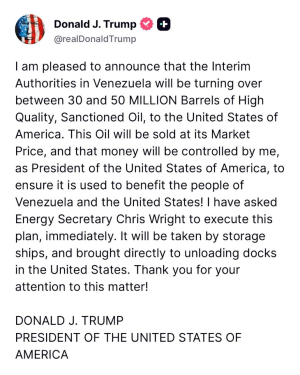
Hopefully we send that oil elsewhere. In 1978 we took a lot of South American (mostly Venezuelan) oil because OPEC was jerking us around. The Venezuelan oil was pure shit. Poorly refined (because its begins as "sludge" oil) with a very high sulfur content. But it was cheap(er). The industries that used it were VERY unhappy. I was responsible for the boilers at the old Clackamas High School back then and we got a load. Burned like crap, causing rolling smoke through the surrounding neighborhoods (resulting in a plethora of complaints). I could not keep those boilers adjusted for more than 5-10 minutes. My family is in the heating business and sold heating oil at that time. My dad and uncle refused to accept the South American oil because of the poor quality, and lost some customers because of it. But they soon came running back after going elsewhere to companies that did accept the Venezuelan oil. Customers with oil heat in the PDX were very unhappy campers and the major oil companies got wise very quickly and started turning their backs on South American oil. Getting Venezuelan oil at gunpoint (or any point) is NOT a "win". Venezuelan refineries need a great deal of upgrades (which American taxpayers, NOT the oil companies are gonna pay for) and any oil we get from them for the foreseeable future will be of questionable quality. But then, the Dumb Shit In Chief knows the average citizen has no real clue anyway. All his base cares about is that 'Murrica is swinging a big dick and we're win, win, winning...........

Thanks for this. I was vaguely familiar with the reputation of Venezuelan crude, as it was compared unfavorably to what Canada had to offer when Keystone XL was on the table.Hopefully we send that oil elsewhere. In 1978 we took a lot of South American (mostly Venezuelan) oil because OPEC was jerking us around. The Venezuelan oil was pure shit. Poorly refined (because its begins as "sludge" oil) with a very high sulfur content. But it was cheap(er). The industries that used it were VERY unhappy. I was responsible for the boilers at the old Clackamas High School back then and we got a load. Burned like crap, causing rolling smoke through the surrounding neighborhoods (resulting in a plethora of complaints). I could not keep those boilers adjusted for more than 5-10 minutes. My family is in the heating business and sold heating oil at that time. My dad and uncle refused to accept the South American oil because of the poor quality, and lost some customers because of it. But they soon came running back after going elsewhere to companies that did accept the Venezuelan oil. Customers with oil heat in the PDX were very unhappy campers and the major oil companies got wise very quickly and started turning their backs on South American oil. Getting Venezuelan oil at gunpoint (or any point) is NOT a "win". Venezuelan refineries need a great deal of upgrades (which American taxpayers, NOT the oil companies are gonna pay for) and any oil we get from them for the foreseeable future will be of questionable quality. But then, the Dumb Shit In Chief knows the average citizen has no real clue anyway. All his base cares about is that 'Murrica is swinging a big dick and we're win, win, winning...........
(This is a facebook post, . I normally don't post those as fact or credible but I did find a supporting article.)
Okay - y’all basically bullied me into researching the CITGO deal - so here’s what I found.
You know how some people flip houses? Paul Singer flips countries.
I’m not being hyperbolic. This man’s whole thing - his entire career - is finding nations in financial ruin, buying their debt for basically nothing, and then hounding them through every court on earth until they pay him back at full price plus interest. He did it to Peru. He did it to the Republic of Congo. He’s currently doing it to Venezuela. But Argentina is the one that made him famous.
Like in 2001 when Argentina’s economy imploded. People were rioting. The government defaulted on $100 billion in debt. Most creditors looked at this disaster and thought okay, we’ll take thirty cents on the dollar and cut our losses. Not Paul Singer. He looked at Argentina’s smoldering economy and saw a decade-long payday. His fund bought up bonds for $117 million and then just… waited. And sued. And waited some more. And sued in different countries.
At one point - and I cannot stress enough that this actually happened - Singer’s lawyers convinced a court in Ghana to seize an Argentine naval ship that had docked there. The ship. With the crew still on it. Argentina’s president went on television and said this man can have our boat but he will never have our dignity. The crew was stuck there for weeks while everyone screamed at each other.
Fifteen years later, Argentina elected a new president who wanted to rejoin international markets. Singer collected $2.4 billion. That’s twenty times his original investment. For buying paper and being annoying about it for a decade and a half.
Wall Street calls this “distressed debt investing.” Argentina called him a vulture. Singer doesn’t seem to mind the nickname.
Anyway. Venezuela.
Venezuela has this company called CITGO. You’ve seen their gas stations. What you might not know is that CITGO is actually owned by Venezuela’s state oil company and it’s the crown jewel of their foreign assets. Three huge refineries. Forty-three oil terminals. Over 4,000 gas stations. The whole thing was valued somewhere between $11 billion and $18 billion depending on who you ask.
Problem is, Venezuela owes a lot of people a lot of money. Mining companies that got nationalized. Oil companies with unpaid contracts. Bondholders who never got paid. The debts piled up past $20 billion. A few years ago, a Canadian mining company went to a court in Delaware and said hey,
Venezuela won’t pay us, can we just take their stuff? And the court said sure.
CITGO goes up for auction.
Singer swoops in. His hedge fund bids $7.28 billion in September 2024. Already way below the valuation. But by the time the sale actually closes in November 2025, the price has dropped to $5.9 billion. Why so cheap? Well, CITGO’s refineries were specifically built to process Venezuelan crude oil, but U.S. sanctions cut off that supply. The company had to buy more expensive oil from other countries. Also the Venezuelan government was fighting the sale tooth and nail, calling it “the theft of the century” and filing appeals everywhere.
Singer gets a $13 billion company for $5.9 billion because it’s damaged.
And then.
Two months later.
The United States military captures the president of Venezuela.
Let that sit for a second.
Over 150 aircraft. Delta Force. At one in the morning, American soldiers land at Venezuela’s biggest military base, grab Nicolás Maduro and his wife from their home, and fly them out on a helicopter to a Navy ship. They’re now in New York facing drug charges.
Trump holds a press conference the next day. He says America is going to “run” Venezuela for a while. He says American oil companies are going to go in and “start making money.” He says he tipped off oil executives before the strike. He did not say which ones.
The Venezuelan government that was fighting Singer’s purchase of CITGO? Currently in a New York jail cell.
The appeals they filed? Kind of hard to pursue legal action when your entire executive branch got kidnapped.
The sanctions that were crushing CITGO’s profitability? Suddenly very negotiable when Washington is calling the shots in Caracas.
Now. Let me tell you about Paul Singer’s political donations.
In 2024, he gave $5 million to Trump’s Super PAC. He gave tens of millions to Republican congressional campaigns over the years. He gave $1 million to Trump’s first inaugural fund and some undisclosed amount to the second one. He’s met with Trump multiple times since 2016.
He also funds think tanks. The Manhattan Institute - where he was board chairman for seventeen years - has been publishing papers for months about how Maduro needs to go. “The question that remains is how to remove Maduro from power,” one of their guys wrote last summer. The Foundation for Defense of Democracies, another Singer-funded operation, put out a report in November 2025 explicitly calling for military strikes in Venezuela. A month before the military strikes in Venezuela.
Oh and he’s currently spending a million dollars to defeat Thomas Massie, a Republican congressman from Kentucky, because Massie voted against Israel aid and keeps demanding the Epstein files get released. Singer and a couple other billionaires dumped $2 million into a Super PAC specifically to end this man’s career. Trump endorsed Massie’s opponent.
After the Venezuela thing, Massie posted that Singer “stands to make billions of dollars on his distressed Citgo investment, now that this administration has taken over Venezuela.”
The math here is not subtle. Singer paid $5.9 billion. The company was valued at $11-13 billion in its damaged state. If Venezuelan crude starts flowing to those refineries again - which seems pretty likely when the U.S. is “running” Venezuela - CITGO could easily be worth its original valuation or more. That’s somewhere between $5 billion and $7 billion in profit. Singer’s net worth is estimated around $6-7 billion. This one deal could double his entire fortune.
Did he know the invasion was coming? Did he and Trump chat about it during one of their meetings? I have no idea. What I know is that a man who has spent forty years buying distressed sovereign assets and waiting for political winds to change just happened to buy Venezuela’s most valuable company two months before the U.S. military removed the government that was blocking his purchase.
The same playbook as Argentina. Buy the debt. Wait for regime change. Collect.
Some people see a country in crisis and feel sympathy. Paul Singer sees a buying opportunity. And somehow, the policies of the United States government keep aligning perfectly with his portfolio.

 www.commondreams.org

If it's a war about Trump's fantasies, I'd say we're looking at some underage oil in Venezuela.Paul Krugman: This isn't a war for oil. It's a war for Trump's fantasy about oil.