
Politics Venezuela

Welcome to our community

Be a part of something great, join today!

Venezuela’s new president steered $500,000 to Trump’s inauguration—in 2017

Oops it’s a pay wall, just load it in a private tab if you want to read it all.
Then Venezuela’s foreign minister, Rodríguez directed Citgo — a subsidiary of the state oil company — to make a $500,000 donation to the president’s inauguration. With the socialist administration of Nicolas Maduro struggling to feed Venezuela, Rodríguez gambled on a deal that would have opened the door to American investment. Around the same time, she saw that Trump’s ex-campaign manager was hired as a lobbyist for Citgo, courted Republicans in Congress and tried to secure a meeting with the head of Exxon.

The charm offensive flopped. Within weeks of taking office, Trump, urged by then-Sen. Marco Rubio, made restoring Venezuela’s democracy his driving focus in response to Maduro’s crackdown on opponents. But the outreach did bear fruit for Rodríguez, making her a prominent face in U.S. business and political circles and paving the way for her own rise.
 
When finally released one of his tax returns back in his first term I noticed most of his stocks were oil, coal and steel companies ...I'd say he has a bit of a conflict of interest stealing oil and giving the refineries to American oil companies. Sort of graphic insider trading.
 
Trump told New York Times he will be running Venezuela for years.
 

Donald Trump has laid claim to billions of dollars’ worth of Venezuelan crude this week, which at a stroke has handed the world’s biggest consumer of oil up to 50m barrels – but his ambitions are far greater.

The White House said Venezuela would be “turning over” the nearly $3bn (£2.3bn) of crude stranded in tankers and storage facilities before it is sold on the international market and after that the US plans to control all the country’s oil sales “indefinitely”.


For the Trump administration, the seizure is the first move in taking control of Venezuela’s vast crude reserves, estimated to represent almost a fifth of the proven reserves on Earth, in a push to cut the oil price to $50 a barrel.

But experts have been quick to point out that the crude cargo grab could be the last easy win for the president, with no quick or cheap fix to reignite the country’s oil production. Here are some of the biggest challenges standing in the way of his South American gamble to unlock “tremendous wealth” from a neglected industry.


  1. 1.​

    Venezuela was a founding member of the Opec oil cartel, with its oil output reaching a peak of 3.5m barrels of crude a day in the late 1990s. But after decades of neglect and alleged corruption, the state-run industry has fallen into disrepair, producing less than 1m barrels a day or less than 1% of the global market.

    The total spending required to return Venezuela’s output to 2m barrels a day could hit highs of $183bn and the process could take until 2040, according to analysts at the global consultancy Rystad Energy.


    These sums include the cost of maintaining and upgrading Venezuela’s ageing oil infrastructure, which is owned by the state oil company PDVSA, in addition to investing in extracting the country’s dense, sludgy crude. This oil grade – known as heavy, sour crude – is more expensive to produce than the lighter version found across the US but it is highly sought after by the many US refineries that were originally built to process it.

    Even assuming that Venezuela’s national budget could finance the estimated maintenance spending of $53bn over this period, Rystad said, about $8-9bn of additional investment would be required every year to reach Trump’s output target.

    “In order to make the scenario a possibility, at least 25% of this amount – $30bn-$35bn – would have to be committed in the first two years,” it said. “This could only be financed by international oil companies, which will consider investments in Venezuela only if they have full confidence in the stability of the country’s systems and its investment climate.”

  2. 2.​

    US officials met oil bosses this week on the sidelines of an industry conference in Miami to begin thrashing out the detail of how the multibillion-dollar investment programme may take shape and met Trump in the White House on Friday to further the discussions.


    Such talks have not been straightforward. US oil companies have reportedly warned they will need significant guarantees that their multibillion-dollar investments will be safe.

    Oil bosses are under shareholder pressure to maintain capital discipline, meaning they will only make investments that guarantee strong returns. The falling oil market price means they need to be particularly discerning about which projects they back.

    In the US Permian basin, the country’s shale oil heartland, companies need a market price of about $65 a barrel to break even on their production costs. The equivalent for Venezuelan crude from the oil-rich Orinoco region was put at $49 a barrel in 2020, but some estimate the lack of investment means this may have climbed to $65-$80.

    “Any capex [capital expenditure] committed towards Venezuelan oil would have to compete with the potential return on other projects around the world,” said David Oxley, a commodities expert at Capital Economics, “And there might be more enticing commercial opportunities on offer.”

  3. 3.​

    The reason oil prices are falling, piling pressure on profits, is chiefly that production is outstripping demand, creating a supply glut. This led to a record third consecutive year of annual losses on the global market last year, a trend forecast to continue through 2026.

    Prior to Trump’s oil grab, Goldman Sachs had predicted the average price of a barrel of Brent crude would fall from $69 in 2025 to $56 over this year. If the White House shows some early success in boosting Venezuela’s production, this could fall to $54, while a slump could give a $58 price.

  4. 4.​

    On top of this existing oversupply, climate action could usher in a permanent reduction in global demand, given the rise of green power generation and shift to electric vehicles.

    Trump’s attempt to seize control of Venezuela’s crude risks becoming a “scramble for stranded assets”, with the falling cost of renewables making the country’s heavy crude increasingly unviable to pump, according to research by Carbon Tracker.

    “The tragedy is that we’re fighting over barrels that look huge on spreadsheets but shrink rapidly when confronted with physics, economics and time,” said Guy Prince, the head of energy supply research at the thinktank.

    Economists at the International Energy Agency have predicted that oil demand could peak in about 2030 and begin slowly declining, driven by EV adoption in China and emerging economies such as India. If Venezuela’s crude production takes until 2040 to reach full steam then any investment faces being seriously undermined, particularly if the green revolution further lowers oil prices.


    Any return to mass exploitation of fossil fuels would be disastrous for the climate, experts have said. But Carbon Tracker’s analysis said the most significant impact of the Venezuelan intervention may be indirect.

    “It is not about releasing Venezuela’s carbon but about distracting from the urgent transition to renewables; reinforcing a 20th-century paradigm of resource conflict, which itself delays climate action; potentially creating regional instability that hinders coordinated climate policy,” it said.

  5. 5.​

    Trump has asserted that Venezuela will be transformed by investment from America’s biggest oil companies. But the oil majors may be less enthusiastic about putting their dollars into a region with a history of political instability and popular opposition to foreign interference, working with a regime ostensibly controlled by a highly unpredictable US president.

    “No one wants to go in there when a random fucking tweet can change the entire foreign policy of the country,” one private equity energy investor told the Financial Times.

    Installing a new regime in a politically unstable, oil-rich nation is no guarantee of a boost in production. In Iraq, production took almost a decade to return to the levels recorded before the 2003 US invasion. Libya’s output fell from 1.65m barrels a day to just 20,000 in the civil war that followed Muammar Gaddafi’s ousting in 2011, and today has only recovered to 1.4m.

    The wariness of the largest listed oil companies, combined with their stringent duties to shareholders, means they need time to conduct careful risk analyses of any large investment into the country. Therefore the first to benefit from Trump’s plans are likely to be service companies already active in the region and smaller “wildcat” drillers.

    “First movers with a higher risk tolerance are likely to capture the greatest upside,” said Carlos Bellorin, an analyst at the energy consultancy Welligence. “Smaller US independents are best positioned to play that role. The rationale is straightforward: securing one or two world-class Venezuelan assets could be genuinely transformational – company-making opportunities that are increasingly scarce elsewhere.”
 
“First movers with a higher risk tolerance are likely to capture the greatest upside,” said Carlos Bellorin, an analyst at the energy consultancy Welligence. “Smaller US independents are best positioned to play that role. The rationale is straightforward: securing one or two world-class Venezuelan assets could be genuinely transformational – company-making opportunities that are increasingly scarce elsewhere.”

This an excellent article with a lot of good information but here is the money line.

Trump is going to finance smaller oil companies that he and his friends own to make this happen.
 
This an excellent article with a lot of good information but here is the money line.

Trump is going to finance smaller oil companies that he and his friends own to make this happen.
I liked this part, myself. Small hands Don is an imbecile.

“No one wants to go in there when a random fucking tweet can change the entire foreign policy of the country,” one private equity energy investor told the Financial Times.
 
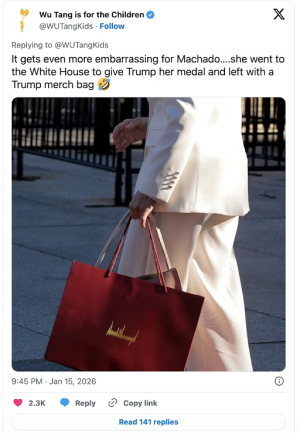
The Nobel Prize committee says that the Nobel Prize cannot be gifted or transferred to another person for any reason for all of history. Sorry Don...you can go fuck yourself now.
 
Trump posted his portrait on his Twitter Lite with caption "acting president of Venezuela".
 
After ten years of America first, no foreign wars, after Trump announced the antiwar candidate and Republicans the party of no wars ... In two weeks, percentage of Republicans supporting invasion of Venezuela jumped 22 points. Percentage supporting Congressional support before going to war dropped 19 points.

The cult was never about foreign wars. Or price of eggs. It has been and always will be, make America white again.
 
Whatever you think of oil industry, its executives are not stupid. They had to sit through two hours of Trump on air meandering. Twice he looked out the window towards where the East Wing used to stand and referred to beautiful view. It is literally a hole in the ground. He has no idea of what is involved in making Venezuela oil assets marketable. Executives report Trump was farting audibly throughout the meeting and smelled like shit and rotten meat. You can see in photos how Vance and Rubio say far away from him.
 
New York Times reports Pentagon disguised planes as civilian aircraft when bombing Venezuelan boats. Which is illegal.
 

Users who are viewing this thread

Back
Top