BLAZINGGIANTS
Well-Known Member
- Joined
- Dec 2, 2008
- Messages
- 22,184
- Likes
- 14,875
- Points
- 113
Stren only wishes he had six fingers for his world famous reach-arounds…Handjob Beast.


Follow along with the video below to see how to install our site as a web app on your home screen.
Note: This feature may not be available in some browsers.
Stren only wishes he had six fingers for his world famous reach-arounds…Handjob Beast.


I think he has those around him.. as long as they show him U.S $ is feasible down the road - all he needs to do is say ok.Stop giving Trump credit as strategic thinker. He is no more strategic thinker than he is humanitarian.

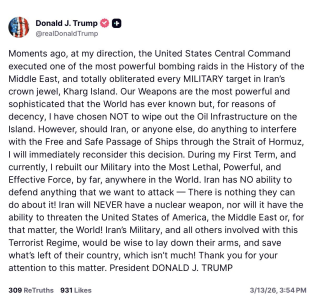
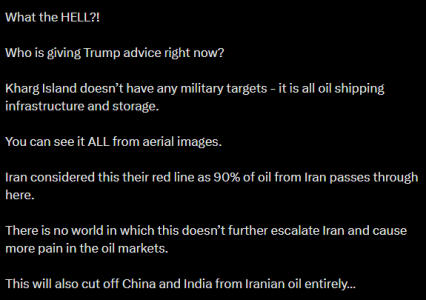
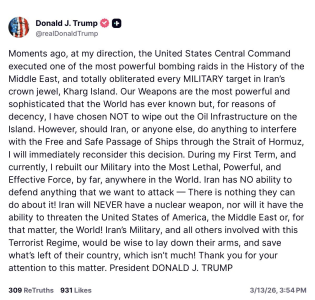
Staying informed means working from documented facts, not media framing, so I would like to share what the record shows if we dive in it.Trump invaded Iran with no clear reason, no clear goals, no strategy for achieving goals, no plan for day after. Early in his administration military leadership and intelligence were purged of most experienced personnel. His cabinet are television personalities. Every person with expertise on politics, history, economics, military strategy are seeing disaster.
Some say Netanyahu talked Trump into war. Maybe. Maybe he thought it would be easy, drop some bombs, kill some people, hold big victory parade. They were unprepared for Iranian response. Like Putin in Ukraine, he thought march in with superior military power. Easy.
Now he says war will end when his bones say so. Yes, he can just declare victory, his cult will nod and right wing media cheer. But this isn't kike tariffs he could turn on and off by whim until Supreme Court said no. He might declare victory and leave but Iran could say they aren't done. Israel isn't done. Gulf states aren't done.
No on knows when or how this will end. World war begun on stupidity.

The Amnesty article is worth engaging with seriously, but it's missing a crucial piece of context that changes the picture significantly.
The restrictions on wells, pumps, and water infrastructure apply specifically to Area C of the West Bank — the roughly 60% of the West Bank that remained under full Israeli civil and military control under the Oslo II Accords. That was the agreed-upon arrangement, pending final status negotiations that were supposed to happen and never did. In Area C, any construction — not just water infrastructure, but any building — requires Israeli permits, which are indeed extremely difficult to obtain. That's a legitimate grievance worth discussing.
For example, Ramallah is in Area A — fully administered by the Palestinian Authority. Palestinians there can and do build water infrastructure without Israeli permits. The PA is responsible for civil affairs including water in Areas A and B. So the framing that Israel made it illegal "for Palestinians in the West Bank" as a blanket statement is misleading — it conflates Area C specifically with the entire West Bank.
The real story is: Oslo created a temporary division that was never resolved, left the majority of land (and most water sources) under Israeli control indefinitely, and the permit system in Area C has been used to severely restrict Palestinian development there. That's the actual, serious problem — not a blanket ban on all Palestinians everywhere in the West Bank.
Amnesty is activist reporting. It's not always wrong, but it often strips context that would complicate the narrative.


US offered "free nuclear fuel forever," which Tehran rejected because it insisted on retaining enrichment rights. This proposition I believe was intended to understand if any agreement can be reached.
Lets say you want to buy the blazers team, and you offer the owner more money than they asked for, but the offer is refused, it is safe to uderstand the owner just doesnt really want to sell. No need for further negotiations. Thats how I see it.. the offered something way out of line and a no means we are just messing around with you to buy time untill the US next election comes..
A key claim in this article deserves more scrutiny than it gets: did Iran actually agree to "zero stockpiling"? The answer is: not according to Iran.
If Iran's proposal was to do it under supervision then the proper authorities would have access. That's part of the proposal.A key claim in this article deserves more scrutiny than it gets: did Iran actually agree to "zero stockpiling"? The answer is: not according to Iran.
The breakthrough was declared by Oman's Foreign Minister — not by any Iranian official. Iran's own Deputy FM told the BBC that zero enrichment was never on the table, and Iran's actual proposal was to dilute uranium inside its own facilities under IAEA supervision. That's a very different thing. The IAEA, meanwhile, had no access to Iran's enrichment sites and could verify nothing either way.
The article presents a major Iranian concession as fact. But it was one government's characterisation of talks — contradicted by the other party at the table.
Iran's proposal as described by their own Deputy FM was to dilute uranium stockpiles inside Iranian facilities under IAEA observation. That means inspectors watching a specific defined operation: the dilution itself. It does not mean broader access to enrichment infrastructure, centrifuge halls, or undeclared sites.If Iran's proposal was to do it under supervision then the proper authorities would have access. That's part of the proposal.
It's crazy to suggest otherwise.

You might want to correct your typo my friend. You just typed a Meyers Leonard slur by mistake.But this isn't kike tariffs
Question, have you been conscripted into military service in Israel given the war? I don't know your demographics so thought I'd ask. Also would Deni A. have any risk of being called to war given his age?Iran's proposal as described by their own Deputy FM was to dilute uranium stockpiles inside Iranian facilities under IAEA observation. That means inspectors watching a specific defined operation: the dilution itself. It does not mean broader access to enrichment infrastructure, centrifuge halls, or undeclared sites.
This is a well-documented problem. The IAEA has been raising alarms for years about Iran blocking access under the Additional Protocol cameras removed, inspectors denied entry, Fordow and Natanz heavily restricted. Iran suspended the Additional Protocol entirely in 2021. So "supervision" of what, exactly, and with what access rights?
The core concern was never just the existing stockpile, it was the centrifuges and the infrastructure that can reconstitute a weapons-grade stockpile quickly. Dilution without verified dismantlement of enrichment capacity is entirely reversible. You're back to square one the moment supervision ends or access is revoked, which Iran has done before.
"They agreed to do it under supervision" and "therefore the proper authorities would have access" doesn't follow, not given what Iran actually proposed, and not given their track record of what they permit inspectors to see. "Supervision of dilution" ≠ "access to the enrichment program." Iran was offering to let inspectors watch them pour water into a bucket, not to open the whole facility. That distinction matters.
Iran's proposal as described by their own Deputy FM was to dilute uranium stockpiles inside Iranian facilities under IAEA observation. That means inspectors watching a specific defined operation: the dilution itself. It does not mean broader access to enrichment infrastructure, centrifuge halls, or undeclared sites.
This is a well-documented problem. The IAEA has been raising alarms for years about Iran blocking access under the Additional Protocol cameras removed, inspectors denied entry, Fordow and Natanz heavily restricted. Iran suspended the Additional Protocol entirely in 2021. So "supervision" of what, exactly, and with what access rights?
The core concern was never just the existing stockpile, it was the centrifuges and the infrastructure that can reconstitute a weapons-grade stockpile quickly. Dilution without verified dismantlement of enrichment capacity is entirely reversible. You're back to square one the moment supervision ends or access is revoked, which Iran has done before.
"They agreed to do it under supervision" and "therefore the proper authorities would have access" doesn't follow, not given what Iran actually proposed, and not given their track record of what they permit inspectors to see. "Supervision of dilution" ≠ "access to the enrichment program." Iran was offering to let inspectors watch them pour water into a bucket, not to open the whole facility. That distinction matters.
That's exactly what we did with Germany and Japan post WWII..N Korea, Russia and China have helped Iran develop weapons programs and Iran has helped those countries with ammo and drones. We aren't exactly setting a great bar for weapons containment ourselves.You're never going to completely eliminate their ability to create nuclear weapons.
I was serving until 2022 but I fell down the stairs that year and broke 2 vertebreas so I am no longer eligble to enlist for combat roles. As I work in a hospital - I am under call and in case of multiple casualties incidence I am required to attened immedieatly.Question, have you been conscripted into military service in Israel given the war? I don't know your demographics so thought I'd ask. Also would Deni A. have any risk of being called to war given his age?
That's exactly what we did with Germany and Japan post WWII
We capped their military development until recently buy you said that wasn't possible although it held since 1945...Japan now has a green light to develop a military presence as does Germany but it's our nukes that are in Germany, not theirs. Any country could break a treaty and go rogue but our history showed successful containment. Both Germany and Japan focused on industry instead of military arms development. Something the whole world should do in my view. We haven't eliminated N Korea, India or Pakistan's nuke programs.Japan could develop nuclear weapons within weeks.
Germany could do it within a few years.
We have not eliminated their ability to develop nuclear weapons.
Right, but that happens because of diplomacy.We capped their military development until recently buy you said that wasn't possible although it held since 1945...Japan now has a green light to develop a military presence as does Germany but it's our nukes that are in Germany, not theirs. Any country could break a treaty and go rogue but our history showed successful containment. Both Germany and Japan focused on industry instead of military arms development. Something the whole world should do in my view.