
UKRAINEFAN
Well-Known Member
- Joined
- Sep 30, 2008
- Messages
- 15,322
- Likes
- 12,476
- Points
- 113
I do believe that every team needs to be told once in awhile that they have the talent to do better than they have been doing.


Follow along with the video below to see how to install our site as a web app on your home screen.
Note: This feature may not be available in some browsers.


Quick made it sound like there was more.

My guess is he was commenting on how aggressive/intense that bald assistant is with the head coach. lolDundon clearly grilling Cronin about Yang not getting any minutes.
Like Paul, Neil, Joe & Bert were big on specifics or plans?Somehow I got blowhard vibes. Reminds me a little of another guy who is short on specifics or a plan. Seems as if he will be very unhappy if we don't make the playoffs; I wonder if he even knows we will lose the draft pick?

It's a big nothing burger to me. But Blazer fans and the local media will always make a mountain out of a molehill.
Looks like they were talking about the X's and O's of basketball. Joe was explaining something to Tom. If it was some sort of argument, I doubt Blazers President Dewayne would be ignoring the conversation like he was.
A lot of Pauls good side of being an owner was, realistically, that he just threw money at stuff.Like Paul, Neil, Joe & Bert were big on specifics or plans?

Yes, expecting any single owner out there it ever be like Paul, is silly. One of a kind.As great as Paul was as an owner he did love drafting small defensively challenged guards

I read body language pretty good. That was not an argument.
Maybe he was saying why so many assistant coaches, there must be at least around 8-10 even on the rode.It looked to me like a blowhard lecturing an expert. But they could just be debating how to make the best BBQ for all I know.

Arguing cats vs dogs.It looked to me like a blowhard lecturing an expert. But they could just be debating how to make the best BBQ for all I know.

If we had less, people would bitch about how cheap our ownership is/wasMaybe he was saying why so many assistant coaches, there must be at least around 8-10 even on the rode.
When we won the cship Jack had I think 2-3 at most. Dont counter with we need a stat guy a film guy etc.
probably rightIf we had less, people would bitch about how cheap our ownership is/was


Him describing his expectations as consistently unrealistic means constant changes and a shit show coming
well what we have had is a "boring" shit show and I am sick of it, at least give me a different version of that shit show cause this one has worn me down. And maybe we'll get some better basketball out of itHim describing his expectations as consistently unrealistic means constant changes and a shit show coming
"The names were changed to protect the innocent........."If there was an extra "don" on the end of the new owner's name, it would make it pretty ominous whenever he was announced at games and press conferences.
Meaning: I don't love that smell.I COULD say I love the smell of skepticism, alarmism, and defeatism in the morning; it smells like...Chick Little. But that would be false.

Vibe code that shitThey've asked me to help program their new team running AI, ChatSPD.
ChatSPD will now make all player and personnel decisions.
Whats wrong with him addressing the group and sharing what he expects and what he wants to accomplish. I believe he will do a much better job of evaluating what works and doesn't work for building a consistent winner. Cant improve w/o changes and cant be afraid to make changes. To stay conservative, status quo will only lead to laggardism. Seems the man has been fairly successful with his sports endeavors. I can see why he and Cuban are buds as they both have an intense, competitive, independent style of management. He will be accountable to investors and a board. What gets measured gets done, if you don't know where you're going you'll end up somewhere else.Him describing his expectations as consistently unrealistic means constant changes and a shit show coming

 www.nytimes.com
PORTLAND, Ore. – For the past year, inside a Portland-area gym, a friendship developed between an NBA superstar and a local entrepreneur.
Three or four times a week, the paths of Damian Lillard and Sheel Tyle would cross. As one would be finishing a workout, the other would be arriving. Eventually, casual conversation developed.
Tyle — the founder of Collective Global, a venture capital firm — already knew Lillard as the Portland Trail Blazers’ all-time leading scorer. Lillard soon got to know Tyle as a sharp, inquisitive guy who never fan-boyed or pushed his way into conversations.
Stars in their own lines of work, the two found comfort in the down-to-earth, realness of the other.
“I just really liked him,” Lillard said. “He was close in age to me, and I just got to know him on an organic level. It was natural, in the flow, not forced. And usually, for me — and I’m sure for him — we can tell when people are trying to force themselves on us to get close. But he had no reason to, and I had no reason to. So it was just perfect that way.”
Soon, they were talking about families, restaurants and sports. When Tyle was in the market for postpartum rehabilitation for his wife, Lillard connected Tyle with his own personal trainer. They learned their birthdays are one day and one year apart: Lillard on July 15, 1990 and Tyle on July 16, 1991.
Eventually, their relationship extended beyond the gym. They shot hoops at Lillard’s home. And they ate dinner at Tyle’s dining room table, after which Lillard cradled Tyle’s infant daughter, Sia.
It wasn’t until months into their acquaintance that Lillard had a startling revelation. While reading a story about a group making an offer to purchase the Trail Blazers, Lillard took special note of an investor listed in the bid: His buddy from the gym.
“Dame messaged me on Instagram: ‘This you, bro?”’ Tyle said. “And I responded, ‘Yes sir!'”
That friendship fostered at the gym officially became a partnership Tuesday after a deal closed to sell the Trail Blazers to Dallas businessman Tom Dundon and four other major investors that include Tyle. In the 56-year history of the Trail Blazers, the 34-year-old Tyle joins franchise founder Harry Glickman as the only Oregonians to stake an ownership claim. Tyle, who will be the Blazers’ alternate governor, is also the youngest to ever own a part of the Blazers, edging former owner Paul Allen, who bought the team in 1988 when he was 35.
Locally, the sale to Dundon’s group is being met with cautious optimism. While some welcome a fresh – and with Tyle a local — approach, some have expressed apprehension about the group’s intentions. The Blazers have an agreement to play at the Moda Center through 2030, but the organization is seeking $600 million in public funding to help renovate the 31-year-old arena. Dundon has said if the renovations are funded, he will sign a 20-year lease. It’s the unspoken threat that unnerves: what if the funding isn’t approved?
What You Should Read Next
Tom Dundon’s first day as Trail Blazers owner: ‘I can’t handle losing’
Dundon says the Blazers will get better with him as owner. "It's going to happen. It always happens when I show up."
Tyle says one of his motives in investing in the Blazers is ensuring they remain in Portland. And that’s why the friendship between Tyle and Lillard, and how it came about, is worth underscoring, however subtle it may be. Communication and transparency were not strong suits of the Allen regimes. Paul Allen would address the fans through the media once a year. Jody Allen never spoke publicly in her eight years. Both entered and left the arena flanked by a small army of security guards. For 38 years, the Portland community had little connection, little dialogue and no understanding of Blazers ownership.
Now, fans could be walking next to the Blazers owner in the grocery store. At the gas station. In the gym. Or while getting pizza at Tyle’s favorite spot, Lovely’s Fifty Fifty.
“He lives here. You can bump into him around town,” Lillard said. “I think that element alone is super important to our fans and people here. He’s been able to see and feel how important the Trail Blazers are to Portland.”
Tyle won’t say how much he invested into the franchise’s $4.25-billion selling price, but says it is the biggest investment he has ever made. This investment is propelled by his core tenet of entrepreneurship: Successful business is not motivated by making money; it is fueled by a cause or passion.
“It was very important the team stay, and for me, that’s one of the reasons why I’m in it,” Tyle said. “The city and state are too special not to have them.”
He has lived in Oregon for only two-plus years, but he says he already has an understanding of how deeply the Blazers matter to Oregonians. He went to high school in Rochester, N.Y., and the passion of Portland fans reminds him of the civic bond the Bills had with Buffalo and upstate New York.
“Sports are one of the great unifiers, where people from different backgrounds, different religions, different beliefs, can rally around the same thing,” Tyle said. “We need that, in Oregon and in this country.”
He says his financial commitment, and his local presence, will give Portland a voice if relocation is ever broached by the rest of the ownership group. Tyle insists moving the team is not on the table.
“I don’t want people to be concerned or scared,” Tyle said. “We are committed to Portland, 100 percent. Full stop.”
Of course, 18 years ago when Clay Bennett bought the Seattle SuperSonics, he told then-NBA commissioner David Stern in an email that he was “passionately committed” to Seattle. One year later, the Sonics became the Oklahoma City Thunder, and emails uncovered between the owners revealed their intentions to move from the onset after public funding for arena upgrades failed.
Lillard said he believes Tyle and his passion for Portland, and he feels that passion can help bridge the gap between the franchise and the community. For most of their 56-year existence, the Blazers have been run by out-of-state owners: Larry Weinberg (Los Angeles) was majority owner from 1975 until he sold to Allen (Seattle) in 1988.
Tyle has lived in the Portland area since 2024 and his wife, Dr. Sejal Hathi, was appointed by Gov. Tina Kotek as the director of the Oregon Health Authority in November 2023. The couple’s only child was born at Oregon Health and Science University last April.
Lillard says Tyle is more than just a guy with a local address, and more than someone making a promise to keep the team in Portland. He described Tyle as humble, authentic and curious … and obsessive about improving the franchise.
When asked what Blazers fans are getting from his friend, Lillard was emphatic.
“You’re gonna have an owner that is one of us,” Lillard said.
On Tuesday, hours after the sale of the Blazers closed, Dundon and Tyle watched their new team play the Clippers in Los Angeles. They met with players and coaches, and flew home on the team’s charter flight.
Tyle says they will be hands-on owners, visible and proactive. And they will be demanding.
“(Dundon) has this great quote, and we’re going to tell the players this: ‘Our job is to find somebody better than you. Your job is to make sure that person doesn’t exist,’” Tyle said.
Tyle and Dundon will hit the ground running. On Wednesday and Thursday, the pair will meet with groups of employees on the business and basketball side of the franchise.
Employees will be asked to provide the new owners their Key Performance Indicators, or how they measure their own success. Tyle says he wants to know what employees view as the challenges within the organization, as well as what opportunities should be pursued.
“The staff will not be used to this level of intensity,” Tyle said. “I don’t think people are going to like it, actually. I think they’ll be uncomfortable.”
Tyle says the intent is not to intimidate, but rather to learn. He says this will not be a group who comes in thinking it has all the answers.
“We are going to ask a ton of questions, and we’re going to show up,” Tyle said. “And then based on everything we learn, we are going to institute a culture of accountability and one driven by metrics.”
His learning process will be amplified by what he believes is his greatest strength: listening. His mom would often remind him he has “two ears and one mouth” and his grandmother instilled into him an adage that resonates: “You don’t learn anything when you are talking.”
“So, I listen a lot more than I talk,” Tyle said.
In the coming days, he wants to hear answers to questions he has wondered throughout this Blazers season.
“How do we not make the same mistakes in Game 60 as Game 6?” Tyle said. “And how do we support players or medical staff so injury recoveries are quicker and don’t recur? I think we see the problems, and we’re asking the questions. We care. A lot.”
He says he plans to occasionally attend practices to gather information and to be available to players, coaches, employees if they want to provide feedback. In March, he and his wife attended a home game of the Blazers’ G League affiliate, the Remix, sitting courtside with Blazers president Dewayne Hankins.
“I want to learn what’s going on,” Tyle said. “What are we doing at practices? Who runs the practices? The only way I’m going to know is to show up.”
Growing up, the Tyle family vacations were not to Disneyland, or sunny beaches. Instead, Tyle has memories of food poisoning in Nairobi, seeing hunger in Lagos, or experiencing chaos and time zone disorientation while being in India, Asia or South America.
“My parents never took us to luxurious places,” Tyle said. “They wanted to show us the real world. I think they wanted to show us how much privilege we had just by being in America. And it made you realize: We’re all far more similar than different. It didn’t matter if I was 12 and living in Rochester, N.Y., or 12 and living in Lagos, Nigeria. We all want to be happy and have a sense of purpose.”
Born in San Diego, Tyle is the son of parents who separately emigrated from India in 1980. His father went to Ohio State and became a chemist who worked for pharmaceutical and biotech companies. His mother went to Washington University in St. Louis and became an architect.
“Their thing with me and my younger brother (Sujay) is that education is your path to a better life,” Tyle said.
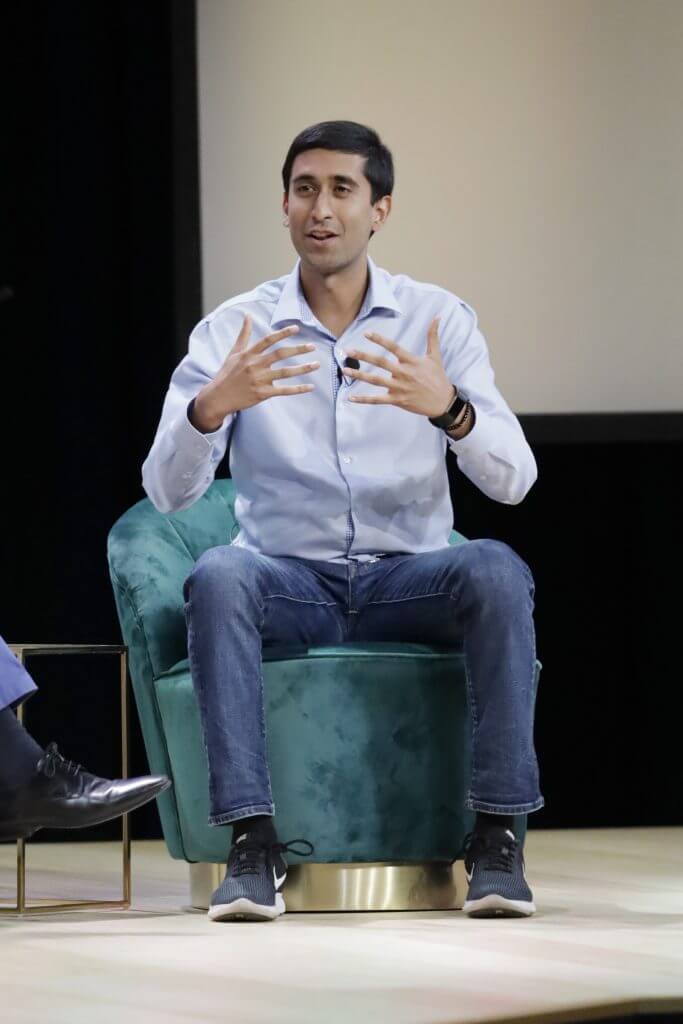
Tyle, the founder of a venture capital firm, speaks at the Fast Company European Innovation Festival in 2019.Claudio Lavenia/Getty Images for Fast Company
Growing up he lived in California, Texas, Michigan, New Jersey and New York.
“My brother and I were always the new kid,” Tyle said. “It forced us to be adaptable and to appreciate and connect with people of different backgrounds, and to make friends quickly.”
His parents were driven by helping people. His father used science to create new therapies and drugs to combat cancer. His mom designed buildings in the Rochester School District, believing architecture could help foster better infrastructure and learning environments.
Tyle, meanwhile, simply wanted to make the world a little better.
When he was a child, while on a family trip to Nairobi, he visited an orphanage for the blind. He was intrigued. What causes blindness? That trip stuck with him, and during high school he emailed a handful of professors at the University of Rochester, hoping to research and experiment with a hypothesis on blindness. Only one professor replied and allowed him to conduct his research.
“That experience taught me that having an intuition is not the same thing as having an answer,” Tyle said. “You have to probe, question, test your assumptions and then let the data validate or disprove what you think. And it taught me to be OK with finding a result that was the opposite of what you thought.”
At 19, he graduated from Stanford, finishing his Bachelor of Arts in Human Biology and Public Policy in three years. He also has a Juris Doctor from Harvard Law School.
Today, one of the traits he values in people is intellectual curiosity.
“I love to be around people who are trying to change the status quo,” Tyle said.
As a college intern at Bessemer Venture Partners, he observed how a single seed investment in the company Celtel transformed an entire continent, bringing the mobile phone to Africa. A few years later, inspired by the Occupy Wall Street Movement, he invested in Robinhood, a company that allowed those with lower to middle income access to financial services, not just the wealthy.
“It was unfair to me that the rich were getting richer, but the poor didn’t have access to the same financial products and were being charged much higher commissions,” Tyle said.
With a credo of “building companies that matter,” Tyle by age 27 had raised a $100-million fund, and today has investments on six continents, ranging from communication software to electronic equipment to artificial intelligence.
His smarts and intuition earned him millions … and a call from Tom Dundon.
After Portland failed to secure a WNBA expansion franchise in 2023, Tyle made a bid to bring the women’s league back to Portland.
“I got scooped,” Tyle said, noting the Bhathal family’s winning bid of $125 million in 2024. “I was frustrated … there was no process.”
There is no bitterness now, in part because he later met the Bhathals (“very nice people”) and in part because a friend put Tyle in contact with Allen & Company, an investment bank hired by the WNBA to find prospective owners for future expansion franchises.
Tyle took part in the WNBA’s process, even making a bid on an expansion team, and on an existing WNBA team. But he pulled his bid, asking himself “what am I doing?”
“It was a great investment opportunity, but I don’t live nor have any ties to those cities,” Tyle said.
In May 2025, the Trail Blazers were put up for sale by the Estate of Paul Allen, which hired Allen & Company to facilitate the sale. Knowing Tyle lived in Portland, and his previous interest in buying a sports franchise, Allen & Company asked Tyle how he wanted to play the Blazers.
He told them he would love to own them, but didn’t have enough money to be the governor (NBA requires the controlling owner to hold at least 15 percent of equity in a team). Tyle said he would, however, be open to partnering with someone and being an alternate governor.
Two weeks later, Allen & Company found someone interested in being the lead investor: Dundon. Over an email, the two were introduced by Allen & Company. Two minutes later, Dundon was ringing Tyle and providing a memorable opening.
There was no “hello.” No “nice to meet you.”
He said the F-word.
“I think he was being kind,” Tyle said.
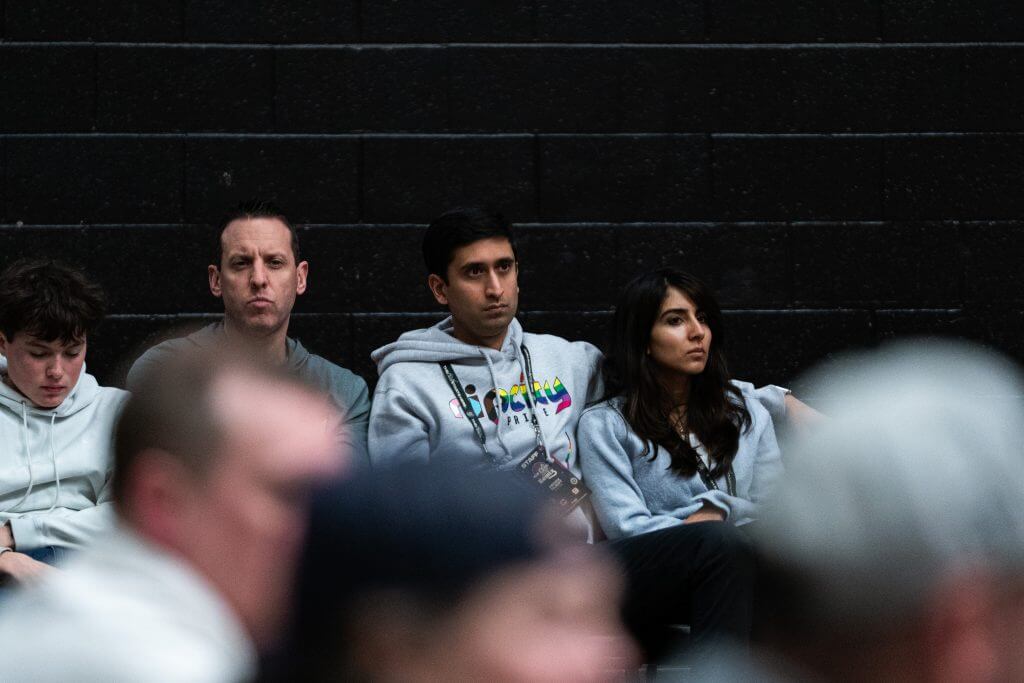
Sheel Tyle sitting with Trail Blazers president Dewayne Hankins and wife, Dr. Sejal Tyle Hathi at a G League game in March at the University of Portland.Trail Blazers photo
Dundon’s expletive was in reverence to Tyle and how much he had accomplished at such a young age. He joked that he wanted Tyle to mentor his kids.
“I think he’s kind of a unique personality,” Dundon said Tuesday. “When people meet him, they like him. He’s got high energy. He’s a younger guy that’s been super successful, loves basketball, lives in Portland, so you put all that together and it’s pretty easy (to say) we could use one of those.”
Meanwhile, Tyle was impressed with Dundon and how direct and egoless he was as they flowed through topics. But mostly, Tyle liked Dundon’s primary philosophy: When we pay, we pay players.
“Tom’s whole thing is ‘I don’t want to save money on players; I want the best players,”’ Tyle said.
Since that first phone call in May, Tyle said he and Dundon have talked nearly every day.
One of the topics they have discussed: Dundon’s volatile past. He was sued by the Alliance of American Football League, which accused him of not fulfilling an investment promise (Dundon was ordered to pay $1). And in 2020, one of Dundon’s subprime loan companies — Santander Consumer USA — lost a $550-million lawsuit filed by 34 states for deceptive and improper loan servicing.
“Unfortunately, when you are successful, you get sued,” Tyle said. “But for me, it was how he stood by his principles through it all that stayed with me. And you see that show up in how he does business day to day.”
Tyle says Dundon had a recent interaction with a bank while securing a business loan. Dundon had a handshake agreement on borrowing terms with one bank, but a week later was proposed a better rate from a different bank. Tyle says Dundon did business with the first bank, even though it cost him money.
“He was like, ‘No, I’m a man of my word,” Tyle said. “I’m going to take that deal for better or for worse.”
Maybe it stems from those vacations to Nairobi and Lagos as a youth, or maybe it’s because he does business on six continents, but Tyle says one of his grandest goals is to elevate the Blazers beyond Portland.
“One thing you will find about me: I don’t think regional. I think global,” Tyle said.
He notes how the Blazers lead the NBA in minutes played by international players, including starters Deni Avdija (Israel), Toumani Camara (Belgium), Shaedon Sharpe (Canada) and reserves Vit Krejčí (Czech Republic), Sidy Cissoko (France) and Yang Hansen (China). And in January, he dined with former NBA star Yao Ming of China while on a trip to China and Korea.
“Yao said more people are watching the Blazers in China than any other team,” Tyle said. “They knew Hansen’s stats from the Rip City Remix (Portland’s G League team) from the night before. It just shows again how sports can be a unifier.”
In May, Tyle and his wife are traveling to Japan, where he is meeting with a collection of Japanese dignitaries, as well as the heads of two Japanese airlines. He wants to restart nonstop flights between Tokyo and Portland.
“One of my goals is to have the Blazers be Asia’s team,” Tyle said.
His desire to expand Portland’s reach is fueled by a belief that Portland is worthy. He says that’s why he named the group’s purchasing entity Rip City Rising, a nod to his mission of making his investment about more than basketball.
He believes the Blazers can be the hub to a vibrant civic environment while also helping Portland ascend into a world-class attraction.
“We didn’t call the group Rip City Stabilizing, or Rip City Reminiscing — we called it Rip City Rising because the Trail Blazers can and should be a small part of the state’s resurgence to greater heights,” Tyle said. “I don’t want the story to be ‘Portland has a homeless issue, a drug problem, the economy stinks … let’s leave.’ The opposite should be true. I love this place. We are rising, this is a city on the ascent.”
That optimism, that enthusiasm, and that vision are why Lillard says he believes the Blazers are getting something special with Tyle. Few players have been embraced by fans in Portland like Lillard, he knows what the fan base values. They want dedicated work, transparency and a passion that Portland can be better. They want to feel a part of the Blazers, and the people running it.
“You know, it’s one thing to have a player who is one of you, and to even have a coach who is one of you,” Lillard said. “But to have an owner that’s one of us? That’s a different thing. And he is that.”


