OT Hurricane Florence

Welcome to our community

Be a part of something great, join today!

That caption is cringy. 28 miles across isn't even close to being the "biggest ever recorded".
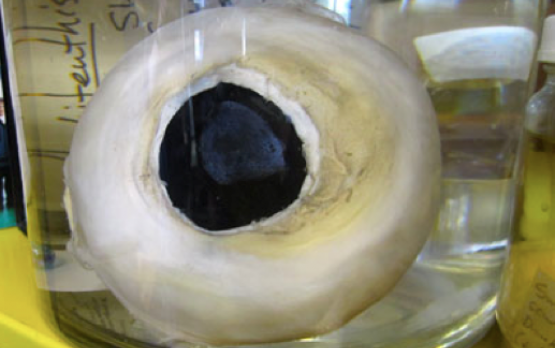

The Biggest Eyes in the Animal Kingdom
August 20, 2012

By Mera McGrew

Researchers say that colossal squid (Mesonychoteuthis hamiltoni) have the largest eyes ever studied in the animal kingdom. Measuring 27cm (11in) in diameter, each eye is roughly the size of a soccer ball. “They are probably the largest eyes that have ever existed,” says Eric Warrant, a professor at the University of Lund in Sweden and an expert on animal vision.

Researchers say these huge eyes help the colossal squid survive and thrive in the depths of the Southern Ocean. Their eyes face forward, allowing them to properly judge distances. At great depths, where there is very little light, their large eyes also help them spot large animals, including predators like sperm whales.

Recently, Mission Blue caught up with Warrant to ask him more about his research and the massive eyes of the colossal squid.

At Lund University’s Department of Biology, Warrant pursues world-leading research that focuses on vision in dim light, primarily concentrating on deep-sea and nocturnal animals. In 2008, Warrant traveled to the Museum of New Zealand Te Papa in Wellington to take part in the dissection of a colossal squid and investigate the morphology of their eyes along with his friend and colleague Dan-Eric Nilsson.

Below is a cut version of a Q&A with Eric Warrant.

Why do colossal squid have such large eyes?

In order to spot sperm whales (their major enemy) at great depths in the sea where there is almost no daylight. Sperm whales trigger bioluminescence from the great density of tiny planktonic animals that they collide with while swimming. This light creates a bright aura around and behind the whale that can be seen at a great distance in the sea (about 120 m away), but only by an animal with an eye as large as that of the colossal squid.

In your opinion what is the most fascinating thing about the colossal squid’s eyes and why?

Their sheer size. They are probably the largest eyes that have ever existed, and the next largest eyes are only 9 cm in diameter (the eyes of a large swordfish). For most visual tasks – such as detecting objects illuminated in the faint downwelling daylight – an eye of greater than 9 cm isn’t justified on the basis of visual gains per unit energy cost. The only visual task that is an exception to this is the detection of large luminous objects – the major reason for the evolution of the giant eyes of squids. This evolution was necessary in order to give them an early warning visual alarm system for detecting sperm whales.

In 2008, you traveled to the Museum of New Zealand Te Papa in Willington to take part in the dissection of a colossal squid. Can you briefly describe what your role was within that dissection?

My role – together with my friend and colleague Dan-Eric Nilsson – was to investigate the morphology of the eyes of the squid to that level it was possible in an animal that had been frozen for over a year and then thawed-out.

Why was dissecting the colossal squid so important from a scientific standpoint?

Colossal squid are not uncommon in the deep ocean but our investigations of them are very few because they are so hard to see and to find. Most specimens that exist in museums are in very poor condition, having been found washed up on beaches in a half-rotten state. The eyes are usually in a particularly bad state. The New Zealand specimen had been caught alive on a long-line fishing vessel, dragged up onto the ship’s deck and then frozen immediately (I suspect that the ship’s crew recognized the scientific value in the specimen directly). Never before in the history of colossal squid research had so fine a specimen been obtained. Hence its enormous scientific value.
 
Not if you are on an island! But yeah, the people this week need to take the advice of getting out of town. Of course some people don’t have the means so they are screwed
If people haven't gotten gas they're probably screwed. I would've gotten gas 4-5 days ago.
 
If 3000 deaths from a small island are the best ever, 30,000 from a tremendously larger island are just as acceptable to president dump.

Which island? There are many off the coast of the carolinas and virginia
 
41499476_1953361921386583_1646000401775853568_n.jpg
 
One day left. Weakened to a strong Cat 2 but that's pretty much irrelevant when it comes to this beast. Problem is it's weakening might be deadly because people focus too much of hurricane categories, which are based off wind only, while storm surge and flooding will be whats deadly.

I think it's resrtenghtening though. It's over the gulf stream. Should approach as a weak Cat 3.
 
One day left. Weakened to a strong Cat 2 but that's pretty much irrelevant when it comes to this beast. Problem is it's weakening might be deadly because people focus too much of hurricane categories, which are based off wind only, while storm surge and flooding will be whats deadly.

I think it's resrtenghtening though. It's over the gulf stream. Should approach as a weak Cat 3.
More people are killed by the storm surge than by the wind.
 
One day left. Weakened to a strong Cat 2 but that's pretty much irrelevant when it comes to this beast. Problem is it's weakening might be deadly because people focus too much of hurricane categories, which are based off wind only, while storm surge and flooding will be whats deadly.

I think it's resrtenghtening though. It's over the gulf stream. Should approach as a weak Cat 3.
I thought the Gulf Stream was in the Gulf of Mexico.
 

Users who are viewing this thread

Back
Top