
"Net Neutrality" is Obamacare for the Internet

Welcome to our community

Be a part of something great, join today!

I will also add a thanks to DC for showing this is a more complicated issue than it initially appears, and after reading up on it I feel that me and you are arguing over different issues that seem to be the same at first glance. The real issue is that there is no real competition in this industry and to few companies are only getting bigger and more powerful with no oversight or free market to adjust their behavior. Net neutrality might not be the answer but that doesn't mean there isn't a problem.

This article sums things up pretty well

http://www.wired.com/2014/06/net_neutrality_missing/

Couple of key takes from it.

Even Tim Wu, the man who coined the term net neutrality, will tell you that the fast lane idea isn’t what it seems. “The fast lane is not a literal truth,” he says. “But it’s a sense that you should have a fair shot.” On the modern internet, as Wu indicates, the real issue is that such a small number of internet service providers now control the pipes that reach out to U.S. consumers—and that number is getting even smaller, with Comcast looking to acquire Time Warner, one of its biggest rivals. The real issue is that the Comcasts and Verizons are becoming too big and too powerful. Because every web company has no choice but to go through these ISPs, the Comcasts and the Verizons may eventually have too much freedom to decide how much companies must pay for fast speeds.

For Ammori and others, this seems like a shake-down that lets the service providers get paid at at both ends—by their home subscribers and by the web companies that deliver stuff to these subscribers. Ammori worries that the ISPs will start throwing their weight around unfairly. “We don’t want AT&T and others to impose a tax and to treat those who pay a tax better than others,” he says. The strange thing is that even some of the biggest “net neutrality” advocates downplay the importance of these peering deals, saying they have nothing to do with net neutrality. But this is largely an argument of semantics. The point is that, whatever terms you use to describe it, the situation could lead to an unfair playing field.

One way to prevent this is through greater competition among ISPs. If consumers and web companies have many ISPs to choose from, no one ISP can control who gets what. Ammori doesn’t see more competition among ISPs as a panacea, but he thinks it would help. And another network activist, Seth Johnson, believes competition can change things, but that it will take government action to make that happen. “Competition and regulation are not at odds in every case. Particularly in telecom,” he says. In any event, competition is a bigger issue than net neutrality. The internet has evolved, but the debate must evolve along with it.

If Comcast’s last-mile of cable connection was available to all competitors under the same terms that gave dial-up service providers access to all copper telephone networks back in the 1990s, we would have more ISPs in more geographical areas. Consumers could simply switch providers whenever Netflix or YouTube started to get choppy. And that would give Netflix and YouTube more leverage in their deals with the ISPs. At the moment, this option—where ISPs are treated as “common carriers”—is on the table, but it seems like a remote possibility. Maybe it shouldn’t be. Instead of railing against fast lanes, we should be pushing Washington to explore ideas like this that could actually promote competition among ISPs. “In the present situation,” Johnson says, “the debate is misdirected.”
 
Oh now I totally agree with more competition. Where I live, I have my choice between Frontier,
a couple satellite providers, and Verizon wireless. At&t just put in a new tower but won't sell access in this area?? Frontier's DSL service is really poor, slow and unreliable. I had Satellite service before but they over sold it and had to throttle down everyone, but it maybe time to give them a go again with their new higher speed service.

I see no role for the Feds in this, I hope for more competition. on the ground. Satellite can never be adequate with the unavoidable delay associated with the distance involved.
 
Oh now I totally agree with more competition. Where I live, I have my choice between Frontier,
a couple satellite providers, and Verizon wireless. At&t just put in a new tower but won't sell access in this area?? Frontier's DSL service is really poor, slow and unreliable. I had Satellite service before but they over sold it and had to throttle down everyone, but it maybe time to give them a go again with their new higher speed service.

I see no role for the Feds in this, I hope for more competition. on the ground. Satellite can never be adequate with the unavoidable delay associated with the distance involved.

Problem with more competition is that this industry has a very high barrier for entry in regards to infrastructure investment. The only way to get more competition is for the government to be involved somehow.
 
Problem with more competition is that this industry has a very high barrier for entry in regards to infrastructure investment. The only way to get more competition is for the government to be involved somehow.

The real barrier is local legislation barring competitors from building out infrastructure. I keep saying remove those and they will build it. Google is choosing where it builds fiber almost exclusively based upon how much regulatory hassle and other govt. restrictions put upon them by cities they consider. That should be a huge red flag.

I'm all for economic liberty, but that does not entail corporations buying government officials and getting favorable legislation passed.

The barrier to entry isn't that high for an AT&T, Verizon, Comcast, Cox, Google, etc., to build the infrastructure. They don't have to run fiber to every home before selling service and turning a profit. They can do that on one neighborhood and build out from there.

Just to be clear, a peering arrangement is one where two big networks, like AT&T and Verizon, exchange traffic. The idea is that all of Verizon's customers fetching content (WWW pages, files, whatever) from sites connected to AT&T's network is roughly the same traffic as the opposite pattern (AT&T customers accessing Verizon).

It is incredibly unfair for Google (YouTube) and Netflix to continuously force the ISP to spend lots and lots of money keeping the peering points (there are numerous ones on big networks) while the ISPs aren't raising fees but Netflix and Google (via ads) are raking in ever increasing profits.

Unlike a fair peering arrangement, any deal made that exchanges data coming from Netflix is going to be lopsidedly unfair in Netflix' favor. The ISPs are in the business of selling connectivity. That's what they sold to Netflix and everyone won. They sell connections to us, too. And to corporate offices, and so on.

To keep up with Netflix' demands, the ISPs are also forced to upgrade what's called their "outside plant." This is the cables that run from their offices to the neighborhoods and ultimately to peoples' homes. To increase bandwidth from 10mbit for the whole neighborhood to 100mbit might be as simple as sending out a fleet of trucks and construction workers to replace lots and lots of switching equipments on phone poles or in manholes. Or they may have to replace coax cable in all the streets throughout the city with fiber optic, which they do in phases.

The ISPs have a business model where they oversell their network. If their network is 10mbit throughout, they might sell 100mbit worth of connections to customers (small example). They bank on people using bandwidth to load a WWW page (like this thread) and then use no bandwidth for minutes (while you read all the words on the page). The bandwidth expectations is "bursty" in almost every sense. Where it is not is when you have 20 customers trying to watch 1mbit streams from netflix at the same time. If the ISPs were to build 100mbit and sell 100mbit, I don't think they'd make a profit, or they'd have to charge 10x what they do now.

If any ISP does decide to block sites as net neutrality alarmists fear, both the customers would revolt and it would be an opportunity for another ISP to come into town. Think about it. After all Comcast has done to not allow people to see the Blazers games, there is a certain amount of anger that might drive people to jump from Comcast Internet service to any other provider with decent quality. Opportunity.
 
One more thing. donkiez' post about forcing cable companies to allow ISPs to use their infrastructure is nuts. Why would the cable companies spend $.01 to build any new infrastructure (see how AT&T stopped!)?

What if NEWCO ISP gets access and specializes in torrent sharing? It could bring the cable company's network to its knees.

Only the cable company can and should have the ability to control the traffic on its infrastructure.
 
Problem with more competition is that this industry has a very high barrier for entry in regards to infrastructure investment. The only way to get more competition is for the government to be involved somehow.

It never ceases to amaze me how it is that so many people think the government is needed in their business. When you dig down deep it is damn near always incorrect and in the rare cases they do some good, the politicians will change that before you know it. Like eliminating Glass-Steagall restrictions in banking rules.

I have an FCC licenses and I can't really say I want to see the FCC regulating anything more than allocating band usage and even that makes little sense or is contrary to international normal usage.

Please study what you want before approving of the Federal government coming to your aid.
Remember, a business man only wishes to make a profit. A Politician wants your vote and that comes easier for him when he controls what you need, he needs you to need him. 99 time out of a 100 you really don't need him, you need better educated consumers as allies.
 
Last edited:
It appears as if I am not the only one who thinks AT&T's 100 city promise was complete BS.

http://arstechnica.com/business/201...er-bluff-demands-detailed-construction-plans/

Two days after AT&T claimed it has to "pause" a 100-city fiber build because of uncertainty over network neutrality rules, the Federal Communications Commission today asked the company to finally detail its vague plans for fiber construction.

Despite making all sorts of bold promises about bringing fiber to customers and claiming its fiber construction is contingent on the government giving it what it wants, AT&T has never detailed its exact fiber plans. For one thing, AT&T never promised to build in all of the 100 cities and towns it named as potential fiber spots. The company would only build in cities and towns where local leaders gave AT&T whatever it wanted. In all likelihood, only a small portion of the 100 municipalities were likely to get fiber, and nobody knows which ones.

Yet this week, AT&T CEO Randall Stephenson made it sound as though a full 100 cities and towns would lose a fiber opportunity if the company doesn't like the FCC's final net neutrality proposal. "We can't go out and invest that kind of money deploying fiber to 100 cities not knowing under what rules those investments will be governed," he told investors Wednesday.

AT&T has separately claimed it will bring fiber-to-the-premises Internet service to "2 million additional locations" if it's allowed to buy DirecTV. But since AT&T never said how many locations it would bring fiber to if the merger is rejected, it's not clear what that 2 million number is in addition to. In short, no one outside of AT&T knows how extensive the company's fiber buildouts are planned to be.

Today, the FCC challenged AT&T to finally reveal some facts about its fiber plans in a letter to AT&T Senior VP Robert Quinn. Jamillia Ferris, a former Justice Department antitrust lawyer who joined the FCC to review the AT&T/DirecTV merger, began the letter by describing Stephenson's statement that "the Company would limit its fiber deployment to the '2 million additional homes' that are 'commitments to the DirecTV announcement' and that any other fiber deployment would depend on the outcome of the Commission’s Open Internet Proceeding." Ferris then asked Quinn for:

(a) Data regarding the Company’s current plans for fiber deployment, specifically: (1) the current number of households to which fiber is deployed and the breakdown by technology (i.e., FTTP [fiber-to-the-premises] or FTTN [fiber-to-the-node]) and geographic area of deployment; (2) the total number of households to which the Company planned to deploy fiber prior to the Company’s decision to limit deployment to the 2 million households and the breakdown by technology and geographic area of deployment; and (3) the total number of households to which the Company currently plans to deploy fiber, including the 2 million households, and the breakdown by technology and geographic area of deployment;

(b) A description of (1) whether the AT&T FTTP Investment Model demonstrates that fiber deployment is now unprofitable; and (2) whether the fiber to the 2 million homes following acquisition of DirecTV would be unprofitable; and

(c) All documents relating to the Company’s decision to limit AT&T’s deployment of fiber to 2 million homes following the acquisition of DirecTV.
Ferris asked Quinn for a response by November 21. AT&T told Re/code that it is “happy to respond to the questions posed by the FCC in its review of our merger with DirecTV. As we made clear earlier this week, we remain committed to our DirecTV merger-related build-out plans.”

The net neutrality debate went into overdrive this week when President Obama urged the FCC to reclassify broadband as a utility and prevent Internet providers from blocking or throttling content or charging websites for prioritization. FCC Chairman Tom Wheeler hasn't detailed his plans yet, but Internet service providers, Republican members of Congress, and Republican members of the FCC lined up in opposition.
 
While reading the last story I came across this from 2007 that I knew nothing about.

http://www.pbs.org/cringely/pulpit/2007/pulpit_20070810_002683.html


This is part three of my explanation of how America went from having the fastest and cheapest Internet service in the world to what we have today -- not very fast, not very cheap Internet service that is hurting our ability to compete economically with the rest of the world. Part one detailed expected improvements in U.S. broadband based on emerging competitive factors, yet decried that it was too little too late. Part two explained how U.S. broadband ISPs are different from most overseas ISPs and how those differences make it unlikely that we'll ever regain leadership in this space. And this week's final part explains that this all came about because Americans were deceived and defrauded by many of their telephone companies to the tune of $200 billion -- money that was supposed to have gone to pay for a broadband future we don't -- and never will -- have.

I feel qualified to write about this because, for a short time, I was right in the middle of it. A key term here is video dial tone, which referred in the mid-1990s to the provision of video-on-demand and cable TV-equivalent service by U.S. telephone companies at (bidirectional!) speeds up to 45 megabits per second over fiber and hybrid fiber-coax networks. Much of the publicity back then was generated by an outfit called Tele-TV, which was a video partnership of Nynex, Bell Atlantic, and Pacific Bell. Howard Stringer, former president of CBS and current CEO of Sony, ran Tele-TV, which had some ambitious plans to deploy video service to millions of homes. The company twice asked vendors to submit proposals to build set-top boxes for this ambitious network. In those days I designed set-top boxes and in the case of both Tele-TV bids, my designs came in at the lowest price, first under the name of my own start-up and then under the Fujitsu brand after Tele-TV urged me to find a big manufacturing partner. I can't claim to have actually WON either time, though, because not a single box was ever built or paid for and Tele-TV went out of business without ever actually having been IN business. At the time I had no idea what was going on, but today I know and now so will you.

The National Information Infrastructure as codified in the Telecommunications Act of 1996 existed on two levels -- federal and state. As a federal law, the Act specified certain data services that were to be made available to schools, libraries, hospitals, and public safety agencies and paid for through special surcharges and some tax credits. Looking solely at the Federal side of the story, the so-called Information Superhighway still doesn't appear to have been a success, but it wasn't a criminal failure. Many schools and libraries were wired at considerable expense though the health care and public safety components never amounted to much.

It is on the state level where one can find the greatest excesses of the Telecommunications Act. All 50 U.S. states and the District of Columbia contracted with their local telecommunication utilities for the build-out of fiber and hybrid fiber-coax networks intended to bring bidirectional digital video service to millions of homes by the year 2000. The Telecom Act set the mandate but, as it works with phone companies, the details were left to the states. Fifty-one plans were laid and 51 plans failed.

Failure is not foreign to the information technology business. Big development projects fail all the time and I have written several times about this and how those failures come to be and how they can be avoided. But I find it hard to remember any company or industry segment ever going zero for 51. This is a failure rate so amazing that any statistician would question the motives of those even entering such an endeavor. Did they actually expect to succeed? Or did they actually expect to fail? We may never know and it probably doesn't even matter, but one thing is sure: they expected to be paid and they were.

Over the decade from 1994-2004 the major telephone companies profited from higher phone rates paid by all of us, accelerated depreciation on their networks, and direct tax credits an average of $2,000 per subscriber for which the companies delivered precisely nothing in terms of service to customers. That's $200 billion with nothing to be shown for it.

In a Federal Communications Commission (FCC) report from 1994 there were requests from U.S. telephone companies to provide video dial-tone service at unprecedented levels. Bell Atlantic (now part of Verizon) wanted to install service to 3.5 million homes in its service area. Nynex (now also a part of Verizon) requested permission to install service to 400,000 homes. Pacific Bell (now part of AT&T) wanted to install service to 1.3 million homes. Ameritech (now part of AT&T) wanted to install service to 1.2 million homes. GTE (now part of Verizon) wanted to install service to 1.1 million homes.

Note that these applications were all prior to the Telecommunications Act of 1996 being passed, so they were covered under the prior 1934 Act. And by 1995 most of these applications had been withdrawn by the telephone companies, though the FCC oddly continued to act as though the applications were still valid.

What went wrong? First there were technical problems. Bidirectional 45-megabit-per-second service was going to be harder to install and more expensive than expected, though oddly more than one Regional Bell Operating Company tried to demur because of stated fears that the proposed technology would become obsolete, not that it was too advanced.

Then there were regulatory problems as the FCC tried to control deployment centrally while states and cities tended to view video dial tone as just another cable company to be taxed and regulated. Bell Atlantic switched its plans to MMDS (Multichannel Multipoint Distribution Service -- so-called "wireless cable") as did GTE, but MMDS suffered from interference by trees and was never fully reliable, though some of that spectrum is today being redeployed for WiMax networks.

When the 1996 Act was finally passed, though, the idea of video dial tone had been converted to a justification for deploying ADSL. Where telephone companies had been promising EITHER 45 mbps bidirectional service OR at least the ability to carry HDTV (nominally 20 mbps) suddenly it was an acceptable alternative to substitute ADSL, which for most users would be limited to 1.5 mbps downstream and 128 kbps upstream, which isn't today considered adequate for any video service of higher quality than YouTube.

This could all be credited to technology misadventure and forgotten if it weren't for the money. The telcos played games with state utility commissions, cutting deals with the states to deploy new technologies in exchange for "incentives," which were new charges and new ways of charging customers. One typical ploy was to offer to freeze basic telephone rates for a period of years (typically five) then deploy a bunch of new services, which would be sold on an a la carte basis. The problem with this is that it applied analog economics to what were now digital services. The cost of providing digital services is always going DOWN, not up, so the telcos that might have been forced to cut rates instead offered to freeze them, locking in an effective multiyear rate increase.

It is an ugly story of greed and poor regulation that you can read in excruciating detail in a 406-page e-book that is among this week's links.

The RBOCs cut heads, cut spending, cut construction, increased depreciation rates, failed to deliver promised services, increased telephone bills, and had booming profits as a result. Then each mega-merger brought with it new contortions that inevitably led to poorer service and higher charges. Twenty-two percent of telco equipment, for example, SIMPLY DISAPPEARED. Penalties for missing service goals were often folded into merger payments, so instead of paying the states a penalty for not doing what they had promised to, the companies paid themselves.

As just a small example of the way the phone companies took advantage of ineffectual regulation, they charged an average of $1 per month per customer to run Bellcore, the research organization set up to replace Bell Labs after the 1983 split up of AT&T. But when Bellcore was later sold and the profits from that sale distributed to the telephone companies, not to the customers, ALL BUT ONE RBOC CONTINUED THE $1 CHARGE DESPITE THE FACT THAT IT NO LONGER DIRECTLY SUPPORTED ANYTHING.

There are no good guys in this story. Misguided and incompetent regulation combined with utilities that found ways to game the system resulted in what had been the best communication system in the world becoming just so-so, though very profitable. We as consumers were consistently sold ideas that were impractical only to have those be replaced later by less-ambitious technologies that, in turn, were still under-delivered. Congress set mandates then provided little or no oversight. The FCC was (and probably still is) managed for the benefit of the companies and their lobbyists, not for you and me. And the upshot is that I could move to Japan and pay $14 per month for 100-megabit-per-second Internet service but I can't do that here and will probably never be able to.

Despite this, the FCC says America has the highest broadband deployment rate in the world and President Bush has set a goal of having broadband available to every U.S. home by the end of this year. What have these guys been smoking? Nothing, actually, they simply redefined "broadband" as any Internet service with a download speed of 200 kilobits per second or better. That's less than one percent the target speed set in 1994 that we were supposed to have achieved by 2000 under regulations that still remain in place.
 
D'oh?
I say busted and clearly biased.

http://www.att.com/att/gigapowercities/mobile/

It also appears your article is from over 10 years ago?

biased as an att.com talking about at&t? Looks like we can watch them beat each other up over it for the next few weeks.

10 years ago? You mean the one that i said was from 2007? Its just history that I thought was interesting and relevent to the conversation.
 
A lot has changed since 2007. Did Google run fiber in any city back then? Did AT&T announce their fiber service?

If think AT&T would be in big trouble with the SEC if they lie on their Website. A lie of the proportion that is being imagined would certainly influence stock prices and deceive investors.
 
Do you think they could really get pinned down on a lie like that? I mean the web site doesn't have a lot of real information on it. Seems any level of consideration could get them off that hook, even if was just Bob in pay roll chatting with Cathy in receiving about it over lunch. The FCC is just asking them to prove how much consideration they were actually putting into it, Ill be curious to see what they come up with.
 
The site is pretty specific. Itemizes which cities are planned, considerations, etc.

Google won't run fiber in cities that have hostile regulatory environments. I don't know why AT&T or any other company would.

As a publicly traded company, their spending, budgets, etc., are required to be transparent. They are reported according to SEC rules.
 
squirrel+with+acorn.jpg
 
A thoroughly good read.

http://www.forbes.com/sites/larrydownes/2014/11/25/how-netflix-poisoned-the-net-neutrality-debate/

Misunderstandings of modern network engineering by lawyers explains much of the current public confusion. When Netflix announced that Comcast’s alleged throttling had forced it to switch its transit from Cogent to a direct connection with Comcast, for example, Columbia law professor Tim Wu, who coined the phrase “net neutrality” in 2003, claimed it was “the first-ever direct interconnection deal between a broadband provider, like Comcast, and a content company, like Netflix or Google.” The beginning, once again, of the end.

But that too proved to be wildly inaccurate. As Rayburn noted in May, nearly every major content provider, including Apple, Amazon, Facebook, eBay, and Google had long since established such deals with nearly every large ISP and backbone provider. Not because they were forced to, but because such deals made good technical and business sense.

Indeed, despite its public rhetoric, Netflix privately acknowledged the unremarkable nature of these deals–and their cost. At a June event sponsored by the Aspen Institute in Washington, as reported by fellow Forbes contributor Hal Singer, a Netflix representative admitted that the price the company was paying Comcast to connect directly to its network was too trivial to report, or to serve as a source of competitive marketing. (Content licensing from copyright holders accounts for the vast majority of the company’s expenses.)
 
Porn Stars Explain Net Neutrality


Kind of NSFW.


Net Neutrality is just another bleeding heart progressive attempt to forced equality. Equality for all!

Bah! Make the heavy users pay for use which will also provide resources for the gear needed for good service for the common use at a standard price. Of coarse, I want every advantage I can find, to hell with equality.

Government not required.
 
What's frustrating is that people have no clue how the internet operates from an interconnectivity standpoint and think net neutrality is required. Competition is required.

Especially Obama. He has a supposedly elite group of people at the FCC who know a lot better what they're doing than Obama.

http://www.theverge.com/2014/11/7/7173511/colorado-towns-vote-for-right-to-build-broadband-internet

"The facts speak for themselves: competition works – when it is allowed to," wrote chairman Tom Wheeler back in June. "Throughout the country where we have seen competitive broadband providers come in to a market, prices have gone down and broadband speeds have gone up. No wonder incumbent broadband providers want to legislate rather than innovate."

AT&T stops running fiber in 100 cities. Obama has singlehandedly stopped competition.

That's a lie. From beginning to end.
 
Bullshit. Utter bullshit. You clearly have no clue about this subject.

You're the one spreading manure.

Nowhere in America
have prices gone down and broadband speeds gone up. Not in a single household.

What has happened is speed-per-buck has gone down, giving the user far less for his money. If he wants fast, or even normal speed, it now costs more than it did. And the unlimited data previously available for a mere pittance is now completely unaffordable to the average user.

Andalusian clearly has a better grip than you do on the realities of this latest financial rape of Real Americans.
 
You're the one spreading manure.

Nowhere in America
have prices gone down and broadband speeds gone up. Not in a single household.

What has happened is speed-per-buck has gone down, giving the user far less for his money. If he wants fast, or even normal speed, it now costs more than it did. And the unlimited data previously available for a mere pittance is now completely unaffordable to the average user.

Andalusian clearly has a better grip than you do on the realities of this latest financial rape of Real Americans.

That's just plain idiotic.

15 years ago, you paid $30/month for 56.6K baud dial up modem access.

Today, $30/month buys you broadband fast enough to deliver high quality video to more than one TV at the same time. Video is by far the biggest type of thing as far as bandwidth usage.

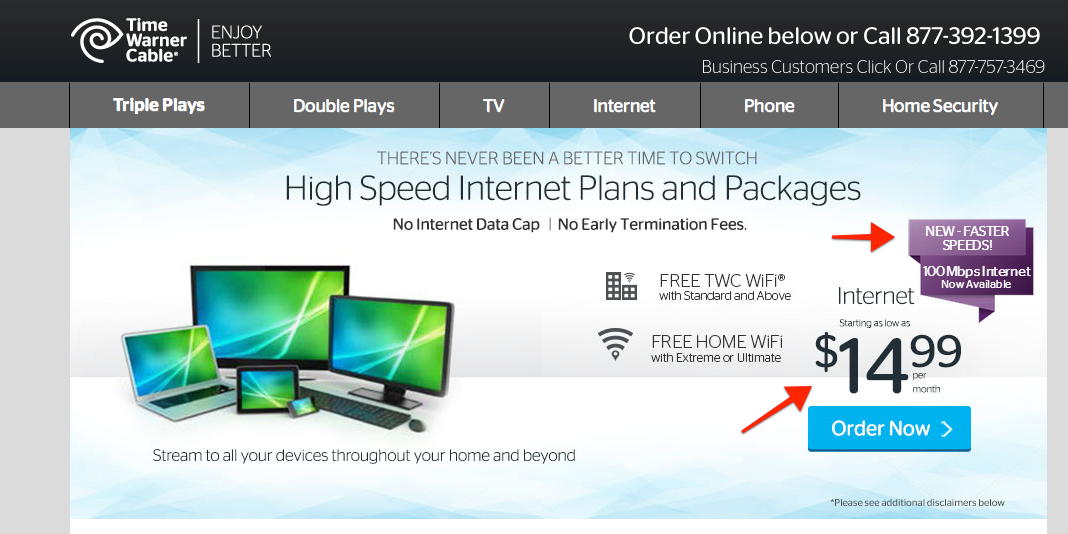
In fact, you can pay 1/2 the price for many thousands of times the speed of dialup modem.

2014-12-30%20at%206.23%20AM.png


That ad is for "unlimited" data. But I'm talking to a realtor about a subject he knows near nothing about.
 
That's just plain idiotic.

15 years ago, you paid $30/month for 56.6K baud dial up modem access.

Today, $30/month buys you broadband fast enough to deliver high quality video to more than one TV at the same time. Video is by far the biggest type of thing as far as bandwidth usage.

In fact, you can pay 1/2 the price for many thousands of times the speed of dialup modem.

2014-12-30%20at%206.23%20AM.png


That ad is for "unlimited" data. But I'm talking to a realtor about a subject he knows near nothing about.

Where does one obtain this $30/month internet service?
 
http://www.utsandiego.com/news/2014/oct/21/cox-communications-google-bandwidth-Internet-speed/

Cox Communications said Tuesday that it would boost Internet speeds for the bulk of its customers in San Diego County this week with no immediate increase in subscription fees.

Cox, which is the region’s largest cable company with about 500,000 subscribers, upgraded its network to increase speeds in three of its four Internet packages.

The company’s “Internet Preferred” plan will increase from 25 megabits per second to 50 megabits per second. Its “Internet Premier” plan will go from 50 megabits to 100 megabits, while “Internet Ultimate” will jump from 100 megabits to 150 megabits.

At those speeds, subscribers could download a full length movie in 1 minute to 4 minutes, depending on the plan. All of the plans come with cloud storage.

The company’s bottom tier “Internet Essentials” plan is staying at 5 megabits per second download speeds.

About 75 percent of Cox Communications’ subscribers have “Internet Preferred” or higher broadband plans, said Suzanne Schlundt, vice president of marketing for Cox in California.

“Internet usage is doubling every two years, and we want to be ahead of what consumers need,” she said. “This is actually the 10th time we have increased our Internet speeds in 11 years. So we are doubling on the most popular packages, and Ultimate is getting a substantial increase as well.”

Schlundt said Internet subscription prices won’t increase at this time. But for existing customers to tap into faster Internet, they’ll need a Docsis 3.0 modem, which can be purchased at Cox Solutions stores or at electronics retailers for around $70. Cox also rents the modems to customers.

While Cox is juicing its Internet speeds locally, it is doing more elsewhere. Cox has rolled out gigabit Internet speeds in parts of Phoenix recently, and it has announced plans to offer gigabit Internet in Las Vegas and Omaha.
 
BTW, $30 15 years ago is $42 today in inflation adjusted dollars.

So in theory if you got 56.6K baud today for $42/month, you'd be getting the same service as then at the same price now.
 

Users who are viewing this thread

Back
Top