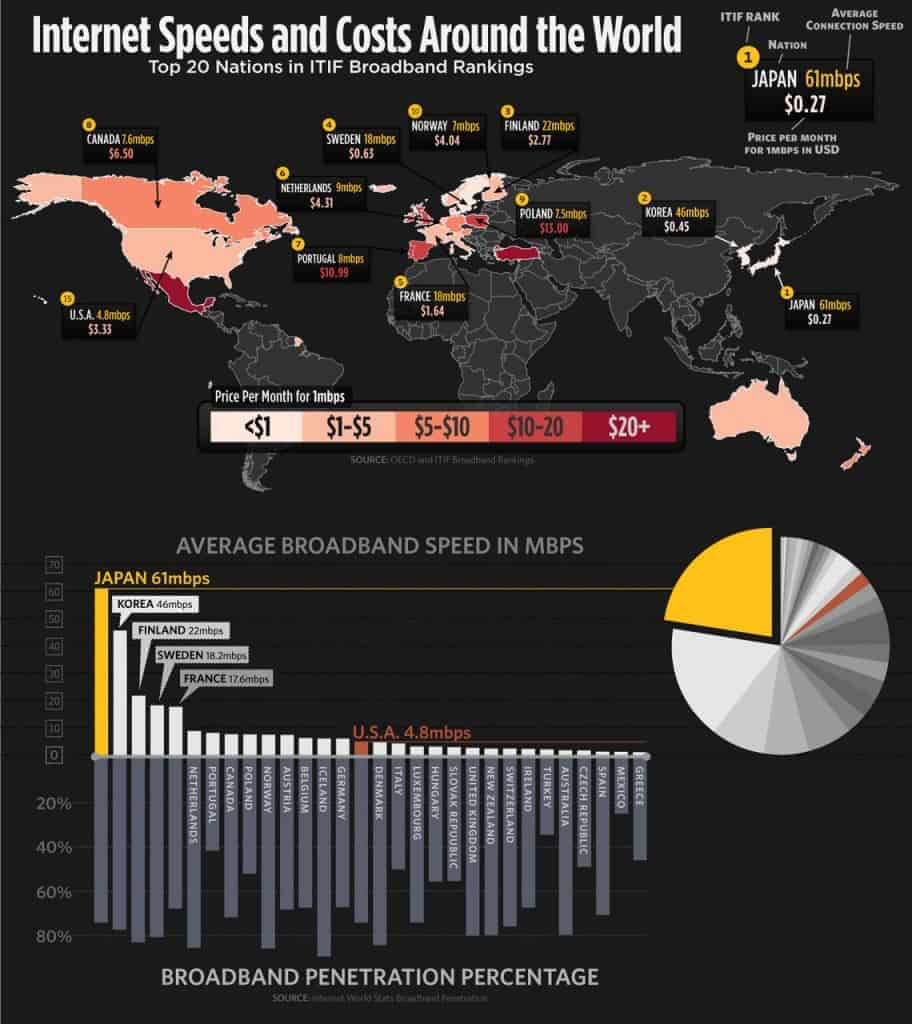
Your own link says Average Peak Connection Speed is a better measure and the US ranks in the low 40s in that measurement (but it is improving)
And there ARE cases of companies cherry picking traffic to throttle. It seems like someone who claims to understand net neutrality would know that. Google is your friend.
You make the claim, you prove it.
The only case of traffic cherry picked was Comcast and bittorrent. The company did it for two reasons: people were committing a crime and it was swamping their network. No matter how you view things, the companies must have the right to manage their networks when they're being overloaded with traffic.
http://www.techpolicydaily.com/comm...thodology-cherry-picked-data-distort-results/
The New America Foundation just published its third annual
Cost of Connectivity report, a so-called “consumer-focused” survey of broadband prices and speeds in 24 cities around the world. My
review of last year’s edition noted a number of troubling issues, including listing operators in cities they did not serve, printing standalone broadband prices where the offer required a bundle purchase (fortunately disclosed in this year’s report), and failing to account for taxes and other mandatory fees on top of advertised prices.
...
Furthermore, NAF’s focus on a few select European cities gives the impression that high-speed networks are widespread on the continent, when in fact they exist only in pockets. Point Topic’s EU-commissioned
competition map clearly shows that much of the UK, France, Germany, Ireland, the Czech Republic, and Romania lack next-generation access coverage. As of
2012, only 54 percent of EU households had access to speeds in excess of 25 Mbps, compared to 82 percent of homes in the US. Moreover, many of the ISPs which the NAF report celebrates, particularly municipal providers, have abysmally low rates of subscribership. Even in the countries where NAF considers broadband prices to be low, subscribership to high-speed networks lags. More than 70 percent of households and businesses in Denmark
can get speeds of 100 Mbps and higher, but less than 2 percent of households subscribe to the highest tier. People get the service they want at lower speeds. In any case, an EU
report states that actual speeds experienced in the EU are 25% less than advertised speeds. In comparison, the FCC
notes that Americans get 101% of speeds advertised.




 (They should).