"Net Neutrality" is Obamacare for the Internet

Welcome to our community

Be a part of something great, join today!

It really doesn't matter. With the ruling going either way, the customer loses. The customer ALWAYS lose because they will be charged for any bullshit scam that is being drawn up; whether it's a future "government" tax due to the NN rules, or whether it's a "fee" passed on to you when NetFlix must pay Comcast to give you a movie.

So to correct Denny when he said "Big Government wins, and we lose" it's more like , "Big Government wins, Big Corporations lose, and customers get fucked like normal".

And the B.S about the infrastructure all of the sudden now coming to a standstill because they don't want to invest is horseshit. Someone eventually will continue to propel it forward. Sure maybe not ATT, but someone will.

Except big corporations do win. Google and Netflix profit off of AT&T's investment because the government mandates it so. After Google and Netflix spent considerable sums buying the opinion.

Government wins because now they have to monitor all this. In the process of putting in their gear to monitor the traffic, they can freely spy on everything going on.

We do lose.
 
Denny is spot on! Pay attention, you lose each time the Government sticks it's foot in the door.

This net neutrality is ridiculous, if you applied it to a satellite provider, Streaming movies over a Satellite would fix it so no one had internet service via that satellite.
While that is the easy pipe to overload, so can a plethora of puny DSL lines around the country and eventually all other normally serviceable lines.

It only makes sense that video streaming (and their users) should pay the freight for upgrading the network to support this extreme usage.

Having the government level this field is mind boggling. About like leveling the cost of health insurance which started out as a very reasonable way for health people to
share risk. Now the government has a new definition of the word and the original people sharing risk are now paying a tax while being subject to much more risk
 
Google and Netflix profit off of AT&T's investment because the government mandates it so. After Google and Netflix spent considerable sums buying the opinion.

Aren't AT&T and Comcast profiting off of Google's and Netflix's investments since those companies are driving 2/3 of the demand for the use of telecom infrastructure?

Comcast has cherry picked traffic to throttle in the past. I think this is a bad thing. Open internet is good and the FCC's decision bring the US in line with similar actions with other countries. Net Neutrality goes beyond US borders.

I would like to see more congressional oversight of the FCC since it ends up doing the bidding of the very telecom giants they are supposed to be regulating.
 
Aren't AT&T and Comcast profiting off of Google's and Netflix's investments since those companies are driving 2/3 of the demand for the use of telecom infrastructure?

Comcast has cherry picked traffic to throttle in the past. I think this is a bad thing. Open internet is good and the FCC's decision bring the US in line with similar actions with other countries. Net Neutrality goes beyond US borders.

I would like to see more congressional oversight of the FCC since it ends up doing the bidding of the very telecom giants they are supposed to be regulating.

Netflix and Google aren't driving 2/3 of the usage, only of the bandwidth. If you have 100 people in a neighborhood actively browsing the internet, and only one is watching netflix, that one person is using far more bandwidth than the other 99 combined.

Comcast has not cherry picked traffic to throttle in the past. My internet connection is 50MBit down and 5MBit up. They're throttling my up speed! :lol: (They should).

FWIW, I really like Netflix and watch it a lot. It's not like I'm against them or for the ISPs. I'm for keeping government out of it because there is no excuse for them to be involved (solving made up "issues" that don't exist in reality). The way this was done was to rule the ISPs as Title II carriers, which is just not the right tool for dealing with them in the first place.

The FCC has tried making idiotic rules in the past and been shot down in the courts every time. Looking for a loophole to centralize control of one of the last mostly free and democratic platforms (by the people for the people for real) is just wrong.

Without government oversight, the Internet has ruled itself fine and disputes like the Comcast/Netflix ones have been resolved exactly as they should be. There was no need of government intervention then, and never will be.
 
A few things to consider. The absence of net neutrality would be bad for smaller start up companies that have streaming services. If the cost of streaming their content goes up, many are unlikely to survive and bigger companies like Netflix and Google can absorb that cost and likely pass it onto their customers for a profit.

The ISP companies will not lower the cost of accessing the internet so in the end if net neutrality is not around, the average person still gets screwed financially because as stated above Netflix, online gaming, anything streaming will go up in cost because the content providers will have to charge more to pay for the bandwith access they would have to pay for

people who stream movies, games etc usually pay for more than a base internet access package from ISP's (like myself) so you could argue that ISP's do benefit from having net neutrality because if the cost of accessing Hulu, Netflix and Amazon Prime all go up, some ppl are going to just ditch those services and downgrade their internet package... of course ISP's like comcast (or Bell, Roger and Shaw here in Canada) would still benefit because ppl like me who have cut the cable and don't have cable tv may go back to cable simply because of the prohibitive cost of having an internet connection + paying raising costs of streaming content.

another thing to consider, in countries outside North America, the bandwith and speeds are vastly higher than here. Big telecom is holding back on the consumers here and just for plain greed.

I don't think this is government oversite of the internet as much as it's stopping collusion by telecom companies to screw over customers and start up internet companies that need net neutrality to survive and grow.
 
A few things to consider. The absence of net neutrality would be bad for smaller start up companies that have streaming services. If the cost of streaming their content goes up, many are unlikely to survive and bigger companies like Netflix and Google can absorb that cost and likely pass it onto their customers for a profit.

The ISP companies will not lower the cost of accessing the internet so in the end if net neutrality is not around, the average person still gets screwed financially because as stated above Netflix, online gaming, anything streaming will go up in cost because the content providers will have to charge more to pay for the bandwith access they would have to pay for

people who stream movies, games etc usually pay for more than a base internet access package from ISP's (like myself) so you could argue that ISP's do benefit from having net neutrality because if the cost of accessing Hulu, Netflix and Amazon Prime all go up, some ppl are going to just ditch those services and downgrade their internet package... of course ISP's like comcast (or Bell, Roger and Shaw here in Canada) would still benefit because ppl like me who have cut the cable and don't have cable tv may go back to cable simply because of the prohibitive cost of having an internet connection + paying raising costs of streaming content.

another thing to consider, in countries outside North America, the bandwith and speeds are vastly higher than here. Big telecom is holding back on the consumers here and just for plain greed.

I don't think this is government oversite of the internet as much as it's stopping collusion by telecom companies to screw over customers and start up internet companies that need net neutrality to survive and grow.

Almost all of this is wrong.

Only in a few countries is internet faster than the US.

The ISPs do not need government involvement to figure out pricing and bandwidth rates. They already offer a reasonable set of choices so gamers or other hardcore users can buy more bandwidth and those who just want to send emails and read facebook can buy low end service.

The ISP companies have built up their networks in absence of regulation to the point where they were rolling out 300MBit service in cities with plans to implement it nationwide. Time Warner was going to upgrade my service to that 300MBit for $0 extra cost. Measured in dollars per byte, bandwidth has gotten cheaper by factors of tens of thousands.

As for new startups, they are spit in the ocean, in terms of bandwidth. If they gain popularity, they will need to raise significant money for infrastructure no matter if the government is involved or not.

As for Netflix, they have maybe 70 million customers. There are at least a billion people who use the internet. They're a fraction of all users. They will charge $9 instead of $7 and only the people who actually use the service will be paying for the bandwidth costs Netflix incurs.

In fact, Netflix is not showing any financial hardship or loss of profits for paying for peering. The better quality streaming they are now able to provide is attracting more customers, and they have raised their fees.
 
Holy Crap! I think the voting age should be raised to at least 40.

And then a qualification test required.
 
Almost all of this is wrong.

Only in a few countries is internet faster than the US.

The ISPs do not need government involvement to figure out pricing and bandwidth rates. They already offer a reasonable set of choices so gamers or other hardcore users can buy more bandwidth and those who just want to send emails and read facebook can buy low end service.

The ISP companies have built up their networks in absence of regulation to the point where they were rolling out 300MBit service in cities with plans to implement it nationwide. Time Warner was going to upgrade my service to that 300MBit for $0 extra cost. Measured in dollars per byte, bandwidth has gotten cheaper by factors of tens of thousands.

As for new startups, they are spit in the ocean, in terms of bandwidth. If they gain popularity, they will need to raise significant money for infrastructure no matter if the government is involved or not.

As for Netflix, they have maybe 70 million customers. There are at least a billion people who use the internet. They're a fraction of all users. They will charge $9 instead of $7 and only the people who actually use the service will be paying for the bandwidth costs Netflix incurs.

In fact, Netflix is not showing any financial hardship or loss of profits for paying for peering. The better quality streaming they are now able to provide is attracting more customers, and they have raised their fees.


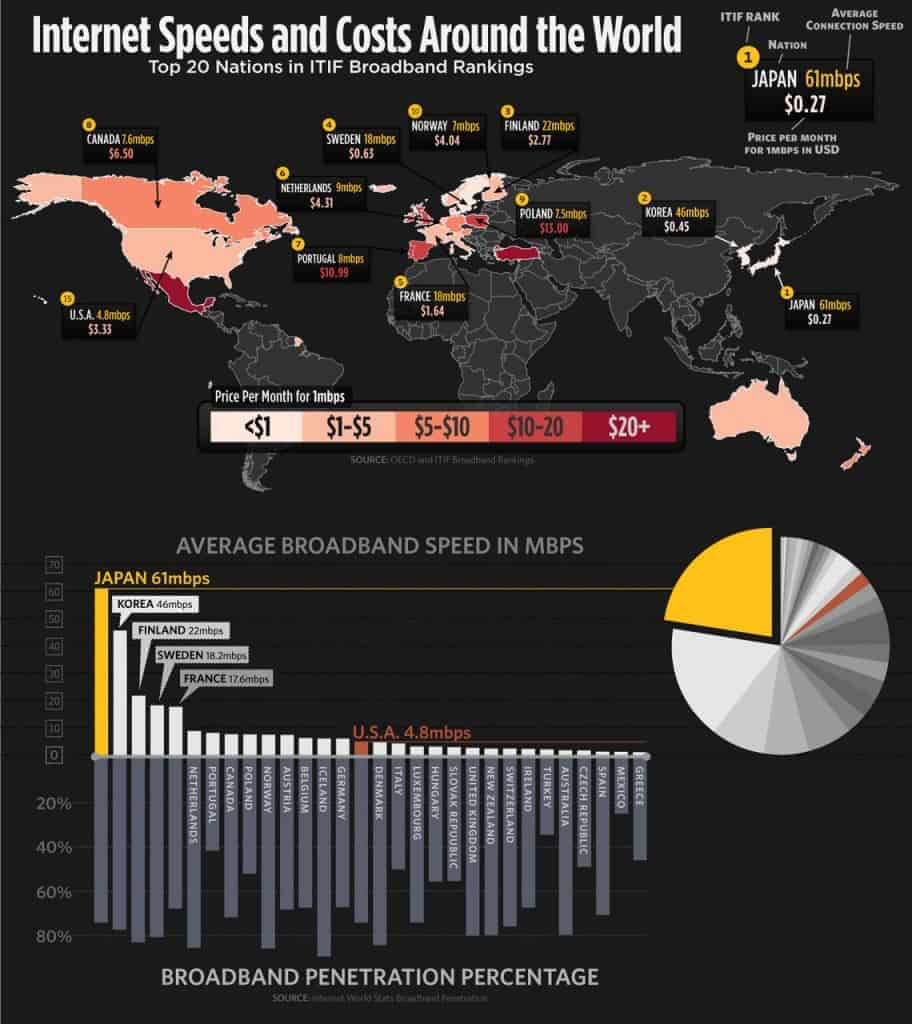
You say it's a reasonable rate (and it's 1/2 the cost I pay here in Canada) the ISP's charge but it's still much cheaper in other countries.

the-beauty-of-infographics.jpeg


And would it be fair to have a two tiered system of the internet where larger corporations could afford to pay for faster access to their content and smaller companies would suffer? That is what was going to happen and then if some sites were slower because the provider couldn't afford the cost of faster speeds, then why am I paying so much for better speeds but unable to enjoy them. Bottom line is the telecom companies wanted to throttle the internet more and part of it was because they feel threatened by online streaming from Netflix, Hulu, Amazon and even HBO GO as more and more ppl are reducing or removing their TV cable bill. What they proposed and tired to sneak in as law through the government by attaching their proposal to other bills was just pure greed, not something to benefit users.

Check out this site where I occasionally read up on net neutrality for some more info on it if you want.

https://openmedia.ca/news/canadian-...-us-fcc-announces-strong-new-rules-save-net-n
 
Your chart is bullshit.

And any company that puts s server in each of two places has and advantage. If they pay to use a CDN, they have and advantage.

Clearly people who have no clue are giving other clueless people utterly false talking points.

No offense intended.
 
I owe you a better answer.

If Mayberry RFD issues bonds and raises taxes to pay the payments on the bonds, and uses the bond money to build 10 gigabit fiber to every home in Mayberry, you have 10 gigabit internet and 100% penetration. But you won't be able to browse a single WWW site outside of Mayberry.

I know why, I am 100% sure you don't know why.

Finland has ONE city of population greater than 500,000 and 108 total towns and townships. The united states has 25 cities > 500K population and 20,000 total towns and townships. Of course it costs a fraction of the money to wire up Finland with the cable of your choice.

http://www.huffingtonpost.com/2013/07/24/us-internet-speed_n_3645927.html

The U.S. now has the ninth-fastest average Internet connection speed in the world, behind South Korea, Japan, Hong Kong, Switzerland, the Netherlands, Latvia, the Czech Republic and Sweden. That's a slip in the rankings: In the last Akamai report, the U.S. was eighth, with faster average connection speeds than Sweden.

Given that Akamai surveys 243 countries to produce its "State of the Internet" report, ninth place might not seem too low. U.S. Internet providers, after all, contend with a bigger landmass -- and a larger population -- than those in South Korea or Japan. And in real terms, the U.S. average connection speed improved in the interval between reports, becoming 27 percent faster than last year. It just wasn't enough to beat ever-speedier Sweden.
 
Last edited:
But Denny!, Any thing faster than damn near immediate is foolish to pay the provider for the privilege. So faster doesn't mean shit when fast enough cost less. Damned if I can see why someone will pay bucks for pipe fast enough to download the movies being made. Hell, snail mail will get them here before they are needed.
 
Last edited:
But Denny!, Any thing faster than damn near immediate is foolish to pay the provider for the privilege. So faster doesn't mean shit when fast enough cost less. Damned if I can see why someone will pay bucks for pipe fast enough to download the movies being made. Hell, snail mail will get them here before they are needed.

Nothing is immediate. The speed of light actually comes into play, and it's measurable.
 
Given that Akamai surveys 243 countries to produce its "State of the Internet" report, ninth place might not seem too low. U.S. Internet providers, after all, contend with a bigger landmass -- and a larger population -- than those in South Korea or Japan. And in real terms, the U.S. average connection speed improved in the interval between reports, becoming 27 percent faster than last year. It just wasn't enough to beat ever-speedier Sweden.

Your own link says Average Peak Connection Speed is a better measure and the US ranks in the low 40s in that measurement (but it is improving)

And there ARE cases of companies cherry picking traffic to throttle. It seems like someone who claims to understand net neutrality would know that. Google is your friend.
 
Your own link says Average Peak Connection Speed is a better measure and the US ranks in the low 40s in that measurement (but it is improving)

And there ARE cases of companies cherry picking traffic to throttle. It seems like someone who claims to understand net neutrality would know that. Google is your friend.

You make the claim, you prove it.

The only case of traffic cherry picked was Comcast and bittorrent. The company did it for two reasons: people were committing a crime and it was swamping their network. No matter how you view things, the companies must have the right to manage their networks when they're being overloaded with traffic.

http://www.techpolicydaily.com/comm...thodology-cherry-picked-data-distort-results/

The New America Foundation just published its third annual Cost of Connectivity report, a so-called “consumer-focused” survey of broadband prices and speeds in 24 cities around the world. My review of last year’s edition noted a number of troubling issues, including listing operators in cities they did not serve, printing standalone broadband prices where the offer required a bundle purchase (fortunately disclosed in this year’s report), and failing to account for taxes and other mandatory fees on top of advertised prices.

...

Furthermore, NAF’s focus on a few select European cities gives the impression that high-speed networks are widespread on the continent, when in fact they exist only in pockets. Point Topic’s EU-commissioned competition map clearly shows that much of the UK, France, Germany, Ireland, the Czech Republic, and Romania lack next-generation access coverage. As of 2012, only 54 percent of EU households had access to speeds in excess of 25 Mbps, compared to 82 percent of homes in the US. Moreover, many of the ISPs which the NAF report celebrates, particularly municipal providers, have abysmally low rates of subscribership. Even in the countries where NAF considers broadband prices to be low, subscribership to high-speed networks lags. More than 70 percent of households and businesses in Denmark can get speeds of 100 Mbps and higher, but less than 2 percent of households subscribe to the highest tier. People get the service they want at lower speeds. In any case, an EU report states that actual speeds experienced in the EU are 25% less than advertised speeds. In comparison, the FCC notes that Americans get 101% of speeds advertised.

 
So the only thing I can find related to blocking of anything are articles about corporations using firewalls on their corporate LANs, google filtering your mail into spam folders, people using Norton Utilities to filter out incoming viruses, etc.

ISPs have traditionally blocked port 80 (WWW servers) and 25 (email). An old 486 computer could saturate a gigabit ethernet serving porn pictures via WWW. Port 25 is blocked to (mostly) prevent spammers from using unknowing users' systems to send out mass amounts of email.

These things, and blocking of peer to peer file sharing protocols are not cherry picking and filtering any specific site.

On top of these facts, the ISPs cannot examine https encrypted connections. All that they can do is block packets by IP address, which doesn't allow them to catch all of Netflix's hosts which may be on any of Amazon's 2.25 million servers. If they block all of Amazon, they'd be blocking tens of thousands of WWW sites, not just one.
 
This is awesome.

http://fortune.com/2015/03/04/net-neutrality-is-not-for-europe/

Net neutrality is not for Europe

The European Union is preparing to allow internet providers to run ‘two-speed’ data services, in a sharp contrast to a ruling last week in the U.S. that will enforce ‘net neutrality’.

The Financial Times reported Wednesday that E.U. member states are drawing up proposals that would allow telecoms groups to prioritize certain services to ensure that the network worked properly, in stark contrast to a ruling by the Federal Communications Commission that will effectively ban differentiating the speed of services.

The draft reflects, among other things, the greater lobbying power in the E.U. of the big European telecoms companies that run mobile networks, relative to the (largely U.S.) tech companies that fill those networks with ever more data.

The FT noted that, at this week’s Mobile World Congress in Barcelona, the CEOs of both Vodafone Plc VOD -3.32% and Deutsche Telekom AG DTEGY -0.73% both argued for rules that would allow them to give priority to specific ‘essential’ services, like those connected to hospitals or driverless cars.

The proposals, drafted by the Latvian government that currently holds the E.U.’s rotating presidency, still insist on a basic principle of treating all traffic equally, but allow network operators to be “free to enter into agreements” to deliver faster speeds at higher prices.
 
Whether or not internet traffic has been slowed or blocked in the past is irrelevant in my mind. Wouldn't this set lay the groundwork for traffic to be blocked in the future? Couldn't an ISP slow everything to a virtual stop, reducing the tunnel in your example to a straw, and only transmit data from corporations who pay the fee?

I'm about as anti government regulation as anyone so I am surprised I'm falling on this side of the fence but it seems like the internet has really become public domain, though I can't think of a single other example of something moving from the private to the public sphere.
 
Whether or not internet traffic has been slowed or blocked in the past is irrelevant in my mind. Wouldn't this set lay the groundwork for traffic to be blocked in the future? Couldn't an ISP slow everything to a virtual stop, reducing the tunnel in your example to a straw, and only transmit data from corporations who pay the fee?

I'm about as anti government regulation as anyone so I am surprised I'm falling on this side of the fence but it seems like the internet has really become public domain, though I can't think of a single other example of something moving from the private to the public sphere.

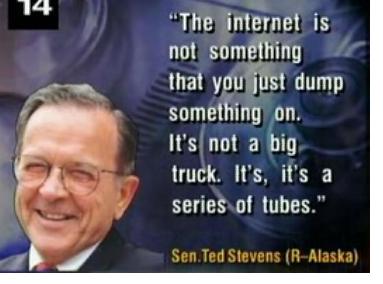
No. If the straw is full of water, any new water you want to put through it gets backed up.

What the ISP does is sell the corporations direct connections to bypass the choke points.

This is NORMAL and fair practice.

The govt. is stepping in and running all the ISPs because of imaginary potential abuses that would never happen in the real world. It's an excuse for a power grab for the sake of central planning.

It's anticapitalist.
 
Yeah but look at all the votes they get right here from the sheep that want that government protection.
 
You've already posted this.

It's dated 3 days ago.

So, no I didn't.

I posted that Google was one of the big corporations chosen as winners over the other big corporations.

Looks like they paid for it. Maybe they even wrote the legislation.
 

Users who are viewing this thread

Back
Top