

What are your beliefs on religion, god?

Welcome to our community

Be a part of something great, join today!

Except for the creation.com distortion of what the scientist actually said, what you posted and quoted all agree with me.

Even where you wrote this:

“Just after matter first appeared (For Denny that suggest matter was always present)"

You seem to not comprehend the words. Just after matter first appeared implies that it didn't exist until it first appeared.

LMAO!!!!!! First off, the site orgin has nothing to do with misquoting the professor. And your "Just after matter first appeared implies that it didn't exist until it first appeared" dude you sound like a lawyer, trying to use a play on words to sway readers to ignore what you've been claiming all along.

You said matter was always present. The universe was always here. There is no before the universe; yet you said "when matter first appeared".

You are redundant and avoiding your falsified claim.
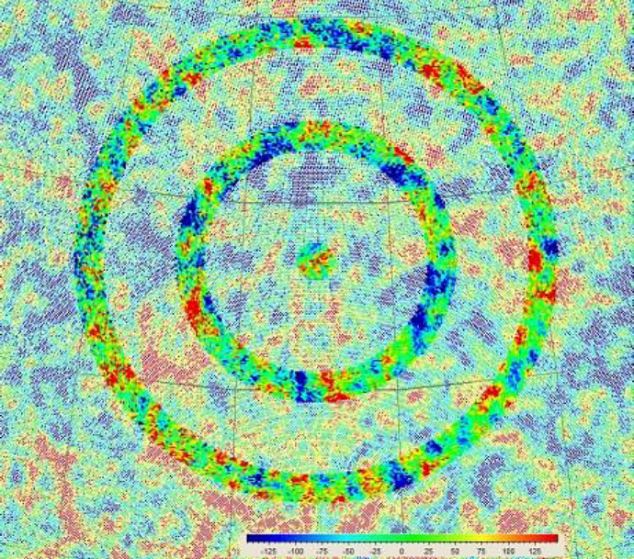
 
And since Denny loves independent journals and pictures of Empirical evidence. I have a link to another independent journal giving evidence that the universe existed before the "Big Bang"

http://www.dailymail.co.uk/sciencet...icrowaves-Scientist-spots-ghost-Big-Bang.html

article-1334027-0C46BBE8000005DC-589_634x559.jpg


A renowned scientist says he has spotted evidence that a universe existed before the Big Bang.
Professor Roger Penrose from Oxford University says concentric circles discovered in the background microwaves of the universe provides evidence of events that took place before the universe came into being.

The Daily Galaxy reports that Prof Penrose, along with Professor Vahe Gurzadyan of the Yerevan State University, Armenia believe images of the CMB from NASA's Wilkinson Microwave Anisotophy Probe shows imprints in the radiation that are older than the Big Bang.
 
think about this..

a small ball of matter, just "suddenly" appeared into "nothing: out of "nothing", and all by itself in this "nothing" that contained "nothing" it "self" exploded into "nothing", and caused "everything"..

That is the Big Bang in a nutshell. You can use all the technical words you want, but is not technically different than what us theist believe. It is impossible to believe and prove. Both sides are flying through faith. One believes that a magical being was the creator; while the other just uses technical logic to try and explain "genesis". Both are as equally faith driven.
 
LMAO!!!!!! First off, the site orgin has nothing to do with misquoting the professor. And your "Just after matter first appeared implies that it didn't exist until it first appeared" dude you sound like a lawyer, trying to use a play on words to sway readers to ignore what you've been claiming all along.

You said matter was always present. The universe was always here. There is no before the universe; yet you said "when matter first appeared".

You are redundant and avoiding your falsified claim.

The universe is always present, but only in the sense that it's been here since the start of time.

"The Host" is your WWW site (creation.com), and it is distorting what the scientist said, or saying things he didn't say.

The sentence "before the big bang" simply doesn't make sense because there was no such thing as time until the big bang. How many times do I have to write this before you comprehend it?
 
The universe is always present, but only in the sense that it's been here since the start of time.

"The Host" is your WWW site (creation.com), and it is distorting what the scientist said, or saying things he didn't say.

The sentence "before the big bang" simply doesn't make sense because there was no such thing as time until the big bang. How many times do I have to write this before you comprehend it?

And what proof do you have that they are distorting what the scientists say? Or are you just assuming they are?

And your explanation that time was created when the universe was created is right; but you are failing to understand that there could be another measurement of time before the universe was created. The time created by whatever created the universe. Obviously you aren't making a valid point. It has holes. You don't understand that we are bound by this universe, but what's outside this Universe isn't bound by this universe.

So your concept of time isn't a valid argument, because time before this universe was created by either God, other universes or another unexplainable thing.
 
think about this..

a small ball of matter, just "suddenly" appeared into "nothing: out of "nothing", and all by itself in this "nothing" that contained "nothing" it "self" exploded into "nothing", and caused "everything"..

That is the Big Bang in a nutshell. You can use all the technical words you want, but is not technically different than what us theist believe. It is impossible to believe and prove. Both sides are flying through faith. One believes that a magical being was the creator; while the other just uses technical logic to try and explain "genesis". Both are as equally faith driven.

It is not impossible to believe and prove.

Scientists can see the universe is expanding. We measure the light coming from distant galaxies and see a red shift:

800px-Redshift_blueshift.svg.png


This means everything is moving away from everything else, the universe is expanding. If you need some analogy to visualize it, consider it a balloon. As you blow it up, the rubber stretches - this would be similar to how space/time (the universe) expands. If you let the air out the balloon gets smaller.

If you plot where everything was 1M years ago, it was all closer together. If you do it 2M years ago, even closer together. Repeat this and you find everything had to be a singularity and 13.7B years ago. There are literally hundreds or thousands of experiments and observations that agree with this. When you see snow on a TV channel where no station broadcasting, or hear static on the radio between stations, you are picking up the radiation from the big bang itself.

If it were a simple matter of faith, the really "smart" people (actual rocket scientists, and guys who invent a-bombs) wouldn't believe in it.

Here's a quote from your creation.com WWW site:

http://www.creationtoday.org/the-big-bang-theory/

The most common misconception about the Big Bang theory is the idea that it teaches that matter exploded and spread out into empty space. This is not what the theory teaches, and it is important as creationists that we do not misrepresent what secular scientists believe. The theory actually teaches that space itself was also small. This is difficult to get our heads around, but it is worth trying, for reasons that will become clear.

So far so good, then the writer goes on to totally get it wrong:

Thus, at the point of singularity, they believe that there was still matter everywhere in the Universe–it is simply that they believe the Universe itself to have been very small.

Actually, what was in the singularity was a sort of plasma. Not a gas, not a liquid, not a solid, but very hot. Only a (very very very) short time after the big bang (expansion) did things cool off enough for matter to form.

http://www.space.com/52-the-expanding-universe-from-the-big-bang-to-today.html

The universe was born with the Big Bang as an unimaginably hot, dense point. When the universe was just 10-34 of a second or so old — that is, a hundredth of a billionth of a trillionth of a trillionth of a second in age — it experienced an incredible burst of expansion known as inflation, in which space itself expanded faster than the speed of light. During this period, the universe doubled in size at least 90 times, going from subatomic-sized to golf-ball-sized almost instantaneously.

After inflation, the growth of the universe continued, but at a slower rate. As space expanded, the universe cooled and matter formed. One second after the Big Bang, the universe was filled with neutrons, protons, electrons, anti-electrons, photons and neutrinos.
 
It is not impossible to believe and prove.

Scientists can see the universe is expanding. We measure the light coming from distant galaxies and see a red shift:

800px-Redshift_blueshift.svg.png


This means everything is moving away from everything else, the universe is expanding. If you need some analogy to visualize it, consider it a balloon. As you blow it up, the rubber stretches - this would be similar to how space/time (the universe) expands. If you let the air out the balloon gets smaller.

If you plot where everything was 1M years ago, it was all closer together. If you do it 2M years ago, even closer together. Repeat this and you find everything had to be a singularity and 13.7B years ago. There are literally hundreds or thousands of experiments and observations that agree with this. When you see snow on a TV channel where no station broadcasting, or hear static on the radio between stations, you are picking up the radiation from the big bang itself.

If it were a simple matter of faith, the really "smart" people (actual rocket scientists, and guys who invent a-bombs) wouldn't believe in it.

Here's a quote from your creation.com WWW site:

http://www.creationtoday.org/the-big-bang-theory/


So far so good, then the writer goes on to totally get it wrong:


Actually, what was in the singularity was a sort of plasma. Not a gas, not a liquid, not a solid, but very hot. Only a (very very very) short time after the big bang (expansion) did things cool off enough for matter to form.

http://www.space.com/52-the-expanding-universe-from-the-big-bang-to-today.html

Plasma is matter brother; which completely is accurate.

http://www.plasma-universe.com/Plasma-Universe.com
 
Without this faith; we wouldn't have been able to travel into space, drive cars, or communicate with each other with people on the other side of this planet.


faith equals chemical combustion and electomagnetic waves?
 
http://www.plasmas.org/what-are-plasmas.htm

Plasma is by far the most common form of matter. Plasma in the stars and in the tenuous space between them makes up over 99% of the visible universe and perhaps most of that which is not visible.

On earth we live upon an island of "ordinary" matter. The different states of matter generally found on earth are solid, liquid, and gas. We have learned to work, play, and rest using these familiar states of matter. Sir William Crookes, an English physicist, identified a fourth state of matter, now called plasma, in 1879.
 
faith equals chemical combustion and electomagnetic waves?

Believing that matter has always existed and had no beginning is faith driven because it goes against everything we know now.

I speak of faith driving the cars, communication and chemical combustion because before there were these mechanics; it really didn't exist. Just like new science will be faith driven and become reality at some point. Before Dir William Crookes identified plasma in 1879; we only knew of three forms of matter, solid, liquid and gas. His discovery and faith there is something more discovered another state of matter. There maybe even more before long.
 
Last edited:
There are some scientists working on theories about the why and how of the big bang. What I've been posting about is the what of the big bang. It did what it did.

You cite Michio Kaku, a well known physicist. He is presenting the idea of the multiverse, m-branes, string theory, etc. All of that stuff is highly theoretical. There's a lot of "beautiful" math that makes it elegant and all that. There just isn't any actual observed evidence or experimental evidence to prove any of it is real. It doesn't predict anything we can measure and observe.

There are other theories equally as "valid" and equally as theoretical.

The Penrose concentric circles image you found and posted in post #722 is quite interesting. Penrose is a great modern physicist, no doubt. He speculates as to the source of the circles.

The beauty of science is that he can make his speculation, announce it to the world, and other scientists will give it rigorous scrutiny. Such as this paper:
http://arxiv.org/abs/1012.1656v1
(which shows that the concentric circles are typical and expected fatures of the universe as we currently understand it).
 
There are some scientists working on theories about the why and how of the big bang. What I've been posting about is the what of the big bang. It did what it did.

You cite Michio Kaku, a well known physicist. He is presenting the idea of the multiverse, m-branes, string theory, etc. All of that stuff is highly theoretical. There's a lot of "beautiful" math that makes it elegant and all that. There just isn't any actual observed evidence or experimental evidence to prove any of it is real. It doesn't predict anything we can measure and observe.

There are other theories equally as "valid" and equally as theoretical.

The Penrose concentric circles image you found and posted in post #722 is quite interesting. Penrose is a great modern physicist, no doubt. He speculates as to the source of the circles.

The beauty of science is that he can make his speculation, announce it to the world, and other scientists will give it rigorous scrutiny. Such as this paper:
http://arxiv.org/abs/1012.1656v1
(which shows that the concentric circles are typical and expected fatures of the universe as we currently understand it).

But that scrutiny doesn't explain that it always existed.

Penrose's basic construction[4] is to connect a countable sequence of open FLRW spacetimes, each representing a big bang followed by an infinite future expansion. Penrose noticed that the past conformal boundary of one copy of FLRW spacetime can be "attached" to the future conformal boundary of another, after an appropriate conformal rescaling.

There could be a connection between one boundry of space and time from this universe; to the residual boundary of space and time of another universe. Or the "starting point" of creation.

http://en.wikipedia.org/wiki/Conformal_cyclic_cosmology
 
Geez

I wrote "sort of a plasma" and that's interpreted as "is plasma."

At the ginormous pressure of everything packed into a singularity, there would be no solid, liquid, gas, or plasma. Those states of matter require actual particles to exist. The "sort of plasma" I referred to is so incredibly hot that there are no particles of any kind.

But carry on.
 
I'm having trouble finding any scientific paper that reproduces Penrose's results or agrees with his findings.

Good luck with that.
 
Geez

I wrote "sort of a plasma" and that's interpreted as "is plasma."

At the ginormous pressure of everything packed into a singularity, there would be no solid, liquid, gas, or plasma. Those states of matter require actual particles to exist. The "sort of plasma" I referred to is so incredibly hot that there are no particles of any kind.

But carry on.

Plasma is plasma and it's still matter, regardless of "sort of" to avoid scrutiny by me. If something is 5% plasma; it is still matter.
 
OK

Sort of a plasma is a bad way to describe it.

A very hot soup of stuff that doesn't resemble anything in the known universe today. It was so hot and compressed and in a state where the rules of physics as we know them do not apply.

It was so hot that the universe is still cooling some 13.7B years later. Those images you posted from Penrose's paper are the HEAT from the big bang.
 
There are some scientists working on theories about the why and how of the big bang. What I've been posting about is the what of the big bang. It did what it did.

You cite Michio Kaku, a well known physicist. He is presenting the idea of the multiverse, m-branes, string theory, etc. All of that stuff is highly theoretical. There's a lot of "beautiful" math that makes it elegant and all that. There just isn't any actual observed evidence or experimental evidence to prove any of it is real. It doesn't predict anything we can measure and observe.

There are other theories equally as "valid" and equally as theoretical.

The Penrose concentric circles image you found and posted in post #722 is quite interesting. Penrose is a great modern physicist, no doubt. He speculates as to the source of the circles.

The beauty of science is that he can make his speculation, announce it to the world, and other scientists will give it rigorous scrutiny. Such as this paper:
http://arxiv.org/abs/1012.1656v1
(which shows that the concentric circles are typical and expected fatures of the universe as we currently understand it).

Well i see your scrutiny and raise it this one

http://www.mendeley.com/catalog/more-low-variance-circles-cmb-sky/

Two groups 3,4 have confirmed the results of our paper concerning the actual existence of low variance circles in the cosmic microwave background (CMB) sky. They also point out that the effect does not contradict the LCDM model - a matter which is not in dispute. We point out two discrepancies between their treatment and ours, however, one technical, the other having to do with the very understanding of what constitutes a Gaussian random signal. Both groups simulate maps using the CMB power spectrum for LCDM, while we simulate a pure Gaussian sky plus the WMAP's noise, which points out the contradiction with a common statement 3 that "CMB signal is random noise of Gaussian nature". For as it was shown in 5, the random component is a minor one in the CMB signal, namely, about 0.2. Accordingly, the circles we saw are a real structure of the CMB sky and they are not of a random Gaussian nature. Although the structures studied certainly cannot contradict the power spectrum, which is well fitted by LCDM model, we particularly emphasize that the low variance circles occur in concentric families, and this key fact cannot be explained as a purely random effect. It is, however a clear prediction of conformal cyclic cosmology.
 
Believing that matter has always existed and had no beginning is faith driven because it goes against everything we know now.

I speak of faith driving the cars, communication and chemical combustion because before there were these mechanics; it really didn't exist. Just like new science will be faith driven and become reality at some point. Before Dir William Crookes identified plasma in 1879; we only knew of three forms of matter, solid, liquid and gas. His discovery and faith there is something more discovered another state of matter. There maybe even more before long.


that's a pretty odd definition of faith you are using there.

it's also irrelevant to the point you are trying to make, since the majority of scientific hypothesis turn out to be wrong and many critical scientific discoveries have been accidental and unexpected.
 
OK

Sort of a plasma is a bad way to describe it.

A very hot soup of stuff that doesn't resemble anything in the known universe today. It was so hot and compressed and in a state where the rules of physics as we know them do not apply.

It was so hot that the universe is still cooling some 13.7B years later. Those images you posted from Penrose's paper are the HEAT from the big bang.

Ah but that would go against physics right? I mean matter cannot be created unless it's created by matter; therefor this soup you keep mentioning must have matter already in it. You can call it anything you want. Call it the Stay-puff-marshmallow man and it will still consist and be "matter".
 
that's a pretty odd definition of faith you are using there.

it's also irrelevant to the point you are trying to make, since the majority of scientific hypothesis turn out to be wrong and many critical scientific discoveries have been accidental and unexpected.

We are not robots crowtrobot, like your name. We actually have emotionally driven needs. Einstein wondered, used his noggin and discovered relativity. It wasn't just by chance. He actually had an agenda and seeked it out. At the time, it didn't exist. When he was finished it became.
 
You cite Penrose's paper. Again, he's the only one who's making the claim that the concentric circles mean something beyond random noise.

http://iopscience.iop.org/2041-8205/733/2/L29/fulltext/

4. RESULTS
We now present the results obtained from the analysis outlined above as applied to the 7 year WMAP data. First, the left panel of Figure 1 shows the standard deviation profile computed from the WMAP data centered on Galactic coordinates (l, b) = (105.°04, 37°). (The mean is not subtracted in this plot.) This is the same profile as that presented in Figure 2 of Gurzadyan & Penrose (2010) and mentioned as a possible statistical anomaly. As seen here, we obtain very similar results as Gurzadyan & Penrose (2010), and this validates the computational routines used in both analyses. The right panel shows a corresponding profile computed from a random simulation.

I guess I'm lucky! Hahaha
 
We are not robots crowtrobot, like your name. We actually have emotionally driven needs. Einstein wondered, used his noggin and discovered relativity. It wasn't just by chance. He actually had an agenda and seeked it out. At the time, it didn't exist. When he was finished it became.


faith by definition is actual belief something is true in the absence of proof. it is not 'wondering' what might be true or instinctive feeling something might be true. scientists aren't required to believe something is true in order to have an agenda to test it.

also as noted the point you are trying to make would be trivial anyway, since scientific hypothesis are wrong way more than they are right. if you define faith as something that is required to formulate one apparently faith isn't very reliable.
 
faith by definition is actual belief something is true in the absence of proof. it is not 'wondering' what might be true or instinctive feeling something might be true. scientists aren't required to believe something is true in order to have an agenda to test it.

also as noted the point you are trying to make would be trivial anyway, since scientific hypothesis are wrong way more than they are right. if you define faith as something that is required to formulate one apparently faith isn't very reliable.

Before Einstein discovered relativity, was their proof that it existed? Einstein had an agenda and worked to seek out that agenda.
 

You're not getting lucky.

These other scientists are seeing the concentric rings all right. That's not in dispute. Penrose proposes that they're the echo of something older than the universe, somehow. The others find the rings to be consistent with our model and understanding of the universe. In other words, they in no way find that there's any sort of echo of anything.
 

Users who are viewing this thread

Back
Top